
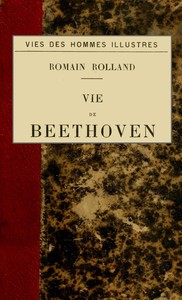
Vie de Beethoven by Romain Rolland
Romain Rolland's Vie de Beethoven (The Life of Beethoven) is a slim book that punches way above its weight. Published in 1903, it's less a chronological biography and more of a passionate character study. Rolland zooms in on the defining crisis of Beethoven's life: his progressive, incurable deafness.
The Story
The book opens with the young Beethoven as a brilliant, fiery talent in Vienna. Then, in his late twenties, the ringing in his ears starts. What follows is a desperate and private struggle. We see him try every doctor and every remedy, writing anguished letters to friends about his 'cursed' condition. The famous 'Heiligenstadt Testament'—a raw, unsent letter where he confesses thoughts of suicide but resolves to live for his art—is the emotional core. Rolland then traces how this physical isolation forced an inward turn. Beethoven's middle-period works, like the heroic Third Symphony, become acts of defiance. His late works, especially the Ninth Symphony with its 'Ode to Joy,' are presented as a hard-won victory, a conscious choice to preach universal brotherhood from a place of profound personal silence.
Why You Should Read It
You should read this because it takes a legend and makes him heartbreakingly real. Rolland's Beethoven isn't a god on a pedestal; he's rude, messy, suspicious, and often miserable. His genius wasn't in spite of his suffering, but in constant, daily conversation with it. What moved me wasn't just the tragedy, but the stubbornness. This is a portrait of creative spirit as a form of resistance. When I listen to Beethoven now, I don't just hear notes—I hear a man refusing to be silenced. Rolland argues that Beethoven's greatest lesson is that 'through suffering, joy.' It's a cliché until you walk with him through the depths of his despair and see the staggering art that came out the other side.
Final Verdict
This is a perfect book for anyone who loves music, but maybe feels intimidated by classical composers. It's your backstage pass. It's also for anyone who's ever faced a setback that felt like it defined them. Rolland writes with a novelist's flair, so it reads quickly and emotionally. If you want dates and dry facts, look elsewhere. But if you want to understand the why behind the music—the human fire that forged those immortal sounds—this little book is a powerful and unforgettable place to start.
This book is widely considered to be in the public domain. You can copy, modify, and distribute it freely.
Mary Davis
2 years agoThis is an essential addition to any academic digital library.
Thomas Brown
2 years agoIt took me a while to process the complex ideas here, but the formatting on mobile devices is surprisingly crisp and clear. A trustworthy resource that I'll keep in my digital library.
Emily Jackson
6 months agoI found the data interpretation to be highly professional and unbiased.
Paul Brown
5 months agoVery helpful, thanks.



Elizabeth Perez
11 months agoComparing this to other titles in the same genre, the way it handles controversial points with balance is quite professional. An excellent example of how quality digital books should be formatted.