
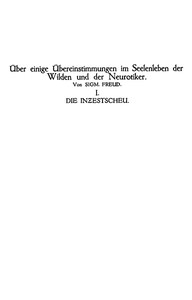
Die Inzestscheu by Sigmund Freud
Let's be clear from the start: this isn't a novel. There's no plot in the traditional sense. 'Die Inzestscheu' is Freud building an argument, brick by psychological brick. He starts with a simple observation: across all human cultures, there is a powerful, almost instinctive prohibition against incest. Why? If it were truly 'natural' to avoid it, we wouldn't need such a strong taboo.
The Story
Freud's 'story' is the story of human development. He uses his clinical work, mythology (especially the Oedipus myth), and observations of 'primitive' societies to make his case. He proposes that children naturally develop intense, sexualized feelings for the parent of the opposite sex and see the same-sex parent as a rival. This is the Oedipus complex. The 'horror of incest' is the social and psychological force that breaks this complex. The child must repress those desires, identify with the same-sex parent, and redirect their love outward. This painful internal drama, Freud argues, is the engine that drives us into society. It's the reason we make friends, fall in love with non-family, and create cultural rules.
Why You Should Read It
You should read this not to agree with it, but to engage with it. Freud's writing is surprisingly direct. Even when his ideas feel outrageous, there's a compelling logic to how he strings them together. Reading this original text cuts through a century of pop-culture Freudianism. You get the raw, unfiltered theory. It forces you to think about where your own desires, jealousies, and sense of morality might come from. Is he right? Maybe not entirely. But the questions he raises about family, desire, and the price of civilization are still incredibly potent.
Final Verdict
This book is for the intellectually curious reader who isn't afraid of big, challenging ideas. It's perfect for anyone interested in psychology's origins, for book clubs that love a good debate, or for writers looking to understand character motivation on a deeper level. If you only know Freud as the 'sex guy' from cartoons, this is the place to start. It's a short, dense, and mind-bending read that will stick with you long after you finish the last page. Just don't blame me if you start analyzing your dreams afterward.
No rights are reserved for this publication. It is now common property for all to enjoy.
James Wright
2 years agoA bit long but worth it.
Anthony Young
10 months agoI had low expectations initially, however it challenges the reader's perspective in an intellectual way. I will read more from this author.
Aiden Walker
7 months agoAfter hearing about this author multiple times, the character development leaves a lasting impact. Absolutely essential reading.
Mason Thompson
1 year agoClear and concise.



Donald Harris
11 months agoFinally found time to read this!