
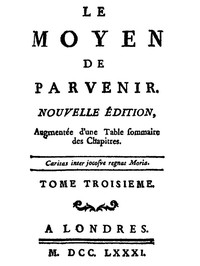
Le moyen de parvenir, tome 3/3 by Béroalde de Verville
So, what actually happens in this book? Honestly, trying to explain the 'plot' of Le moyen de parvenir is a bit like trying to nail jelly to a wall. It's the final volume of a three-part work that's more of a philosophical carnival than a novel. The book presents itself as a record of a massive, sprawling banquet or gathering. A huge cast of characters—historical figures, invented personas, allegorical representations—sit around and engage in endless dialogue.
The Story
There's no main character to follow. Instead, you jump from one conversation to another. One moment, people are debating the nature of truth and knowledge with serious intensity. The next, they're telling bawdy jokes or sharing bizarre anecdotes. The 'story' is the flow of ideas itself. It's structured as a series of chapters or entries, each often kicking off with a provocative question or statement that the characters then dissect from every possible angle. The title translates to 'The Means of Succeeding' or 'How to Get Ahead,' but the content satirizes that very idea, showing how human ambition and wisdom are often tangled up with folly and chance.
Why You Should Read It
I loved this book because it feels incredibly modern in its chaos. It doesn't preach one single lesson. Instead, it throws a hundred different viewpoints at you and lets you sort through the noise. Reading it is an active experience. You're not being told a story; you're eavesdropping on the most fascinating salon in history. The characters aren't developed in a traditional sense, but their voices are distinct and full of personality. You'll find yourself laughing at a sharp joke on one page and then pausing to think deeply about a philosophical point on the next. It's a reminder that people in the 1600s were just as clever, confused, and curious about life as we are today.
Final Verdict
This is not a book for someone looking for a relaxing bedtime read. It's a book for the intellectually adventurous. Perfect for readers who enjoy diving into classic texts that break all the rules, for fans of satirists like Rabelais or modern writers who play with form and narrative. If you like philosophy served with a heavy dose of humor and human messiness, you'll find a strange and wonderful friend in Béroalde de Verville. Just be prepared to work for it—the reward is a uniquely brilliant and entertaining headache.
This text is dedicated to the public domain. You are welcome to share this with anyone.
Elizabeth Smith
1 month agoI wanted to compare this perspective with traditional views, the clarity of the writing makes even the most dense sections readable. The price-to-value ratio here is simply unbeatable.
Nancy Smith
9 months agoThought-provoking and well-organized content.
Jennifer Lopez
7 months agoI found the author's tone to be very professional yet accessible, the way the author breaks down the core concepts is remarkably clear. I appreciate the effort that went into this curation.








Mary Thomas
10 months agoClear, concise, and incredibly informative.