
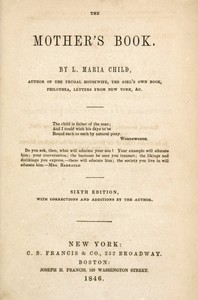
The mother's book by Lydia Maria Child
Let's be clear from the start: this is not a novel. Lydia Maria Child's The Mother's Book is exactly what the title says—a practical guide for American mothers in the 1830s. But don't let that fool you into thinking it's dry. It's a lively, opinionated manual covering everything from feeding and clothing infants to educating older children and shaping their character.
The Story
There's no traditional plot. Instead, Child builds her case chapter by chapter. She starts with the care of babies, giving advice that ranges from sensible (fresh air is good) to dated (specific rules for swaddling). She moves on to early education, stressing the importance of play, nature, and learning through doing. The heart of the book is her philosophy on discipline. She passionately rejects corporal punishment and fear-based obedience. Instead, she urges mothers to use patience, explanation, and natural consequences to guide their children. She wants to raise independent thinkers with strong morals, not just obedient robots.
Why You Should Read It
I found this book utterly absorbing for two reasons. First, Child's voice is so strong and clear. You can feel her conviction. She's not just listing rules; she's arguing for a kinder, more respectful world, starting in the nursery. Second, it's a reality check. While her core philosophy feels shockingly modern, the context does not. Her assumptions about a mother's role (solely at home), her casual references to servants, and her views on certain topics are firmly rooted in her time. Reading it is a constant exercise in separating the timeless wisdom from the historical artifact. It makes you think about what advice we give today that will seem strange in 200 years.
Final Verdict
This is a perfect little book for curious readers, not just parents or historians. If you enjoy social history and want to understand the daily lives and thoughts of ordinary people in the past, this is a primary source goldmine. It's also great for anyone interested in the history of childhood or parenting ideas. The writing is straightforward and engaging. Just be ready for some cultural whiplash—you'll find yourself agreeing with one sentence and staring in disbelief at the next. It’s a short, fascinating, and deeply human look at the hopes and worries of mothers from another era.
Legal analysis indicates this work is in the public domain. You do not need permission to reproduce this work.
Jennifer Brown
8 months agoAs a professional in this niche, the wealth of information provided exceeds the average market standard. Highly recommended for those seeking credible information.
Michael Martinez
10 months agoAfter spending a few days with this digital edition, the logic behind each conclusion is easy to follow and verify. I appreciate the effort that went into this curation.
John Thomas
2 years agoA brilliant read that I finished in one sitting.
David Harris
1 year agoThe clarity of the concluding remarks is very professional.





Thomas Taylor
1 month agoI was particularly interested in the case studies mentioned here, the critical analysis of current industry standards is very timely. An excellent example of how quality digital books should be formatted.