
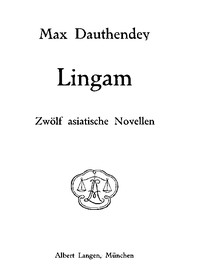
Lingam: Zwölf asiatische Novellen by Max Dauthendey
Let's be clear: this isn't a single, continuous story. 'Lingam' is a box of twelve distinct literary jewels, each set in a different Asian landscape at the turn of the 20th century. Dauthendey acts as our painter and poet, sketching scenes of Japanese geishas navigating rigid social codes, Javanese dancers caught in spiritual trances, and Indian ascetics seeking enlightenment. There's no overarching plot, but a common thread runs through them all: the search for meaning, often symbolized by the 'lingam'—a focus on life, creation, and the essence of things.
The Story
Instead of a plot, think of a mood board. One story might follow a European traveler humbled by the deep, silent wisdom of a Balinese temple. Another might be a bittersweet romance in a Kyoto teahouse, where what's left unsaid matters most. A third could drop you into the chaotic energy of a Bombay market, where the spiritual and the commercial violently collide. The 'story' is the cumulative effect of these glimpses. Dauthendey doesn't just describe pagodas and silk robes; he tries to capture the heartbeat and the hidden tensions of these cultures from an outsider's passionate, if imperfect, perspective.
Why You Should Read It
I love this book for its atmosphere and its honesty. Dauthendey isn't pretending to be an expert. His writing shows his wonder, his misunderstandings, and his genuine attempts to connect. Reading it today is a double journey: you travel to Asia in 1900, and you also travel into the mind of a European artist of that time, with all his romanticism and biases. The prose is poetic and dense, demanding your attention, but the payoff is a feeling of genuine immersion. It makes you think about how we see other cultures, and how much of someone's inner world we can ever truly understand.
Final Verdict
This book is perfect for the patient and curious reader. If you love classic authors like Lafcadio Hearn or Joseph Conrad, and enjoy short stories that prioritize mood and ideas over fast-paced action, you'll find a treasure here. It's also a fascinating read for anyone interested in historical European perspectives on Asia. Just be ready to read slowly, to sit with the imagery, and to forgive the occasional period-typical viewpoint. It's less of a page-turner and more of a window-cleaner, offering a clarified, if filtered, view of a world long past.
This content is free to share and distribute. You are welcome to share this with anyone.
Charles Moore
1 year agoI've been looking for a reliable source on this topic, and the quality of the diagrams and illustrations (if applicable) is top-notch. A mandatory read for anyone in this industry.
Mason Robinson
1 year agoEnjoyed every page.
Mary Torres
1 year agoI didn't expect much, but the clarity of the writing makes this accessible. I couldn't put it down.
Jessica Williams
1 year agoPerfect.



Susan Martin
9 months agoI've gone through the entire material twice now, and the author’s unique perspective adds a fresh layer to the discussion. This exceeded my expectations in almost every way.