
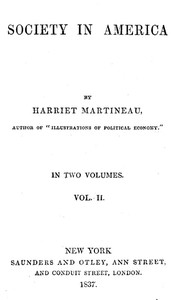
Society in America, Volume 2 (of 2) by Harriet Martineau
Published in 1837, Society in America isn't a novel with a plot, but it has one of the best stories you'll ever read: the story of a country in the middle of becoming itself. Harriet Martineau spent two years traveling from Boston to New Orleans, observing everything. She structured her book around a simple, powerful question: how does the reality of American life measure up to its stated principles? Each section examines an institution—like politics, religion, or the family—and holds it up to the light of the Declaration of Independence.
The Story
There's no protagonist except Martineau herself, armed with a notebook and a fearless mind. The 'plot' follows her journey through different layers of American society. She describes bustling cities and frontier towns, analyzes presidential campaigns, and details the cruel mechanics of the slave economy in the South. She writes about the vibrant press, the contentious debates over women's rights, and the overwhelming focus on money and business. The narrative tension comes from the gap she constantly points out—the loud proclamations of liberty versus the silent acceptance of inequality.
Why You Should Read It
This book is a time machine. Martineau has a gift for the telling detail that brings the past to life. You get the texture of the era: what people argued about at dinner, how they treated their children, what they hoped for. Her perspective as an outsider is key. She wasn't invested in American myths, so she could point out contradictions that locals took for granted. Her writing on the moral catastrophe of slavery is particularly devastating because it's so clear-eyed and logical. It's also surprisingly modern in its concerns about the environment, consumerism, and the role of women.
Final Verdict
Perfect for anyone who loves history that feels immediate, or for readers who enjoy sharp social commentary. If you like the idea of a 19th-century Alexis de Tocqueville but with more focus on the lives of women and the injustice of slavery, this is your book. It's not a quick, easy read—Martineau's thoughts are dense—but it is a deeply rewarding one. You'll come away feeling like you've had a long, fascinating conversation with one of the smartest travelers of all time, and you'll never look at American history the same way again.
This text is dedicated to the public domain. Feel free to use it for personal or commercial purposes.
John Perez
4 months agoIt’s rare to find such a well-structured narrative nowadays, the footnotes provide extra depth for those who want to dig deeper. An excellent example of how quality digital books should be formatted.
Christopher Miller
5 months agoFinally found a version that is easy on the eyes.
Donald Martin
1 month agoThe citations provided are a goldmine for further academic study.
Mary Gonzalez
10 months agoWhile browsing through various academic sources, the attention to detail regarding the core terminology is flawless. A refreshing and intellectually stimulating read.







Elizabeth Thompson
9 months agoThe information is current and very relevant to today's needs.