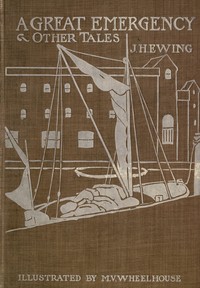
A Great Emergency and Other Tales — A Reader’s Guide

(0 User reviews)   12
Ewing, Juliana Horatia, 1841-1885 Project Gutenberg 2005
Children's stories; Children -- Conduct of life -- Juvenile fiction; Family -- Juvenile fiction; Great Britain -- Social life and customs -- 19th century -- Juvenile fiction Readers of public-domain and historical texts
Project Gutenberg digital edition en

Edition facts

Words: 69,680
Reading time: 303 min
Text sections: 7
Juliana Horatia Ewing's collection opens with a narrator who, alongside siblings, prepares for emergencies via a yellow leather book. The excerpts show moral debates on temper, restraint, and self-knowledge, with vivid domestic dialogue and a shift from adventure to ethical introspection.
Share
Editorial Edition Score 4.7/5

Calculated from edition completeness, EPUB availability, text structure and catalogue metadata. Not a user rating.

Edition quality

Read the Text

ult with in our lives was that there were so few events in them.

It was particularly provoking, because we were so well prepared for events—any events. Rupert prepared us. He had found a fat old book in the garret, bound in yellow leather, at the end of which were "Directions how to act with presence of mind in any emergency;" and he gave lectures out of this in the kitchen garden.

Rupert was twelve years old. He was the eldest. Then came Henrietta, then I, and last of all Baby Cecil, who was only four. The day I was nine years old, Rupert came into the nursery, holding up his handsome head with the dignified air which became him so well, that I had more than once tried to put it on myself before the nursery looking-glass, and said to me, "You are quite old enough now, Charlie, to learn what to do whatever happens; so every half-holiday, when I am not playing cricket, I'll teach you presence of mind near the cucumber frame, if you're punctual. I've put up a bench."

I thanked him warmly, and the next day he put his head into the nursery at three o'clock in the afternoon, and said—"The lecture."

I jumped up, and so did Henrietta.

"It's not for girls," said Rupert; "women are not expected to do things when there's danger."

"_We_ take care of _them_" said I, wondering if my mouth looked like Rupert's when I spoke, and whether my manner impressed Henrietta as much as his impressed me. She sat down again and only said, "I stayed in all Friday afternoon, and worked in bed on Saturday morning to finish your net."

"Come along," said Rupert. "You know I'm very much obliged to you for the net; it's a splendid one."

"I'll bring a camp-stool if there's not room on the bench," said Henrietta cheerfully.

"People never take camp-stools to lectures," said Rupert, and when we got to the cucumber frame we found that the old plank, which he had raised on inverted flower-pots, would have held a much larger audience than he had invited. Opposite to it was a rhubarb-pot, with the round top of a barrel resting on it. On this stood a glass of water. A delightful idea thrilled through me, suggested by an imperfect remembrance of a lecture on chemistry which I had attended.

"Will there be experiments?" I whispered.

"I think not," Henrietta replied. "There are glasses of water at the missionary meetings, and there are no experiments."

Meanwhile Rupert had been turning over the leaves of the yellow leather book. To say the truth, I think he was rather nervous; but if we have a virtue among us it is that of courage; and after dropping the book twice, and drinking all the water at a draught, he found his place, and began.

"_How to act in an emergency_."

"What's an emergency?" I asked. I was very proud of being taught by Rupert, and anxious to understand everything as we went along.

"You shouldn't interrupt," said Rupert, frowning. I am inclined now to think that he could not answer my question off-hand; for though he looked cross then, after referring to the book he answered me: "It's a fire, or drowning, or an apoplectic fit, or anything of that sort." After which explanation, he hurried on. If what he said next came out of his own head, or whether he had learned it by heart, I never knew.

"There is no stronger sign of good-breeding than presence of mind in an—"

"—apoplectic fit," I suggested. I was giving the keenest attention, and Rupert had hesitated, the wind having blown over a leaf too many of the yellow leather book.

"An _emergency_," he shouted, when he had found his place. "Now we'll have one each time. The one for to-day is—How to act in a case of drowning."

To speak the strict truth, I would rather not have thought about drowning. I had my own private horror over a neighbouring mill-dam, and I had once been very much frightened by a spring-tide at the sea; but cowardice is not an indulgence for one of my race, so I screwed up my lips and pricked my ears to learn my duty in the unpleasant emergency of drowning.

"It doesn't mean being drowned yourself," Rupert continued, "but what to do when another person has been drowned."

The emergency was undoubtedly easier, and I gave a cheerful attention as Rupert began to question us.

"Supposing a man had been drowned in the canal, and was brought ashore, and you were the only people there, what would you do with him?"

I was completely nonplussed. "I felt quite sure I could do nothing with him, he would be so heavy; but I felt equally certain that this was not the answer which Rupert expected, so I left the question to Henrietta's readier wit. She knitted her thick eyebrows for some minutes, partly with perplexity, and partly because of the sunshine reflected from the cucumber frame, and then said,

"We should bury him in a vault; Charlie and I _couldn't_ dig a grave deep enough."

I admired Henrietta's foresight, but Rupert was furious.

"How _silly_ you are!" he exclaimed, knocking over the top of the rhubarb-pot table and the empty glass in his wrath. "Of course I don't mean a dead man. I mean what would you do to bring a partly drowned man to life again?"

"That wasn't what you _said_," cried Henrietta, tossing her head.

"I let you come to my lecture," grumbled Rupert bitterly, as he stooped to set his table right, "and this is the way you behave!"

"I'm very sorry, Rupert dear!" said Henrietta. "Indeed, I only mean to do my best, and I do like your lecture so very much!"

"So do I," I cried, "very, very much!" And by a simultaneous impulse Henrietta and I both clapped our hands vehemently. This restored Rupert's self-complacency, and he bowed and continued the lecture. From this we learned that the drowned man should be turned over on his face to let the canal water run out of his mouth and ears, and that his wet clothes should be got off, and he should be made dry and warm as quickly as possible, and placed in a comfortable position, with the head and shoulders slightly raised. All this seemed quite feasible to us. Henrietta had dressed and undressed lots of dolls, and I pictured myself filling a hot-water bottle at the kitchen boiler with an air of responsibility that should scare all lighter-minded folk. But the directions for "restoring breathing" troubled our sincere desire to learn; and this even though Henrietta practised for weeks afterwards upon me. I represented the drowned man, and she drew my arms above my head for "_inspiration_," and counted "one, two;" and doubled them and drove them back for "_expiration_;" but it tickled, and I laughed, and we could not feel at all sure that it would have made the drowned man breathe again.

Meanwhile Rupert went on with the course of lectures, and taught us how to behave in the event of a fire in the house, an epidemic in the neighbourhood, a bite from a mad dog, a chase by a mad bull, broken limbs, runaway horses, a chimney on fire, or a young lady burning to death. The lectures were not only delightful in themselves, but they furnished us with a whole set of new games, for Henrietta and I zealously practised every emergency as far as the nature of things would allow. Covering our faces with wet cloths to keep off the smoke, we crept on our hands and knees to rescue a fancy cripple from an imaginary burning house, because of the current of air which Rupert told us was to be found near the floor. We fastened Baby Cecil's left leg to his right by pocket-handkerchiefs at the ankle, and above and below the knee, pretending that it was broken, and must be kept steady till we could convey him to the doctor. But for some unexplained reason Baby Cecil took offence at this game, and I do not think he could have howled and roared louder under the worst of real compound fractures. We had done it so skilfully, that we were greatly disgusted by his unaccommodating spirit, and his obstinate refusal to be put into the litter we had made out of Henrietta's stilts and a railway rug. We put the Scotch terrier in instead; but when one end of the litter gave way and he fell out, we were not sorry that the emergency was a fancy one, and that no broken limbs were really dependent upon our well-meant efforts.

There was one thing about Rupert's lectures which disappointed me. His emergencies were all things that happened in the daytime. Now I should not have liked the others to know that I was ever afraid of anything; but, really and truly, I was sometimes a little frightened—not of breaking my leg, or a house on fire, or an apoplectic fit, or anything of that sort, but—of things in the dark. Every half-holiday I hoped there would be something about what to do with robbers or ghosts, but there never was. I do not think there can have been any emergencies of that kind in the yellow leather book.

On the whole, I fancy Rupert found us satisfactory pupils, for he never did give up the lectures in a huff, though he sometimes threatened to do so, when I asked stupid questions, or Henrietta argued a point.

HENRIETTA—A FAMILY CHRONICLE—THE SCHOOL MIMIC—MY FIRST FIGHT.

Henrietta often argued points, which made Rupert very angry. He said that even if she were in the right, that had nothing to do with it, for girls oughtn't to dispute or discuss. And then Henrietta argued that point too.

Rupert and Henrietta often squabbled, and always about the same sort of thing. I am sure he would have been _very_ kind to her if she would have agreed with him, and done what he wanted. He often told me that the gentlemen of our family had always been courteous to women, and I think he would have done anything for Henrietta if it had not been that she would do everything for herself.

When we wanted to vex her very much, we used to call her "Monkey," because we knew she liked to be like a boy. She persuaded Mother to let her have her boots made like ours, because she said the roads were so rough and muddy (which they are). And we found two of her books with her name written in, and she had put "Henry," and Rupert wrote Etta after it, and "Monkey" after that. So she tore the leaves out. Her hair was always coming out of curl. It was very dark, and when it fell into her eyes she used to give her head a peculiar shake and toss, so that half of it fell the wrong way, and there was a parting at the side, like our partings. Nothing made Rupert angrier than this.

Henrietta was very good at inventing things. Once she invented a charade quite like a story. Rupert was very much pleased with it, because he was to act the hero, who was to be a young cavalier of a very old family—our family. He was to arrive at an inn; Henrietta made it the real old inn in the middle of the town, and I was the innkeeper, with Henrietta's pillow to make me fat, and one of Nurse's clean aprons. Then he was to ask to spend a night in the old Castle, and Henrietta made that the real Castle, which was about nine miles off, and which belonged to our cousin, though he never spoke to us. And a ghost was to appear. The ghost of the ancestor in the miniature in Mother's bedroom. Henrietta did the ghost in a white sheet; and with her hair combed, and burnt-cork moustache, she looked so exactly like the picture that Rupert started when she came in, and stared; and Mother said he had acted splendidly.

Henrietta was wonderfully like the picture. Much more like than Rupert ever was, which rather vexed him, because that ancestor was one of the very bravest, and his name was Rupert. He was rather vexed, too, when she rode the pony bare-backed which had kicked him off. But I think the pony was fonder of Henrietta, which perhaps made it easier for her to manage it. She used to feed it with bits of bread. It got them out of her pocket.

One of the things Henrietta could not do as well as Rupert was cricket. Rupert was one of the best players in the school. Henrietta used to want to play with us at home, and she and I did play for a bit, before breakfast, in the drying ground; but Rupert said, if I encouraged her in being unladylike, he would not let me come to the school matches. He said I might take my choice, and play either with girls or boys, but not with both. But I thought it would be very mean to leave Henrietta in the lurch. So I told her I would stick by her, as Rupert had not actually forbidden me. He had given me my choice, and he always kept his word. But she would not let me. She pretended that she did not mind; but I know she did, for I could see afterwards that she had been crying. However, she would not play, and Mother said she had much rather she did not, as she was so afraid of her getting hit by the ball. So that settled it, and I was very glad not to have to give up going to the school matches.

The school we went to was the old town grammar school. It was a very famous one; but it was not so expensive as big public schools are, and I believe this was why we lived in this town after my father's death, for Mother was not at all rich.

The grammar school was very large, and there were all sorts of boys there—some of gentlemen, and tradesmen, and farmers. Some of the boys were so very dirty, and had such horrid habits out of school, that when Rupert was thirteen, and I was ten, he called a council at the beginning of the half, and a lot of the boys formed a committee, and drew up the code of honour, and we all subscribed to it.

The code of honour was to forbid a lot of things that had been very common in the school. Lying, cheating over bargains, telling tales, bragging, bad language, and what the code called "conduct unbecoming schoolfellows and gentlemen." There were a lot of rules in it, too, about clean nails, and shirts, and collars and socks, and things of that sort. If any boy refused to agree to it, he had to fight with Thomas Johnson.

There could not have been a better person than Rupert to make a code of honour. We have always been taught that honour was the watch-word of our family—dearer than anything that could be gained or lost, very much dearer than mere life. The motto of our arms came from an ancestor who lost the favour of the King by refusing to do something against his conscience for which he would have been rewarded. It is "Honour before honours."

I can just remember the man, with iron-grey hair and gold spectacles, who came to our house after my father's death. I think he was a lawyer. He took lots of snuff, so that Henrietta sneezed when he kissed her, which made her very angry. He put Rupert and me in front of him, to see which of us was most like my father, and I can recall the big pinch of snuff he took, and the sound of his voice saying "Be like your father, boys! He was as good as he was gallant. And there never lived a more honourable gentleman."

Every one said the same. We were very proud of it, and always boasted about our father to the new nursemaids, or any other suitable hearer. I was a good deal annoyed by one little maid, who when I told her, over our nursery tea, that my father had been the most honourable of men, began to cry about her father, who was dead too, and said he was "just the same; for in the one and twenty years he kept a public-house, he never put so much as a pinch of salt into the beer, nor even a gill of water, unless it was in the evening at fair-time, when the only way to keep the men from fighting was to give them their liquor so that it could not do them much harm." I was very much offended by the comparison of _my_ father, who was an officer and a gentleman of rank, with _her_ father, who was a village publican; but I should like to say, that I think now that I was wrong and Jane was right. If her father gave up profit for principle, he _was_ like my father, and like the ancestor we get the motto from, and like every other honourable man, of any rank or any trade.

Every time I boasted in the nursery of my father being so honourable, I always finished my saying, that that was why he had the word Honourable before his name, as men in old times used to be called "the Good" or "the Lion Heart." The nursemaids quite believed it, and I believed it myself, till the first week I went to school.

It makes me hot all over to remember what I suffered that week, and for long, afterwards. But I think it cured me of bragging, which is a mean ungentlemanly habit, and of telling everybody everything about myself and my relations, which is very weak-minded.

The second day I was there, one of the boys came up to me and said, with a mock ceremony and politeness which unfortunately took me in, "If I am not mistaken, sir, that esteemed lady, your mother, is an Honourable?"

He was nearly five years older than I; his name was Weston; he had a thin cadaverous face, a very large nose, and a very melancholy expression. I found out afterwards that he was commonly called "the clown," and was considered by boys who had been to the London theatres to surpass the best professional comic actors when he chose to put forth his powers. I did not know this then. I thought him a little formal, but particularly courteous in his manner, and not wishing to be behindhand in politeness, I replied, with as much of his style as I could assume, "Certainly, sir. But that is because my father was an Honourable. My father, sir, was the most honourable of men."

A slight spasm appeared to pass over Weston's face, and then he continued the conversation in a sadder tone than the subject seemed to require, but I supposed that this was due to his recalling that my father was dead.

I confess that it did not need many leading inquiries to draw from me such a narrative of my father's valour and high principle, as well as the noble sentiments and conspicuous bravery which have marked our family from Saxon times, as I was well accustomed to pour forth for the edification of our nursemaids. I had not proceeded far, when my new friend said, "Won't you walk in and take a seat?" It was recreation time, and the other boys were all out in the playground. I had no special friend as yet; Rupert had stuck to me all the first day, and had now left me to find my own level. I had lingered near the door as we came out, and there Weston had joined me. He now led me back into the deserted school-room, and we sat down together on an old black oak locker, at the bottom of the room.

How well I remember the scene! The dirty floor, the empty benches, the torn books sprinkled upon the battered desks, the dusty sunshine streaming in, the white-faced clock on the wall opposite, over which the hands moved with almost incredible rapidity. But when does time ever fly so fast as with people who are talking about themselves or their relations?

The narrator of the title story announces early that the children find their lives deficient in events, despite being “so well prepared for events—any events.” This preparation comes from Rupert’s lectures based on a fat old book bound in yellow leather, which contains “Directions how to act with presence of mind in any emergency.” The opening thus establishes a tension between the desire for dramatic happenings and the comically earnest readiness for them. The voice is colloquial and self-aware, with the narrator including siblings Henrietta and Baby Cecil in the collective “we.”

The excerpts from later tales, such as “A Very Ill-Tempered Family,” shift to a different kind of emergency: the internal struggle with anger and moral self-examination. The dialogue between Aunt Isobel and the narrator Isobel reveals a nuanced debate about whether ill-temper is a sin, whether restraint is better than open conflict, and how to identify a “besetting sin.” These passages are dense with psychological observation and family dynamics, suggesting that the collection moves from external adventures to internal ones.

Preparing for Emergencies: The Yellow Leather Book

The opening chapter of “A Great Emergency” introduces the children’s method of readiness: Rupert lectures from a found book. The narrator notes that the book’s end contains practical directions for emergencies, but the excerpts do not reveal what those directions are. What is clear is the children’s eagerness for events, a sentiment that drives the plot. The phrase “so few events in them” is a direct complaint, and the preparation is presented as both earnest and slightly absurd. The yellow leather book becomes a symbol of anticipated adventure, and the narrator’s tone is fondly ironic. This setup primes the reader for a story where preparation meets reality, though the excerpts do not show the emergency itself. The contrast between the children’s readiness and the mundane world is a key tension.

The Ethics of Temper: A Family Debate

In “A Very Ill-Tempered Family,” the narrator Isobel engages her aunt in a theological and practical argument about anger. Isobel confesses that her besetting sin is not conquered, only “civilized,” and questions whether ill-temper is truly a sin. She argues that “restraining your temper means forcing yourself to be good outside, and feeling all the worse inside.” Aunt Isobel, in contrast, advocates for patience and self-examination. The dialogue is sharp and realistic, with interruptions and gestures—Aunt Isobel pulls her eyelashes, Isobel kicks the shovel. The excerpt shows a family where moral questions are debated openly, and where the younger generation challenges received wisdom. This section reveals Ewing’s interest in the psychology of morality, and the reader is drawn into a nuanced discussion that avoids easy answers.

Voice and Structure: First-Person Narration and Dialogue

The excerpts are dominated by first-person narrators who speak directly to the reader. In “A Great Emergency,” the collective “we” creates a sense of shared experience. In “A Very Ill-Tempered Family,” the narrator Isobel uses a confessional tone, admitting past childish spitting and hair-pulling. The dialogue is a key structural element: conversations between Isobel and Aunt Isobel are extended, with interruptions and shifts in tone. Aunt Isobel’s line “I’m patience its very self!” is immediately undercut by her impatience. This technique gives the characters life and makes the moral debates feel immediate. The excerpts also show a preference for domestic settings—the schoolroom, the fireside—where big questions are argued in small spaces. The reader should attend to how Ewing uses voice to convey character and to advance thematic concerns without overt moralizing.

From External Adventure to Internal Conflict

The collection’s title story promises a “great emergency,” but the excerpts from later tales suggest that the real emergencies may be emotional and ethical. The narrator of “A Very Ill-Tempered Family” explicitly compares physical fights with internal restraint, preferring the former for its catharsis. This shift from outer to inner drama is signaled by the table of contents, which lists chapters with titles like “A Family Failing” and “Cases of Conscience.” The excerpts do not reveal whether the children in the title story ever face their anticipated emergency, but the later tales indicate that Ewing is equally interested in the emergencies of daily life—quarrels, self-reproach, and the struggle for self-control. Readers should approach the collection as a series of variations on a theme: how characters respond to crises, whether external or internal, and how preparation (or lack thereof) shapes those responses.

These excerpts offer a window into Ewing’s narrative strategies: direct address, lively dialogue, and a focus on moral psychology. The reader is encouraged to notice how the opening tale’s promise of adventure is balanced by the later stories’ introspective debates. Pay attention to the recurring motif of preparation—Rupert’s lectures, the yellow book, the discussions of temper—and how it plays out across different contexts. The collection rewards attention to voice and to the way Ewing uses family dynamics to explore larger questions of conduct and self-knowledge.

That yellow leather book in Ewing’s tales felt less like a manual and more like a quiet promise we make to ourselves—to be a bit braver, a bit kinder in the small moments. I found that same gentle ache in In Wild Rose Time — Reading Companion, where the wildness softens into something almost like prayer. It lingered, the way certain silences do.

There are no reviews for this eBook.

0
0 out of 5 (0 User reviews )

Add a Review

Your Rating *
  • ...
    James Galloway - 4 weeks ago
    A good anthology with a mix of exciting adventures and gentle lessons. Some stories are stronger than others, and the pacing varies, but overall, it's an enjoyable read. The book could benefit from a more cohesive theme, but it's still worth exploring for fans of classic short stories.

  • ...
    Martin Schultz - 1 week ago
    A wonderful collection of tales that entertain and teach. Each story is unique, with engaging plots and memorable characters. The writing is vivid and captures the reader's imagination. Perfect for children and anyone who appreciates classic storytelling with a moral edge.

  • ...
    Rachel Park - 1 week ago
    This collection feels uneven and dated. The stories are predictable and often preachy, with little variation in tone. The characters are flat and the resolutions too neat. While it might have appealed to a Victorian audience, modern readers will find it lacking in originality and substance.


Reader reflection

How will you remember this book?

Save your reaction, strongest insight, and memorable passage.

Your progress 0 / 10
1

How far have you progressed with this book?

2

How much did you enjoy the reading experience?

3

How likely are you to recommend this book?

4

How demanding did the text feel?

Related eBooks