1

Through the Looking-Glass — Edition Insights
(0 User reviews)
359
Project Gutenberg
2008
Not confirmed
Fantasy fiction; Children's stories; Imaginary places -- Juvenile fiction; Alice (Fictitious character from Carroll) -- Juvenile fiction
Readers of public-domain and historical texts
Project Gutenberg digital edition
en
Edition facts
Words
34,223
Reading time
149 min
Text sections
14
The source record for Through the Looking-Glass — Edition Insights measures this digital text at 34,223 words, 2 hr 29 min estimated reading time, and 14 detected text sections.
The text analysis averages about 15.8 words per sentence, while the detected sections provide another way to judge how the source is divided.
Project Gutenberg metadata also associates the work with “Fantasy fiction,” connecting these edition facts with the source record’s subject description.
Source:
Project Gutenberg record #12
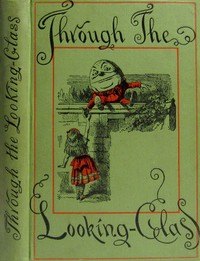
Lewis Carroll's chessboard fantasy where Alice steps through a mirror into a world of talking flowers, argumentative insects, and the literal-minded Humpty Dumpty, with a prefatory poem and dramatis personae arranged as a game.
Read the complete public-domain text at its original source.
Read on Project GutenbergThe prefatory poem sets a wistful tone: Carroll addresses a child 'half a life asunder' from his own youth, framing the tale as a 'love-gift' against winter and bedtime. The book opens not with Alice but with a dramatis personae arranged as a chess game—White and Red pieces with pawns named Daisy, Oyster, and Tiger-lily—and a note that 'White Pawn (Alice) to play, and win in eleven moves.' This structural conceit is immediately at odds with the catalog subject 'Children's stories,' as the chess notation demands a reader willing to parse moves like 'R. Q. to K. R.’s 4th.' The first chapter begins with a domestic dispute: 'the black kitten’s fault entirely,' not the white one's, grounding the fantasy in a recognizable household before Alice climbs into the looking-glass.
Chess as Structure, Not Just Theme
The catalog lists 'Imaginary places' and 'Fantasy fiction,' but the excerpts reveal a precise, rule-bound framework. The dramatis personae is a chess board: White and Red pieces, each with pawns, and a sequence of moves that correspond to Alice's encounters. For instance, move 2 reads 'Alice through Q.’s 3d (by railway) to 4th (Tweedledum and Tweedledee).' This is not a mere backdrop; the game dictates the narrative's geography and pacing. Yet the excerpts show that within this rigid structure, the dialogue is anything but orderly. Humpty Dumpty's argument about 'un-birthday presents' involves a subtraction sum (365 − 1 = 364) that he insists on seeing 'done on paper.' The chess framework provides a skeleton, but the flesh is made of logical games and wordplay that resist the very order the game imposes.
The Literal-Mindedness of Language
Humpty Dumpty's conversation with Alice demonstrates a recurring pattern: characters take words at face value and punish imprecision. When Alice admires his 'beautiful belt,' he corrects her—it is a cravat—and grows 'thoroughly offended.' Alice's internal confusion ('which was neck and which was waist') highlights the gap between her practical understanding and the looking-glass world's rigid definitions. Humpty Dumpty also redefines 'un-birthday present' through arithmetic, treating language as a puzzle to be solved by calculation. This echoes the chess moves: each step is literal, yet the results are absurd. The catalog subject 'Children's stories' might imply simplicity, but the excerpts show a text that demands readers attend to precise wording and its consequences.
The Poem's Frame: Nostalgia and Disruption
The opening poem, not mentioned in the catalog subjects, establishes a contrast between the 'frost, the blinding snow' outside and the 'firelight’s ruddy glow' within. Carroll addresses a child who will 'hearken' to a 'fairy-tale' that may carry 'the shadow of a sigh' for 'happy summer days gone by.' This adult melancholy sits oddly with the catalog's 'Children's stories' classification. The poem's speaker is explicitly older, aware of time's passage, and the tale is offered as a comfort against 'the raving blast.' Yet the excerpts from the main text contain no such sentimentality; instead, they are filled with argumentative characters and logical traps. The poem frames the adventure as a deliberate escape, but the escape itself is fraught with the same kind of verbal and structural rules that govern the real world—only turned inside out.
Readers approaching this as a straightforward children's fantasy will find the chess notation and the poem's adult voice disorienting. Pay attention to the dramatis personae: it is a map of the narrative's logic, not just a list. The excerpts suggest that the book rewards attention to how characters interpret words and rules, often more than to plot. The catalog subjects hint at 'imaginary places,' but the real strangeness lies in how language itself becomes a place where meanings shift and arguments are settled by arithmetic.
I remember how Through the Looking-Glass taught me that a board game can hold a whole world of gentle absurdity, each move a quiet step into mischief. Years later, I found a similar warmth in Bikey the Skicycle and Other Tales of Jimmieboy — A Reader’s Guide, where playthings breathe with the same patient, wondering logic.
There are no reviews for this eBook.
There are no comments for this eBook.
Reader reflection
Before you leave, reflect on the book
Use these questions to collect your thoughts before moving on.
Your progress
0
/
10
2
How did the book work for you overall?
3
Would you pass this book on to a friend?
4
How demanding did the text feel?
5
Was the book what you thought it would be?
6
Did the book give you something worth debating?
7
Is this a title worth rereading?
8
How did the pace of the book feel?
9
What is the main idea you are taking away?
10