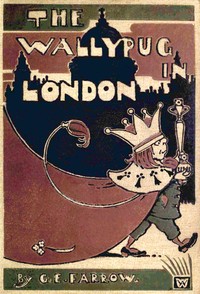
The Wallypug in London — Key Ideas to Explore

(0 User reviews)   43
In Category - Fairy Moral Tales
Farrow, G. E. (George Edward), 1862-1919, Wright, Alan, 1864-1959? [Illustrator] Project Gutenberg 2008
Fantasy fiction; Children's stories; Nonsense verses; Wit and humor, Juvenile; Voyages and travels -- Juvenile fiction; London (England) -- Juvenile fiction; Kings and rulers -- Juvenile fiction; Carroll, Lewis, 1832-1898 -- Parodies, imitations, etc. Readers of public-domain and historical texts
Project Gutenberg digital edition en

Edition facts

Words: 44,074
Reading time: 192 min
Text sections: 10
This editorial note examines how the opening, middle, and later excerpts of G. E. Farrow's 'The Wallypug in London' guide a first reading, focusing on the Wallypug's regal absurdity, the narrator's bemused tone, and the episodic structure of the seaside holiday.
Share
Editorial Edition Score 4.8/5

Calculated from edition completeness, EPUB availability, text structure and catalogue metadata. Not a user rating.

Edition quality

Read the Text

"Oh, Mrs. Putchy," I said, stepping just outside, "these gentlemen, er--that is to say, his Majesty the Wallypug of Why and suite, have honoured me with a visit, and I am anxious if possible to offer them such hospitality as my poor home affords. Do you think that we could manage anyhow to find room for them, for a few days at any rate?"

Now Mrs. Putchy is a very remarkable woman, and I have never known her to show the slightest surprise at anything, and, so far from seeming alarmed at the prospect of having to entertain such notable visitors, she seemed positively delighted.

"His Majesty of Why, sir? How charming! Of course we must do our best, and how fortunate that I put on my best gown to-day, isn't it? Dear me, and shall I be presented to his Majesty?"

"Certainly, Mrs. Putchy, if you wish it," I said. "In fact, if you will call General Mary Jane, I will introduce you both, as you represent my entire household."

Mrs. Putchy disappeared, returning almost immediately, followed by the servant, General Mary Jane, with her mouth wide open, and accompanied by the cat, who rejoices in the extraordinary name of Mrs. Mehetable Murchison. These members of my household were duly presented to the Wallypug. Mrs. Putchy made her curtsey with great dignity, but General Mary Jane was so overcome at the thought of being presented to royalty that she fell flat on her hands and knees in her humility, while Mrs. Mehetable Murchison, realizing, no doubt, the truth of the old saying that "a cat may look at a king," went up and sharpened her claws on the Wallypug's legs in the most friendly manner possible.

It was when the cat caught sight of A. Fish, Esq., that she completely lost her presence of mind, and with arched back and bristling fur glared at him in amazement.

"Priddy pussy, cub alog thed," said the Fish, stooping down and trying to stroke her with one of his fins; but Mrs. Mehetable Murchison, with a startled glance, tore out of the room, showing every sign of alarm.

"And she's so fond of fish too, as a rule, ain't she, mum?" remarked General Mary Jane, who had somewhat overcome the awe with which she had at first regarded the presence of royalty.

"Fod of fish?" repeated A. Fish, Esq., inquiringly. "What do you mead?"

"Why, you see, sir," explained Mrs. Putchy, "we often have fish for dinner--er--that is to say--er--a-hem!"

The Fish was glaring at her in a horrified way, and Mrs. Putchy had become quite nervous.

"Let's change the subject," suggested the Doctor-in-Law, to our great relief. "The most important question for the moment is, where are we all going to sleep?"

This gave Mrs. Putchy an opportunity for exercising her wonderful ability for management, and after arranging for the Wallypug to have the spare bedroom, and the Doctor-in-Law to have my room, I was to have a bed made up in the study, while the Jubilee Rhymester was to sleep in the attic, One-and-Nine was to have a box under the stairs, and there only remained A. Fish, Esq., to dispose of.

"There is the bathroom, mum," suggested General Mary Jane brilliantly; "we could put a lid on the bath and make up a bed there."

"Bedder sdill, fill id with wadter, ad thed I could sleeb _in_ id," suggested the Fish.

"Oh yes, of course!" said Mrs. Putchy, "and now I must go and see about the supper." And, with a low curtsey to the Wallypug, the admirable little woman hurried out, followed by General Mary Jane, who gave a nervous little bob when she reached the door.

They had scarcely disappeared before One-and-Nine came up to me and whispered:

"I am muchly impressionated by that lady with the most militaryish name who has just gone out. Can you kindly inform me is she detached?"

"Detached?" I inquired in bewilderment. "What ever do you mean?"

"If a person is not attached to anyone else, they are detached, I suppose, are they not?" said One-and-Nine rather impatiently.

"Well, if you put it that way, I suppose they are," I replied, laughing. "You mean, has she a sweetheart? Well, really I don't know. I have an idea though that Mrs. Putchy does not allow followers."

"Then I shall considerize my prospectuousness with great hopefulosity!" remarked the soldier with considerable dignity, walking back to the Wallypug's chair.

"What does he say?" asked the Jubilee Rhymester. "He is a little bit cracked, you know. Could you make out what he was driving at?"

"Oh, yes, I could understand within a little what he meant," I replied. "He seems to have fallen in love with General Mary Jane at first sight, from what I can gather."

"Really! Dear me! He is always doing that sort of thing, do you know, and he generally asks me to write poems for him when he gets into that state. I have written as many as 137 odes in one month on his behalf."

"Good gracious," I replied, "and does he pay you well for them?"

"Pay me!" exclaimed the Jubilee Rhymester, staring at me in surprise. "Of course not. Do people ever get paid for writing poetry?"

"Why, yes, to be sure they do," I answered.

"Well, I've never heard of such a thing in all my life," said the Jubilee Rhymester; "I always thought that poets had to pay to have their verses used at all, and that that was why they were always so poor while they were alive. Of course I knew that people sometimes made a fuss about them after they were dead, but I have never heard of such a thing as a live poet being paid for his work."

"Nonsense," I replied; "I believe that quite a lot of money is sometimes paid by the magazines and other papers for poems and verses."

"Well, I am delighted to hear it," said the Jubilee Rhymester, "and I shall certainly start writing to-morrow. I have no doubt whatever that I shall make my fortune before I go back to Zum."

Shortly after this Mrs. Putchy announced that supper was served, and a little later my guests retired to rest, being thoroughly tired out with their long journey. I sat up in my study a little while longer to smoke a pipe, but was just thinking of going to bed when there was a tap at the door and the Doctor-in-Law entered.

"I say, I thought I had better come and arrange with you about money matters," he said; "I didn't like to mention such things before the others. Now then," he continued, "how much are you going to pay us for staying with you?"

"Pay _you_!" I gasped. "What on earth do you mean?"

"Well, you see, it will be a great thing for you to have such distinguished visitors, don't you know, and you ought to be quite willing to pay liberally for the honour," said the Doctor-in-Law, smiling amiably.

Now Girlie had told me what a greedy, avaricious person the Doctor-in-Law really was, despite his benevolent appearance, but this cool cheek almost took my breath away. I was determined, however, to let him see at once that I was not to be imposed upon, so I said as firmly as I could, "Now, look here, Mr. Doctor-in-Law, please understand once and for all, that as you were all so kind to my little friend Girlie when she was at Why, I am quite willing to entertain his Majesty the Wallypug, and the rest of you, to the very best of my ability, but as for paying you for being here, the idea is absurd--impossible!"

Just then a terrific hullabaloo in the passage caused us both to run to the door. We could hear that the noise proceeded from the bathroom, and, hurrying to the door, we found A. Fish, Esq., sitting up in the water shouting for help, while Mrs. Mehetable Murchison and a whole group of her feline friends were out on the tiles, glaring through the window.

"Dear be, dear be," panted the Fish, when he saw us, "I'b so frighteded, just look at all those cats. I had beed to sleeb ad was just dreabig that sobeone was sayig, 'Mrs. Behetable Burchison is _so_ fod of fish, and we ofted have fish for didder,' whed I woke ub and saw all those horrible cats lookig id ad the widdow; id quide gave be a turn. Do drive theb away please."

We soon did this, and, pulling down the blinds, we left A. Fish, Esq., to his dreams and soon afterwards retired to rest ourselves.

THE NEXT DAY'S ADVENTURES

When I entered the breakfast room the next morning I found that the Wallypug and the Doctor-in-Law had been up for some time, and were both gazing out of the window with the greatest of interest.

"I hope your Majesty slept well," I remarked to the Wallypug as I approached them.

"Very well indeed, thank you," he replied smilingly. "The Doctor-in-Law and myself have just been saying that we are sure to have an enjoyable visit here. We have been greatly interested in the man-machines going past. We have never seen anything like them before."

"The man-machines!" I exclaimed, puzzled to know whatever he could mean.

"Yes, the men with wheels instead of legs, you know."

"Oh, you mean the bicyclists," I replied, laughing. "Have you really never seen any before?"

"No, indeed," replied his Majesty. "Are they born with wheels on, or do they grow afterwards?"

I laughed, and fortunately just then the youngster opposite, who always rides to school on his bicycle, came out of doors wheeling his machine, and I was able to explain to the Wallypug the principle upon which they worked.

"Dear me; the Doctor-in-Law told me that the machinery was part of the man, but now I see that it is separate. And he charged me sixpence for the information too," he complained, looking reproachfully at the Doctor-in-Law.

"Charged you sixpence!" I cried.

"Yes," replied the poor Wallypug. "He offered to tell me all about them for sixpence, and as I was really very curious to know I gave it to him, and then he informed me that they were a peculiar race of people who came from Coventry, and who were all born with wheels instead of legs."

"Take your old sixpence then, if you are going to make all that fuss about it," said the Doctor-in-Law, crossly, throwing the coin down on the table and walking out of the room in a huff. "I'm sure I did read somewhere that they came from Coventry," he added, popping his head in at the door and then slamming it violently after him.

The boy opposite was still riding up and down the road, and I made up my mind that although I had never spoken to him before, I would ask him to let the Wallypug examine his bicycle more closely.

"With pleasure," he replied, raising his hat politely to the Wallypug, when I had explained who he was; "and if his Majesty would like to try it he is quite welcome to do so."

The Doctor-in-Law's curiosity had so far overcome his ill-humour that, when he saw us talking to the boy, he came forward and offered to help the Wallypug to mount.

"I really don't think he had better," I said, "he might damage the machine."

"Oh no, he won't hurt it, I'm sure," said the boy generously; and so with our united assistance the Wallypug got on to the bicycle, and after a few preliminary wobblings started off in fine style. Faster and faster he went, clinging desperately to the handle-bars, till we, who were running beside him, could no longer keep pace with him.

"I can't stop," we heard him shout; and a moment later he charged straight at a large stone and half a brick which lay in the middle of the roadway.

Poor Wallypug! The sudden impact threw him right over the handle-bars, and he landed in a huddled heap on his hands and knees in the gutter. The machine flew in half, and the front portion careered madly away by itself till stopped by the kerb.

We hurried up to his Majesty to discover if he was much hurt, but, with the exception of a few scratches on his hands and knees and a thorough shaking, he seemed to have come off pretty well.

"I suppose we can't stick it together again?" he inquired, gazing ruefully at the broken bicycle, and I was obliged to tell him that there was not much chance of our doing so. The boy to whom it belonged bravely made the best of the matter, especially when I told him that the next half-holiday he had I would take him to Holborn to choose another one in its place.

And when I discovered that he had a half-holiday that very afternoon, it was arranged that General Mary Jane should order a carriage at the livery stable, and that we should all drive to the city after luncheon.

The Wallypug, after a good wash and a hearty breakfast, went to his room to lie down for an hour or two to recover from the effects of his accident, and I was just answering my morning letters when there was a knock at the study door, and the Rhymester entered.

"I sat up most of the night writing poetry," he remarked, "and I have just brought you one or two specimens. The first one is called 'The Ode of a Toad.' Perhaps I had better read it to you. My writing is rather peculiar," and he began as follows:

There was once an old toad who lived under a tree, Hippety hop--Flippety flop, And his head was as bald as bald could be, He was deaf as a post and could hardly see, But a giddy and frivolous toad was he, With his hippety-hoppety-plop.

And he gambolled and danced on the village green, Hippety hop--Flippety flop, In a way that had never before been seen, Tho' he wasn't so young as once he had been, And the people all wondered whate'er he could mean, With his hippety-hoppety-plop.

But the old chap kept bobbing about just the same, Hippety hop--Flippety flop, Till everyone thought he _must_ make himself lame, And not a soul ever could find out his aim, In keeping up such a ridiculous game, As his hippety-hoppety-plop.

Some said he was mad, tho' as mild as a dove, Hippety hop--Flippety flop, And as the result of a push or a shove, Was a little bit cracked in the storey above, _But I fancy myself the old boy was in love_, With his hippety-hoppety-plop.

"There! What do you think of it?" he asked when he had finished.

"Well, candidly, I'm afraid not very much," I replied; "and what on earth do you call it an ode for?"

"Why, you see, ode went so well with the word toad. I was going to call it 'Ode to a Toad,' but it isn't _to_ a toad at all, though it's about a toad. Ah! by the bye, I might call it 'A Toad's Ode,' mightn't I? I think that sounds very jolly." He altered the title in pencil.

"I have another which I think you will say is very touching." And after getting his handkerchief out in case he should be moved to tears, he began:

THE BALLADE OF A BUN.

Don't talk to me of "Sally Lunn," Or toasted tea-cake nice and hot, I do not care for either one A single solitary jot; My heart is fixed and changeth not, In all the world--whate'er I see, And rich or poor--whate'er my lot-- Oh! penny bun, I love but thee.

For thy dear sake all cakes I shun Smeared o'er with jam. No apricot Or greengage tart my heart hath won; Their sweetness doth but cloy and clot. What marmalade in fancy pot Or cream meringue, though fair it be, Thine image e'er can mar or blot? Oh! penny bun, I love but thee.

I vowed to cherish thee, or none (Such love thy simple charms begot), When first I saw thee, precious one; And now to some sweet lonely spot, Some shady dell or mossy grot, Come let us hasten, you and me, And I will eat you like a shot; Oh! penny bun, I love but thee.

Small boys or girls that homeward trot From school in time for early tea, This moral ne'er must be forgot: "Love penny buns, and they'll love thee."

"Isn't it affecting?" he inquired, wiping his eyes when he had finished.

"Well, perhaps I didn't quite appreciate the pathos of it as I might have done," I answered, trying hard not to laugh. "You see I was paying so much attention to the scansion. I find that you have altered the refrain in the Envoy. Surely that's not correct, is it?"

"Oh, you are a great deal too particular," remarked the Rhymester crossly. "Why, I should think from the Doctor-in-Law's description of a critic that you must be one."

"What did he say a critic was?" I asked.

"Why, he said a critic was a person who found fault with another, for not doing what he was unable to do himself. And he charged me fourpence three-farthings for the information, and as I only had fourpence halfpenny I have to pay him the odd farthing when I sell some of my poems. Can you tell me how I can set to work about it?"

"Well, I hardly know," I replied, "unless you send them to the editors of the various magazines. They may take them, but you must not be disappointed if some of them are rejected. You see they cannot possibly print everything that is sent to them."

There were several magazines in the study, and I suggested that the Rhymester should make a list of the addresses of the various editors, and he was busy about that till luncheon time.

At half-past two the carriage came to the door, and goodness only knows what General Mary Jane must have told the livery stable people about the Wallypug, for, evidently anxious to send an equipage worthy of royalty, they had painted an enormous monogram in gold on the sides of the carriage, while the coachman was resplendent in blue plush and gold lace, with silk stockings and a powdered wig.

The Wallypug was delighted when he saw this elaborate turn-out, and so were the others, for I overheard One-and-Nine murmuring something about "equipageous grandiosity," as he climbed up to the seat beside the coachman. When the Wallypug, the Doctor-in-Law, A. Fish, Esq., and the Rhymester, were seated, there was no room left for the boy and myself, so we followed behind in a modest dog-cart, which was hurriedly procured from the livery stable. Many were the wondering glances bestowed upon the carriage, with its somewhat remarkable burden, as we drove along through Kensington to the Gardens. And everywhere our appearance was hailed with enthusiasm, people being evidently under the impression that the Wallypug was one of the royal guests invited to the Jubilee festivities. Who could he be? That was decidedly the question which everyone was asking, and I could not quite determine who was causing the greater sensation, the Wallypug or A. Fish, Esq. These two individuals, however, comported themselves with the calmest dignity, only the Doctor-in-Law seemed flurried by the attention which they attracted, and smiled and bowed right and left, whether the people took any notice of him or not.

As we approached Hyde-Park corner attention was diverted from the Wallypug's carriage by the fact that _another_ royal equipage had entered the Park gates; and as the Princess passed us, an amused glance and a whispered conversation with the other occupant of the carriage showed that the Wallypug's extraordinary party had not escaped Her Royal Highness's attention.

After going once round the Park we went out at the Marble Arch and along Oxford Street to Holborn, our progress through the crowded streets everywhere attracting the most excited interest. And when we stopped before one of the large bicycle _depots_ in Holborn the crowd around the carriage was so large that the policeman had quite a difficulty in preventing a block in the traffic. Our business was soon transacted, and, having secured an excellent machine for the boy in place of the one which his Majesty had damaged in the morning, we drove back to Kensington without further adventure.

The Wallypug in London opens with a Chant Royal addressed to Queen Victoria, commemorating her 1897 Jubilee, before plunging into a chaotic scene where the Wallypug sits on a sweep, mistaking him for a burglar. This juxtaposition of formal verse and farcical misunderstanding sets the tone: a playful, irreverent homage to Victorian authority. The narrator, a first-person observer, records the Wallypug's antics—such as insisting on wearing his crown while bathing—with dry humor, noting that seaweed caught in the crown gave him 'a singularly untidy appearance for a king.' The excerpts reveal a structure built around episodic misadventures, with the Wallypug's suite (Doctor-in-Law, A. Fish, Esq., One-and-Nine, and the Rhymester) each contributing distinct comic voices.

The Wallypug's Regal Absurdity

The Wallypug's behavior consistently undermines royal dignity. In the Folkestone episode, he wears his crown in the sea, convinced that 'no one will know that I am a king if I don't.' The narrator's description—'dripping with water and his long straight hair hung half over his face'—emphasizes the bathos. Earlier, the Wallypug sits on the sweep, 'complacently wriggling his toes about,' while the sweep protests in Irish dialect. This pattern of misplaced authority recurs: the Wallypug mistakes a chimney sweep for a burglar, and his companions eagerly join the farce. The narrator's understated commentary—'evidently greatly disappointed that it was not a real burglar'—highlights the gap between the Wallypug's self-importance and the mundane reality.

Voices of the Suite

Each member of the Wallypug's suite has a distinct verbal tic. The Doctor-in-Law speaks in emphatic declarations: 'The man is a burglar,' he asserts, despite evidence to the contrary. A. Fish, Esq. is silent in the excerpts but participates physically, while One-and-Nine 'kept guard.' The Rhymester, a cowardly poet, boasts afterward that he knew the sweep was innocent, though the narrator notes he 'did a good deal of screaming.' The Irish sweep's dialect—'Av ye plaze, sor'—adds a layer of linguistic comedy. The narrator's neutral reporting allows these voices to clash naturally, creating a comic ensemble reminiscent of Carroll's Wonderland but with a more overtly satirical edge toward legal and poetic pretensions.

Episodic Structure and Setting

The excerpts suggest a loose, episodic plot. The Folkestone holiday is described as 'the only remarkable incident' during a stay that 'passed very pleasantly and very quietly.' This undercuts the preceding chaos, implying that the Wallypug's adventures are isolated comic set-pieces rather than a continuous narrative. The seaside setting provides opportunities for physical comedy: A. Fish, Esq. 'nearly learned to swim' with a lifebuoy; the Doctor-in-Law paddles to save money and is knocked over by a wave; the Rhymester refuses to go past his knees. The narrator's wry observation—'I rather fancy that that was because he was afraid of wetting his bathing costume'—reinforces the gentle mockery. The episodes are self-contained, inviting readers to enjoy each absurdity without needing to follow a complex plot.

Narrator's Role and Tone

The first-person narrator functions as a straight man, recording events with apparent objectivity. Phrases like 'I inquired as soon as I entered' and 'I am bound to admit' establish a confiding, slightly amused tone. The narrator never judges the Wallypug directly, but the juxtaposition of the Wallypug's regal pretensions with mundane details (seaweed in the crown, a half-crown peace offering) creates irony. The narrator also includes the Rhymester's self-serving justification, allowing the reader to see through it. This narrative stance guides the reader to appreciate the humor without being told to laugh. The excerpts do not reveal the narrator's identity or relationship to the Wallypug, leaving a gap that the full book may fill.

These excerpts position The Wallypug in London as a series of comic vignettes rather than a tightly plotted novel. Readers should expect each chapter to introduce a new predicament, with the Wallypug's dignity repeatedly punctured. The narrator's dry commentary and the suite's distinct voices reward attention to dialogue and dialect. The opening Chant Royal signals a playful engagement with Victorian pomp, but the humor is gentle, not satirical. Approach the book as a light-hearted entertainment, best enjoyed in small doses, and note how the Wallypug's crown—both literal and metaphorical—keeps getting tangled in seaweed.

In The Wallypug in London, there’s a sweet, wandering chaos I’ve always treasured, the kind that makes a king’s foolishness feel like a lullaby. It reminds me of when I first held Alice in Wonderland, Retold in Words of One Syllable — Text and Context—that same gentle bewilderment, softened for younger ears, yet never losing its curious, quiet heart. Both feel like old friends.

There are no reviews for this eBook.

0
0 out of 5 (0 User reviews )

Add a Review

Your Rating *
  • ...
    Luis King - 1 month ago
    The Wallypug In London is a whimsical and witty tale that had me smiling from beginning to end. The absurdity and charm of the Wallypug's adventures in London are delightful, and the humor is clever enough to appeal to both children and adults. The author's inventive storytelling and playful language make this a truly enjoyable read for anyone who loves classic fantasy.

  • ...
    Larry Owens - 3 weeks ago
    The Wallypug In London tries too hard to be whimsical, resulting in a confusing and chaotic story. The humor feels forced, and the characters are hard to care about. The plot jumps around without clear direction, making it a tedious read. While it might have been amusing in its era, it hasn't aged well and is likely to bore contemporary audiences.

  • ...
    James Miller - 1 week ago
    This book offers a quirky and imaginative narrative that will appeal to fans of nonsense literature. The Wallypug is an endearing character, and the London setting provides a fun backdrop. However, the plot is somewhat disjointed, and the humor might not resonate with modern readers. Still, it's an interesting piece for those studying early children's fantasy.


Reader reflection

What was your reading experience?

Capture what you thought, learned, and would like to remember.

Your progress 0 / 10
1

What is your current status with this title?

2

Was reading this book enjoyable?

3

Would you pass this book on to a friend?

4

How much effort did this book require?

Related eBooks