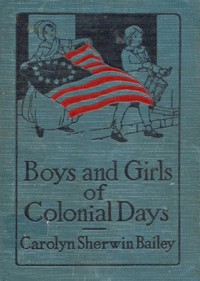
Boys and Girls of Colonial Days — Reading Notes

(8 User reviews)   2209
Bailey, Carolyn Sherwin, 1875-1961, Shriver, Uldene [Illustrator] Project Gutenberg 2012
Children's stories; Patriotism -- Juvenile fiction; Colonists -- Juvenile fiction; United States -- History -- Colonial period, ca. 1600-1775 -- Juvenile fiction; Children -- United States -- Juvenile fiction Readers of public-domain and historical texts
Project Gutenberg digital edition en

Edition facts

Words: 33,880
Reading time: 148 min
Text sections: 4
This editorial note examines the narrative voice and pacing in Carolyn Sherwin Bailey's collection of colonial-era stories, focusing on how the author shifts between domestic detail and historical incident to create varied rhythms.
Share
Editorial Edition Score 4.6/5

Calculated from edition completeness, EPUB availability, text structure and catalogue metadata. Not a user rating.

Edition quality

Read the Text

e will keep his word. See, Love, see the little boy of your own age down there in the fishing boat.”

Love looked in the direction in which the woman pointed. A plump, rosy little boy with eyes as blue as Love’s own and dressed in full brown trousers and clumsy wooden shoes sat on a big net in one end of the boat. He looked up as the sails of the little fishing craft brought it alongside the boat that bore the wanderers from England. At first he dropped his eyes in shyness at sight of the little girl. Then he lifted them again and, as his eyes met hers, the two children smiled at each other. It was like a flash of sunshine piercing the gray haze that hung over the sea.

There were friends waiting on the shore for all save Love. Older brothers these were, fathers and other relatives who had made the pilgrimage from England a few months before and had homes ready for them all. They climbed a long hill, very flat on the top, and reached by a flight of steps. Then they were as high as the trees that lined the beach and could look over the narrow streets, the tidy cottages with their red roofs, and the pretty gardens. There were many little canals, like blue ribbons, cutting the green fields.

“Welcome to Amsterdam!” said a Dutch housewife, in wide white cap and apron, who met them. She put her hand on Love’s yellow hair. “And in which house are you going to live, little English blossom?” she asked kindly.

Love looked up wonderingly into her face and there was a whispered consultation between Mistress Brewster and the Amsterdam woman. “Poor little blossom! She shall come home with me. There is always room for one more in the stork’s nest,” the Dutch woman said kindly. She took Love’s hand and led her away from the others, and along the canal.

The house where they stopped was very odd indeed. It was made of red and yellow bricks and it stood on great posts sunk deep into the ground. Opening the white door that fairly shone, it was so clean, they were in the kitchen. Such a kitchen it was, so cosy and so quaint! The floor was made of white tiles and there was a queer little fireplace. It looked like a big brass pan filled with coals, and there was a shining copper kettle hung over it by a chain from the ceiling. The kettle bubbled and sang a cheerful welcome to Love. There were stiff white curtains at the windows and, on the sill of one, was a row of blossoming plants. Blue and white dishes and a pair of tall candlesticks stood on a shelf. Love could see a bright sitting room beyond and another room where there was a strange bed built in the wall, and stretching almost from the floor to the ceiling.

“Jan, Jan,” the woman called. “Come in from the garden and offer your new little English sister a seed cake. You may have one yourself, too. You have long wished for a playmate and here is one come to live in the house with you.”

The door opened slowly and in came Jan. He did not look up at first. Then his eyes caught Love’s. It was the little boy of the fishing boat. His dear mother it was who had offered to take care of lonely little Love.

“You may help me drive the dogs that draw the milk wagon,” Jan said to Love the next morning after they had become very well acquainted over their breakfast of milk and oatmeal cakes.

“And so I can help to earn money for your kind mother,” Love said with shining eyes.

Jan had two dogs and a little two-wheeled cart to which he harnessed them every morning. Into the cart his mother put two shining pails of milk and a long handled dipper for measuring. To-day she put in some round, white cheeses and golden balls of butter. Off started the cart along the narrow street with Love running gaily along one side and Jan clattering along in his wooden shoes on the other side. The dogs knew where to stop almost as well as Jan did for they had made the trip so many times. The cheese and butter were soon gone, and every one had a pleasant smile for the little English lass. At one cottage, a Dutch housewife brought out a strange, earth-colored bulb that she put in Love’s hands. Then, smiling down into the little girl’s wondering face, she said:

“It is a rare one indeed. I give it to you that you may plant it and tend it all winter. When the spring comes, you will have a finer one than any child in all Amsterdam.”

Love thanked the woman but she puzzled over the hard, dry bulb as she and Jan walked home beside the empty milk cart. “It looks like nothing but an onion. What good is it, Jan?”

Jan’s eyes twinkled. “I know, but I won’t tell,” he said. “I want you to be surprised next spring. Come, Love, we will plant it in the corner of the garden that the sun shines on first in the spring. Then we will wait.”

As Jan dug a hole and Love planted the bulb, his words repeated themselves in the little girl’s lonely heart. She remembered, too, what her dear father had said last to her, “Wait patiently until I come, Love.” Would her patience bring the hard bulb to life or her father back, Love wondered sorrowfully.

The days passed, with blue skies and the bright sun shining down upon the canal, and then grew shorter. The storks flew south, and Love was very happy. Her days with Jan were busy, merry ones. She, too, had wooden shoes now; and Jan’s mother had made her a warm red skirt and a velvet girdle and a little, green, quilted coat. Love looked like a real little Dutch girl as she skated to school, with her knitting in her school bag to busy her fingers with when it was recess time.

There was never any place in England, Love thought, so merry and gay as the frozen canal in front of her new home in Holland. Everybody was on skates; the market women with wooden yokes over their shoulders, from which hung baskets of vegetables; and even a mother skating and holding her baby in a snug nest made of a shawl on her back. The old doctor skated, with his pill bag on one arm, to see a sick patient at the other end of the town; and long rows of happy children glided by, holding each other’s coats and twisting and twining about like a gay ribbon.

“Are you not glad, Love, that you came here to Holland to be my sister?” Jan asked as, holding her hand in his, he skated with Love to school.

“I am glad, Jan,” Love laughed back. “I feel as if it were a story book that I am living in, and you and your dear mother and our house and the canal were the pictures in it. But, oh, Jan, I wish very much that I could see my father—so tall and brave and strong!” Then she stopped. “We must be hastening, Jan,” she said, “or we shall be late for school.” But to herself, Love was saying, “Be patient.”

Spring came early that year in Amsterdam. The ice melted and the canals were once more blue ribbons of water. The sails of the windmills whirred, and the housewives scrubbed their sidewalks until the stones were clean enough to eat from. The storks built again in the red chimneys and, everywhere, the tulips burst into bloom. Love had never seen such beautiful flowers in all her life. There was no garden in all Amsterdam so small or so poor as not to have a bed of bright red and yellow tulips.

With the first sunshine, Love went out to the garden where she and Jan had planted the ugly, hard bulb. How wonderful; her patience had been rewarded! There were two tall, straight green leaves and between them, like a wonderful cup upon its green stem, a great, beautiful tulip. It was larger than any of the others. It was not red or yellow like the others, but pink, like a rose, or a sunrise cloud, or a baby’s cheek.

“Come, Jan; come, mother,” cried Love, and then the three stood about the pink tulip in admiration.

“It is the most beautiful tulip in all Amsterdam,” said Jan.

“It is worth money,” said his mother. “Some one would pay a good price for the bulb.”

Love remembered what Jan’s mother had said. As the days passed and the pink tulip opened wider and showed a deeper tint each day, a plan began to form in the little girl’s mind. She knew that there was not very much money in Jan’s home to which she had been so kindly welcomed. She knew, too, that nothing was so dear to the people of Holland as their tulips. Strange tales were told; how they sold houses, cattle, land, everything to buy tulip bulbs.

One Saturday when Jan was away doing an errand for his mother, Love dug up her precious pink tulip and planted it carefully in a large flower pot. With the pot hugged close to her heart, she went swiftly away from the house, down the long steps, and as far as the road that led along the coast of the sea below the dike. Here, where great merchant ships from all over the world anchored almost every day, Love felt sure that some one would see her tulip and want to buy it.

There was such a crowd,—folk of many nations busy unloading cargoes,—that at first no one saw the little girl with the flower in her arms. Up and down the shore she walked, a little frightened but brave. She held the flower high, and called in her sweet voice, “A rare pink tulip. Who will buy my pink tulip?”

Intent on holding the flower carefully, she came suddenly in front of a man who had been walking in lonely fashion up and down the shore. She heard him call her name eagerly.

“Love! Love! Oh, my little Love!”

Looking up, Love almost dropped the tulip in her joy. Then she set it down and rushed into his arms.

“Father, dear father! Oh, where have you been so long?” she cried.

It was a story told between laughter and tears. Goodman Bradford, only a short time since released from prison, had come straight to Amsterdam, but he had been able to find no trace of Love. Mistress Brewster had gone on with the Pilgrims to America, and there was no one to tell Goodman Bradford where his little daughter was. Now, he could make a home for her and reward Jan’s mother.

“I was patient,” Love said, “as you bade me be, and see,” she cried as, hand in hand, they reached the quaint little cottage where Jan and his mother stood at the door to greet them, “in good time they both came to me—the pink tulip, and my father.”

BIG HAWK’S DECORATION

“See to it, Preserve, that you win a colored ribbon from the schoolmaster to-day,” Mistress Edwards said as she turned from her task of polishing the pewter platter to look at the boy who stood in the doorway of the log cabin.

“This is the day, I hear, on which the good-conduct ribbons are given out for the month, brightly dyed ones for the boys and girls whose lessons have been well learned, and black for the dunces. There is no chance of your coming home to me to-night without a ribbon of merit, is there?” The Colonial mother crossed the room and put her hands on her lad’s shoulder, looking anxiously into his honest brown eyes.

“No, mother,” Preserve answered. “At least I have hopes of winning a ribbon. Not once this month have I failed in my sums, and I can read my chapters in the Bible as well as any child in school.”

“That is good!” Mistress Edwards said, pulling the boy’s long, dark cloak more closely about him and smoothing the cloth of his tall hat.

Preserve Edwards was a Puritan lad of many years ago. The log cabin that he was leaving to walk two miles through the clearing and across the woods to school was but a rough home. A few straight chairs and a hard settle, made of logs and standing by the fireplace, a deal table and the few pewter utensils, were almost the only furnishings of the living room. In one corner stood an old musket. Mistress Edwards looked toward it now in fear.

“Do you come home as soon as school is out, Preserve. I pray you do not linger on the way to play hare and hounds with the other boys and girls of the village. Remember, my boy, that your father is away with the horse these two days to fetch back a piece of linsey-woolsey cloth and some flour from Boston for me. He is not likely to come home for some days yet, and I am full of strange dread at what I saw in the cornfield this morning.”

“What did you see, mother?” Preserve’s eyes opened wide with wonder.

“It was not so much what I saw, but what it portended for us,” Mistress Edwards said. “It was only a flash of color, like painted feathers, among the withered stalks of corn. It minded me of Big Hawk’s headdress. If he were to find out that we were alone, one helpless woman and a boy of twelve here, I think it would go badly with us.”

Preserve laughed bravely. Then he reached up to kiss his mother good-bye.

“It was no more than a red-winged blackbird that you saw,” he said, “or perhaps it was a bright tanager. The birds are getting ready to flock, now, for they feel the autumn chill in the air. But I will hurry home—with my ribbon,” Preserve added.

Then he ran down the little path to the gate in the paling that surrounded the cabin, his speller under his arm, and his high-heeled, buckled shoes making the dry leaves scatter as he went.

It was a long road and a lonely one to the log schoolhouse. Preserve took his way through the cornfield where the dried stalks, rattling in the cold wind, made him think of the songs that he had heard Big Hawk and his tribe sing the last time they attacked the little Colonial settlement. That had been some months since, now, and Preserve could find no traces of footprints or any other marks of Indians in the cornfield.

“My mother had a fear for nothing,” Preserve said to himself. He went through a bit of woods, next, and pulled a small square of bark from one of the many birch trees that stood there, so white and still. It was for Preserve to write his sums upon in school, and as he hurried on he repeated his tables over and over to be sure that he knew them well.

There were log cabins scattered here and there, and from these came other boys and girls who followed Preserve on the way to school. Deliverance Baxter joined Preserve. She wore a long, scant, gray frock, and her yellow hair was tucked tightly inside a close, white cap. A white kerchief was folded neatly around her neck, and she, also, wore big buckles on her black slippers. Her eyes twinkled roguishly, though, as she chatted to Preserve.

“There is no doubt at all, Preserve, but that you will wear home the long streamers of red ribbon on your cape this afternoon. I have been quite as perfect as you in my lessons for the month, but, woe is me, I did a great wrong yesterday. You know that Master Biddle, our schoolmaster, has just purchased a new wig from Boston town. The queue in the back is so unusually long and tied with such a large bow that it caught my eye when I was getting the pile of copy books from behind his desk. I know not, Preserve, what witchery was in my fingers, but I tied Master Biddle’s queue to his chair. When he stood up, why, his wig was greatly disarranged; and I must needs stay after school until dusk, sitting on the dunce’s stool. I am most sorry, and will never be so witch-like again. You see I stand small chance of the ribbon, now, Preserve.”

The boy laughed, but he took the little girl’s hand comfortingly in his. Reaching in his lunch bag, he took out a red apple and slipped it into the big pocket that hung at her side.

“You were always a bit roguish in spite of your Puritan dress and sober living, Deliverance,” he said. “Never mind about the ribbon. If I should win it, why, there is all the more chance of its being yours the next time. Here we are! See to it, Deliverance, that you tie no more queues to-day. Oh, see how finely Master Biddle is dressed for giving out the prizes!” Preserve said as they reached the schoolhouse door and took their places behind the rude desks, built of boards and resting on pegs in the floor.

Other children were quietly taking their places in the little schoolroom, the smaller ones perched on hard benches made of logs. They all looked in awe at the schoolmaster, who stood on a platform, facing them. He wore a smart velvet coat with long tails, and inside it could be seen a waist coat which was very long and a fine white shirt with stiffly-starched ruffles. His knee breeches were of velvet like his coat, and there were silver buckles at the knees as well as on his shoes. A stiffly-ironed stock was wound about his neck, and worn to keep his head stiff and straight as became the dignity of the times. Above all was his white powdered wig, neatly braided in the back.

Looking at Master Biddle alone was enough to make the children of the Colonies sit up very straight and recite their lessons as well as they could. There was a prayer first, and then the boys and girls recited their reading, spelling, and arithmetic. Their pencils were thick plummets of lead and their copy books were made of foolscap paper, sewed in the shape of books and carefully ruled by hand. At eleven o’clock came recess, and at the end of the afternoon the awarding of the good-conduct ribbons.

“For perfect deportment,” Master Biddle announced as he pinned a bow of blue ribbon to one boy’s cape.

“For poor lessons!” he said, sadly, as he fastened a black bow to another. Then he held up a red bow with especially long, streaming ends.

“For perfect deportment, and for perfect lessons,” he said, as he fastened the red ribbon bow to Preserve Edward’s cape.

To-day it would seem but a small prize, but in the eyes of these Puritan boys and girls of so many years ago, the bow of ribbon, its streamers of red gayly flying over the long cape of a boy or the dull linsey-woolsey frock of a little girl, was a mark of great honor indeed. Ribbons were scarce and high in price in those days. Colors for children were almost forbidden, and for their elders as well. So Preserve walked out of the school door at the end of the day with his head very high and started home as proudly as any soldier wearing a decoration for bravery.

He did not notice how the dusk was settling down all about him. The trees on either side, made dark shadows and there was no sound except the whir of a partridge’s wing or the rattle of a falling nut. He did not hear the soft footfall behind him until Deliverance, breathless and her face white with fear, was upon him. She laid a soft hand on his shoulder and whispered in his ear:

“I beg you, Preserve, to let me walk with you. I know that it is not far to my cabin, but all the way through these woods I have heard strange sounds and I fancy, even now, that I see shapes behind the trees and bushes.”

Carolyn Sherwin Bailey's Boys and Girls of Colonial Days opens not with a declaration of historical importance but with a child's sensory experience: Love Bradford, flaxen-haired and weary, peers over a boat rail at Amsterdam's windmills and storks. This immediate grounding in a specific, tangible detail—the storks standing "in one-legged fashion"—establishes a narrative voice that privileges the child's perspective over adult exposition. The prose moves in short, image-driven clauses, a pattern that recurs throughout the collection. Bailey often slows the pace to dwell on domestic crafts—soap making, sampler stitching, copper forging—before accelerating into moments of political tension, such as a tea party or a soldier's enlistment. These shifts in tempo are not arbitrary; they mirror the way colonial children might have experienced history: as interruptions to daily routine.

The Child's Eye as Narrative Filter

Bailey consistently filters events through a child's limited but acute awareness. In "The Pink Tulip," Love Bradford's observation of Amsterdam is rendered through what she can see from the boat: "tall, shining towers, gold church spires, pointed roofs with wide, red chimneys where the storks stood." The description is catalog-like, mimicking a child's habit of listing what catches the eye. The narrator does not explain the Pilgrims' religious motives or the political significance of their journey; instead, the text stays close to Love's physical sensations—the gray cloak, the weary eyes. This technique recurs in "The Deacon's Grasshopper," where the children's curiosity about the coppersmith's hidden creations drives the narrative. The adult world of commerce and craftsmanship is secondary to the children's wonder at a "little brass rooster" or a "copper grasshopper." By limiting the narrative to what the children perceive, Bailey creates a voice that is intimate and immediate, though occasionally at the cost of broader historical context.

Pacing Through Domestic Interiors

The collection's rhythm is often set by the slow, repetitive work of colonial households. In the soap-making episode, the text lingers on the process: the kettle that "bubbled and sang a cheerful welcome," the careful measuring of fats and lye. Bailey uses such scenes to create a sense of cyclical time, where daily chores anchor the narrative. The prose becomes almost ritualistic, with short sentences that mimic the step-by-step nature of the task. This domestic pace contrasts sharply with the sudden acceleration when historical events intrude. For instance, in "A Boston Tea Party," the measured description of tea preparation gives way to decisive action: "Susan deliberately tipped her cup, throwing the tea, untasted, on the grass." The shift is abrupt, mirroring how political defiance might have felt to a child—a break in routine. Bailey does not always signal these transitions; the reader must adjust to the changing tempo, which can be disorienting but effective in conveying the unpredictability of colonial life.

Dialogue as a Tool for Character and Tempo

Bailey uses dialogue to vary pace and reveal character without heavy narration. In "The Deacon's Grasshopper," the children's questions—"What will you do with it, Deacon Drowne?"—are short and direct, while the Deacon's replies are thoughtful and slightly melancholic: "Perhaps it has no use." The exchange slows the scene, allowing the reader to dwell on the grasshopper's fate. Elsewhere, dialogue accelerates tension. In "Dick, the Youngest Soldier," clipped commands and urgent questions quicken the pulse. The speech patterns are era-appropriate but not archaic; Bailey favors clarity over period authenticity. Notably, the children often speak with a formality that suggests adult influence, yet their concerns remain childlike—wondering about a hidden toy, worrying about a parent's return. This blend of adult diction and juvenile preoccupation creates a distinctive narrative voice that is neither fully naive nor fully knowing. The dialogue thus serves a dual purpose: it advances the plot and modulates the reading experience, alternating between leisurely exchange and brisk confrontation.

Readers attentive to narrative rhythm will find that Bailey's collection rewards a careful, unhurried approach. The shifts between domestic stillness and historical action are not flaws but deliberate choices that reflect the texture of colonial childhood. Rather than skimming for plot, consider how the author uses sensory detail and dialogue to create a world where the extraordinary emerges from the ordinary. The stories are best read as vignettes of daily life punctuated by moments of change, much like the historical period they depict.

There's a particular rhythm in those colonial tales, the way Bailey lets quiet, domestic moments breathe before a historical event interrupts them. It reminds me of how Edith and Her Ayah, and Other Stories — A Closer Reading lingers on small gestures. Sometimes pacing is just the echo of a life lived between rooms and larger forces. I find myself still thinking about that.

Anthony Mitchell
1 week ago

Michael Gonzalez
3 weeks ago

Olivia Lee
2 weeks ago

Avery Lopez
3 weeks ago

William Campbell
4 weeks ago

5
5 out of 5 (8 User reviews )

Add a Review

Your Rating *
There are no comments for this eBook.

Reader reflection

What did you think of this book?

Answer a few questions and save a private reflection on this device.

Your progress 0 / 10
1

Where are you in your reading?

2

Did this book hold your interest?

3

How likely are you to recommend this book?

4

What was the reading difficulty like?

Related eBooks