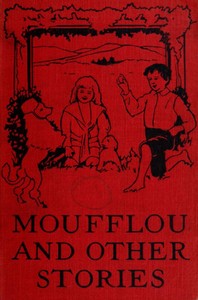
Moufflou, and other stories — Themes and Context

(11 User reviews)   1655
Ouida, 1839-1908, Garrett, Edmund H. (Edmund Henry), 1853-1929 [Illustrator], Kirk, Maria Louise, 1860-1938 [Illustrator] Project Gutenberg 2025
Dogs -- Juvenile fiction; Children's stories, English -- 19th century; Conduct of life -- Juvenile fiction; Pride and vanity -- Juvenile fiction; Pigments -- Juvenile fiction; Roses -- Juvenile fiction Readers of public-domain and historical texts
Project Gutenberg digital edition en

Edition facts

Words: 19,330
Reading time: 85 min
Text sections: 8
In four animal tales, Ouida contrasts pride and humility through a clever poodle, a scorned pigment, a vain rose, and a loyal dog, using vivid studio and garden settings.
Share
Editorial Edition Score 4.6/5

Calculated from edition completeness, EPUB availability, text structure and catalogue metadata. Not a user rating.

Edition quality

Read the Text

idst of his weeping brothers and sisters, with his mother leaning against his shoulder, and down his own brown cheeks the tears were falling. He must go, and lose his place in the public gardens, and leave his people to starve as they might, and be put in a tomfool’s jacket, and drafted off among cursing and swearing and strange faces, friendless, homeless, miserable! And the mother,--what would become of the mother?

Tasso was the best of lads and the mildest. He was quite happy sweeping up the leaves in the long alleys of the Cascine, or mowing the green lawns under the ilex avenues, and coming home at supper-time among the merry little people and the good woman that he loved. He was quite contented; he wanted nothing, only to be let alone; and they would not let him alone. They would haul him away to put a heavy musket in his hand and a heavy knapsack on his back, and drill him, and curse him, and make him into a human target, a live popinjay.

No one had any heed for Lolo and his five francs, and Moufflou, understanding that some great sorrow had fallen on his friends, sat down and lifted up his voice and howled.

Tasso must go away!--that was all they understood. For three long years they must go without the sight of his face, the aid of his strength, the pleasure of his smile: Tasso must go! When Lolo understood the calamity that had befallen them, he gathered Moufflou up against his breast, and sat down, too, on the floor beside him and cried as if he would never stop crying.

There was no help for it: it was one of those misfortunes which are, as we say in Italian, like a tile tumbled on the head. The tile drops from a height, and the poor head bows under the unseen blow. That is all.

“What is the use of that?” said the mother, passionately, when Lolo showed her his five francs. “It will not buy Tasso’s discharge.”

Lolo felt that his mother was cruel and unjust, and crept to bed with Moufflou. Moufflou always slept on Lolo’s feet.

The next morning Lolo got up before sunrise, and he and Moufflou accompanied Tasso to his work in the Cascine.

Lolo loved his brother, and clung to every moment whilst they could still be together.

“Can nothing keep you, Tasso?” he said, despairingly, as they went down the leafy aisles, whilst the Arno water was growing golden as the sun rose.

“Nothing, dear. Unless Gesú would send me a thousand francs to buy a substitute.”

And he knew he might as well have said, “If one could coin gold ducats out of the sunbeams on Arno water.”

Lolo was very sorrowful as he lay on the grass in the meadow where Tasso was at work, and the poodle lay stretched beside him.

When Lolo went home to dinner (Tasso took his wrapped in a handkerchief) he found his mother very agitated and excited. She was laughing one moment, crying the next. She was passionate and peevish, tender and jocose by turns; there was something forced and feverish about her which the children felt but did not comprehend. She was a woman of not very much intelligence, and she had a secret, and she carried it ill, and knew not what to do with it; but they could not tell that. They only felt a vague sense of disturbance and timidity at her unwonted manner.

The meal over (it was only bean-soup, and that is soon eaten), the mother said sharply to Lolo, “Your aunt Anita wants you this afternoon. She has to go out, and you are needed to stay with the children: be off with you.”

Lolo was an obedient child; he took his hat and jumped up as quickly as his halting hip would let him. He called Moufflou, who was asleep.

“Leave the dog,” said his mother, sharply. “’Nita will not have him messing and carrying mud about her nice clean rooms. She told me so. Leave him, I say.”

“Leave Moufflou!” echoed Lolo, for never in all Moufflou’s life had Lolo parted from him. Leave Moufflou! He stared open-eyed and open-mouthed at his mother. What could have come to her?

“Leave him, I say,” she repeated, more sharply than ever. “Must I speak twice to my own children? Be off with you, and leave the dog, I say.”

And she clutched Moufflou by his long silky mane and dragged him backwards, whilst with the other hand she thrust out of the door Lolo and Bice.

Lolo began to hammer with his crutch at the door thus closed on him; but Bice coaxed and entreated him.

“Poor mother has been so worried about Tasso,” she pleaded. “And what harm can come to Moufflou? And I do think he was tired, Lolo; the Cascine is a long way; and it is quite true that Aunt ’Nita never liked him.”

So by one means and another she coaxed her brother away; and they went almost in silence to where their aunt Anita dwelt, which was across the river, near the dark-red bell-shaped dome of Santa Spirito.

It was true that her aunt had wanted them to mind her room and her babies whilst she was away carrying home some lace to a villa outside the Roman gate, for she was a lace-washer and clear-starcher by trade. There they had to stay in the little dark room with the two babies, with nothing to amuse the time except the clang of the bells of the church of the Holy Spirit, and the voices of the lemonade-sellers shouting in the street below. Aunt Anita did not get back till it was more than dusk, and the two children trotted homeward hand in hand, Lolo’s leg dragging itself painfully along, for without Moufflou’s white figure dancing on before him he felt very tired indeed. It was pitch dark when they got to Or San Michele, and the lamps burned dully.

Lolo stumped up the stairs wearily, with a vague, dull fear at his small heart.

“Moufflou, Moufflou!” he called. Where was Moufflou? Always at the first sound of his crutch the poodle came flying towards him. “Moufflou, Moufflou!” he called all the way up the long, dark twisting stone stair. He pushed open the door, and he called again, “Moufflou, Moufflou!”

But no dog answered to his call.

“Mother, where is Moufflou?” he asked, staring with blinking, dazzled eyes into the oil-lit room where his mother sat knitting. Tasso was not then home from work. His mother went on with her knitting; there was an uneasy look on her face.

“Mother, what have you done with Moufflou, _my_ Moufflou?” said Lolo, with a look that was almost stern on his ten-year-old face.

Then his mother, without looking up and moving her knitting-needles very rapidly, said,--

And little Dina, who was a quick, pert child, cried, with a shrill voice,--

“Mother has sold him for a thousand francs to the foreign gentleman.”

Lolo grew white and grew cold as ice; he stammered, threw up his hands over his head, gasped a little for breath, then fell down in a dead swoon, his poor useless limb doubled under him.

When Tasso came home that sad night and found his little brother shivering, moaning, and half delirious, and when he heard what had been done, he was sorely grieved.

“Oh, mother, how could you do it?” he cried. “Poor, poor Moufflou! and Lolo loves him so!”

“I have got the money,” said his mother, feverishly, “and you will not need to go for a soldier: we can buy your substitute. What is a poodle, that you mourn about it? We can get another poodle for Lolo.”

“Another will not be Moufflou,” said Tasso, and yet was seized with such a frantic happiness himself at the knowledge that he would not need go to the army, that he, too, felt as if he were drunk on new wine, and had not the heart to rebuke his mother.

“A thousand francs!” he muttered; “a thousand francs! _Dio mio!_ Who could ever have fancied anybody would have given such a price for a common white poodle? One would think the gentleman had bought the church and the tabernacle!”

“Fools and their money are soon parted,” said his mother, with cross contempt.

It was true: she had sold Moufflou.

The English gentleman had called on her while Lolo and the dog had been in the Cascine, and had said that he was desirous of buying the poodle, which had so diverted his sick child that the little invalid would not be comforted unless he possessed it. Now, at any other time the good woman would have sturdily refused any idea of selling Moufflou; but that morning the thousand francs which would buy Tasso’s substitute were forever in her mind and before her eyes. When she heard the foreigner her heart gave a great leap, and her head swam giddily, and she thought, in a spasm of longing--if she could get those thousand francs! But though she was so dizzy and so upset she retained her grip on her native Florentine shrewdness. She said nothing of her need of the money; not a syllable of her sore distress. On the contrary, she was coy and wary, affected great reluctance to part with her pet, invented a great offer made for him by a director of a circus, and finally let fall a hint that less than a thousand francs she could never take for poor Moufflou.

The gentleman assented with so much willingness to the price that she instantly regretted not having asked double. He told her that if she would take the poodle that afternoon to his hotel the money should be paid to her; so she despatched her children after their noonday meal in various directions, and herself took Moufflou to his doom. She could not believe her senses when ten hundred-franc notes were put into her hand. She scrawled her signature, Rosina Calabucci, to a formal receipt, and went away, leaving Moufflou in his new owner’s rooms, and hearing his howls and moans pursue her all the way down the staircase and out into the air.

She was not easy at what she had done.

“It seemed,” she said to herself, “like selling a Christian.”

But then to keep her eldest son at home--what a joy that was! On the whole, she cried so and laughed so as she went down the Lung’ Arno that once or twice people looked at her, thinking her out of her senses, and a guard spoke to her angrily.

Meanwhile, Lolo was sick and delirious with grief. Twenty times he got out of his bed and screamed to be allowed to go with Moufflou, and twenty times his mother and his brothers put him back again and held him down and tried in vain to quiet him.

The child was beside himself with misery. “Moufflou! Moufflou!” he sobbed at every moment; and by night he was in a raging fever, and when his mother, frightened, ran in and called in the doctor of the quarter, that worthy shook his head and said something as to a shock of the nervous system, and muttered a long word--“meningitis.”

Lolo took a hatred to the sight of Tasso, and thrust him away, and his mother, too.

“It is for you Moufflou is sold,” he said, with his little teeth and hands tight clinched.

After a day or two Tasso felt as if he could not bear his life, and went down to the hotel to see if the foreign gentleman would allow him to have Moufflou back for half an hour to quiet his little brother by a sight of him. But at the hotel he was told that the _Milord Inglese_ who had bought the dog of Rosina Calabucci had gone that same night of the purchase to Rome, to Naples, to Palermo, _chi sa_?

“And Moufflou with him?” asked Tasso.

“The _barbone_ he had bought went with him,” said the porter of the hotel. “Such a beast! Howling, shrieking, raging all the day, and all the paint scratched off the _salon_ door.”

Poor Moufflou! Tasso’s heart was heavy as he heard of that sad helpless misery of their bartered favorite and friend.

“What matter?” said his mother, fiercely, when he told her. “A dog is a dog. They will feed him better than we could. In a week he will have forgotten--_chè_!”

But Tasso feared that Moufflou would not forget. Lolo certainly would not. The doctor came to the bedside twice a day, and ice and water were kept on the aching hot little head that had got the malady with the long name, and for the chief part of the time Lolo lay quiet, dull, and stupid, breathing heavily, and then at intervals cried and sobbed and shrieked hysterically for Moufflou.

“Can you not get what he calls for to quiet him with a sight of it?” said the doctor. But that was not possible, and poor Rosina covered her head with her apron and felt a guilty creature.

“Still, you will not go to the army,” she said to Tasso, clinging to that immense joy for her consolation. “Only think! we can pay Guido Squarcione to go for you. He always said he would go if anybody would pay him. Oh, my Tasso, surely to keep you is worth a dog’s life!”

“And Lolo’s?” said Tasso, gloomily. “Nay, mother, it works ill to meddle too much with fate. I drew my number; I was bound to go. Heaven would have made it up to you somehow.”

“Heaven sent me the foreigner; the Madonna’s own self sent him to ease a mother’s pain,” said Rosina, rapidly and angrily. “There are the thousand francs safe to hand in the _cassone_, and what, pray, is it we miss? Only a dog like a sheep, that brought gallons of mud in with him every time it rained, and ate as much as any one of you.”

“But Lolo?” said Tasso, under his breath.

His mother was so irritated and so tormented by her own conscience that she upset all the cabbage broth into the burning charcoal.

“Lolo was always a little fool, thinking of nothing but the church and the dog and nasty field-flowers,” she said, angrily. “I humored him ever too much because of the hurt to his hip, and so--and so----”

Then the poor soul made matters worse by dropping her tears into the saucepan, and fanning the charcoal so furiously that the flame caught her fan of cane-leaves, and would have burned her arm had not Tasso been there.

“You are my prop and safety always. Who would not have done what I did? Not Santa Felicita herself,” she said, with a great sob.

But all this did not cure poor Lolo.

The days and the weeks of the golden autumn weather passed away, and he was always in danger, and the small close room where he slept with Sandro and Beppo and Tasso was not one to cure such an illness as had now beset him. Tasso went to his work with a sick heart in the Cascine, where the colchicum was all lilac among the meadow grass, and the ashes and elms were taking their first flush of the coming autumnal change. He did not think Lolo would ever get well, and the good lad felt as if he had been the murderer of his little brother.

True, he had had no hand or voice in the sale of Moufflou, but Moufflou had been sold for his sake. It made him feel half guilty, very unhappy, quite unworthy of all the sacrifice that had been made for him. “Nobody should meddle with fate,” thought Tasso, who knew his grandfather had died in San Bonifazio because he had driven himself mad over the dream-book trying to get lucky numbers for the lottery and become a rich man at a stroke.

It was rapture, indeed, to know that he was free of the army for a time at least, that he might go on undisturbed at his healthful labor, and get a raise in wages as time went on, and dwell in peace with his family, and perhaps--perhaps in time earn enough to marry pretty flaxen-haired Biondina, the daughter of the barber in the piazzetta. It was rapture indeed; but then poor Moufflou!--and poor, poor Lolo! Tasso felt as if he had bought his own exemption by seeing his little brother and the good dog torn in pieces and buried alive for his service.

And where was poor Moufflou?

Gone far away somewhere south in the hurrying, screeching, vomiting, braying train that it made Tasso giddy only to look at as it rushed by the green meadows beyond the Cascine on its way to the sea.

“If he could see the dog he cries so for, it might save him,” said the doctor, who stood with a grave face watching Lolo.

But that was beyond any one’s power. No one could tell where Moufflou was. He might be carried away to England, to France, to Russia, to America--who could say? They did not know where his purchaser had gone. Moufflou even might be dead.

The poor mother, when the doctor said that, went and looked at the ten hundred-franc notes that were once like angels’ faces to her, and said to them,--

“Oh, you children of Satan, why did you tempt me? I sold the poor, innocent, trustful beast to get you, and now my child is dying!”

Her eldest son would stay at home, indeed; but if this little lame one died! Rosina Calabucci would have given up the notes and consented never to own five francs in her life if only she could have gone back over the time and kept Moufflou, and seen his little master running out with him into the sunshine.

More than a month went by, and Lolo lay in the same state, his yellow hair shorn, his eyes dilated and yet stupid, life kept in him by a spoonful of milk, a lump of ice, a drink of lemon-water; always muttering, when he spoke at all. “Moufflou, Moufflou, _dov’ è_ Moufflou?” and lying for days together in somnolence and unconsciousness, with the fire eating at his brain and the weight lying on it like a stone.

The neighbors were kind, and brought fruit and the like, and sat up with him, and chattered so all at once in one continuous brawl that they were enough in themselves to kill him, for such is ever the Italian fashion of sympathy in all illness.

But Lolo did not get well, did not even seem to see the light at all, or to distinguish any sounds around him; and the doctor in plain words told Rosina Calabucci that her little boy must die. Die, and the church so near? She could not believe it. Could St. Mark, and St. George, and the rest that he had loved so do nothing for him? No, said the doctor, they could do nothing; the dog might do something, since the brain had so fastened on that one idea; but then they had sold the dog.

“Yes; I sold him!” said the poor mother, breaking into floods of remorseful tears.

So at last the end drew so nigh that one twilight time the priest came out of the great arched door that is next St. Mark, with the Host uplifted, and a little acolyte ringing the bell before it, and passed across the piazzetta, and went up the dark staircase of Rosina’s dwelling, and passed through the weeping, terrified children, and went to the bedside of Lolo.

Lolo was unconscious, but the holy man touched his little body and limbs with the sacred oil, and prayed over him, and then stood sorrowful with bowed head.

Lolo had had his first communion in the summer, and in his preparation for it had shown an intelligence and devoutness that had won the priest’s gentle heart.

Standing there, the holy man commended the innocent soul to God. It was the last service to be rendered to him save that very last of all when the funeral office should be read above his little grave among the millions of nameless dead at the sepulchres of the poor at Trebbiano.

All was still as the priest’s voice ceased; only the sobs of the mother and of the children broke the stillness as they kneeled; the hand of Biondina had stolen into Tasso’s.

Ouida’s collection opens with a poodle named Moufflou, whose cleverness is established through a series of small, precise actions: he fetches, carries, and performs tricks for the poor but merry children who own him. The narrative voice shifts between affectionate observation and a wry, almost theatrical sympathy for its animal and object protagonists. In the second story, the reader enters a painter’s studio where colors in tubes gossip like courtiers, and Lampblack—a neglected pigment—longs for purpose. The stories share a structure that moves from humble beginnings to a moment of transformation or recognition, often through a reversal of fortune. Recurring images of dust, cobwebs, and confinement give way to light, color, and movement, as when Lampblack is finally taken up by the master’s hand.

From Studio to Garden: The Movement of Scenes

The collection’s settings shift between enclosed, domestic spaces and open, natural ones. Moufflou’s story begins in a “dark, tumble-down place” and moves to the garden where Tasso works. The second story is confined almost entirely to a painter’s studio, with its shelves of pigments and brushes, until Lampblack is carried outside to become a signpost. The third story, about a rose, likely unfolds in a garden, while the final tale returns to a more expansive landscape. This alternation between interior and exterior mirrors the characters’ inner journeys: from obscurity or confinement to visibility and purpose. The studio, with its “flood of light” when the master enters, becomes a stage for transformation, while the garden offers both freedom and exposure to the elements.

Recurring Images: Dust, Cobwebs, and Light

Ouida uses a consistent set of images to mark a character’s low point and subsequent elevation. Lampblack lies under “spiders’ webs” and is “growing as gray as an old bottle” before the master finds him. The spiders, “not companionable creatures,” retreat when the master arrives. Light is a recurring signal of change: the studio door opens to “a flood of light,” and the master’s step makes the colors’ hearts “jump for joy.” In Moufflou’s tale, the children’s poverty is described through darkness and decay, but their merriment provides a kind of inner light. These images create a visual shorthand for neglect versus care, and they tie the stories together across different subjects—dog, pigment, rose, and dog again.

Voice and Perspective: Sympathy for the Overlooked

Ouida grants interiority to a pigment, a palette-knife, and a poodle, using free indirect discourse to convey their hopes and disappointments. Lampblack “could not believe his senses” when the master picks him up, and he dreams of “all the scenes he would be in.” The colors mock him with the name “Deposit,” a word he finds hurtful because it is “unintelligible.” This focus on the misunderstood or overlooked extends to the children in the first story, who are poor but “very merry.” The narrator’s tone is often gently ironic, as when the colors’ “little tin helmets” shake with laughter. By centering characters who are usually marginal—a crippled boy, a discarded pigment, a signpost—Ouida invites readers to reconsider what is valuable.

Structure: The Arc of Humiliation and Redemption

Each story follows a similar arc: a character is undervalued or scorned, experiences a moment of despair, and then is unexpectedly elevated or given purpose. Moufflou, though clever, is owned by poor children; Lampblack is mocked as “Old Deposit”; the rose is likely proud and isolated. The turning point often involves a master or authority figure who recognizes worth. For Lampblack, the master’s words—“You will do for this work”—transform his status, even if the work is a mere signpost. The word “BANDITA” becomes a kind of crucifixion, but also a role. This pattern suggests a moral about humility and service, but Ouida undercuts sentimentality with sharp details: the spiders chuckle, the colors titter. The endings are not uniformly happy; they are ironic or ambiguous, leaving room for the reader to judge.

Readers attentive to the interplay of voice and image will find that Ouida’s stories reward close attention to small details—the way a dog’s trick is described, or the exact shade of a pigment’s envy. The collection’s brevity (eight sections, under 20,000 words) makes it possible to trace these patterns across all four tales in a single sitting. Consider how the opening story’s emphasis on cleverness and poverty sets up expectations that the later stories complicate, especially when the point of view shifts from a dog to a tube of paint.

Sometimes a story stays because it asks something gentle of us, like Moufflou and its quiet contrast between showing off and simply being loyal. That same tender unease lingered with me after The Story of Little Black Sambo, and The Story of Little Black Mingo — Story, Setting & Ideas—the way courage folds into grace, without ever raising its voice. I think of them both on gray afternoons.

Ava Anderson
3 weeks ago

Jack Garcia
3 weeks ago

Madison Williams
2 weeks ago

Owen Wright
1 week ago

Olivia Jones
1 month ago

5
5 out of 5 (11 User reviews )

Add a Review

Your Rating *
  • ...
    Deanna Burton - 4 weeks ago
    Moufflou And Other Stories is a delightful collection of tales that are perfect for children and adults alike. Each story is beautifully written with rich, imaginative scenes and memorable characters. The themes are timeless and the gentle humor adds charm. It's a wonderful book to read aloud or enjoy quietly. I was thoroughly enchanted!

  • ...
    Christina Luna - 2 weeks ago
    Moufflou And Other Stories didn't resonate with me. The narratives are overly sentimental and lack the originality needed to stand out. The writing is dated, and the stories feel predictable. While it may have historical value, it doesn't offer enough entertainment or substance for contemporary readers. I found it quite dull.

  • ...
    Marcus Wong - 1 week ago
    Moufflou And Other Stories is a pleasant read with some enchanting moments. The stories are well-crafted and the language is poetic. However, some tales feel longer than necessary, and the pacing can drag. Overall, it's a good book for fans of classic children's literature, but it might not appeal to modern tastes.


Reader reflection

What did you think of this book?

Answer a few questions and save a private reflection on this device.

Your progress 0 / 10
1

What is your current status with this title?

2

How did the book work for you overall?

3

How likely are you to recommend this book?

4

What was the reading difficulty like?

Related eBooks