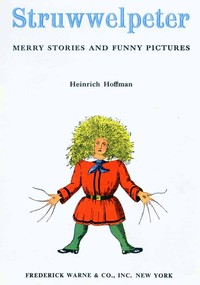
Struwwelpeter: Merry Stories and Funny Pictures — Context and Discussion
Edition facts
Calculated from edition completeness, EPUB availability, text structure and catalogue metadata. Not a user rating.
Read the Text
And was too pleased to put it out.
The Pussy-cats saw this And said: "Oh, naughty, naughty Miss!" And stretched their claws, And raised their paws: "'Tis very, very wrong, you know, Me-ow, me-o, me-ow, me-o, You will be burnt, if you do so."
And see! oh, what dreadful thing! The fire has caught her apron-string; Her apron burns, her arms, her hair-- She burns all over everywhere.
Then how the pussy-cats did mew-- What else, poor pussies, could they do? They screamed for help, 'twas all in vain! So then they said: "We'll scream again; Make haste, make haste, me-ow, me-o, She'll burn to death; we told her so."
So she was burnt, with all her clothes, And arms, and hands, and eyes, and nose; Till she had nothing more to lose Except her little scarlet shoes; And nothing else but these was found Among her ashes on the ground.
And when the good cats sat beside The smoking ashes, how they cried! "Me-ow, me-oo, me-ow, me-oo, What will Mamma and Nursey do?" Their tears ran down their cheeks so fast, They made a little pond at last.
The Story of the Inky Boys
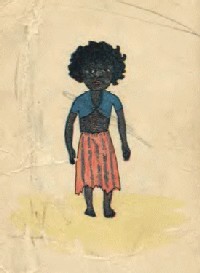
As he had often done before, The woolly-headed Black-a-moor One nice fine summer's day went out To see the shops, and walk about; And, as he found it hot, poor fellow, He took with him his green umbrella, Then Edward, little noisy wag, Ran out and laughed, and waved his flag; And William came in jacket trim, And brought his wooden hoop with him; And Arthur, too, snatched up his toys And joined the other naughty boys. So, one and all set up a roar, And laughed and hooted more and more, And kept on singing,--only think!-- "Oh, Blacky, you're as black as ink!"
Now tall Agrippa lived close by-- So tall, he almost touched the sky; He had a mighty inkstand, too, In which a great goose-feather grew; He called out in an angry tone "Boys, leave the Black-a-moor alone! For, if he tries with all his might, He cannot change from black to white." But, ah! they did not mind a bit What great Agrippa said of it; But went on laughing, as before, And hooting at the Black-a-moor.
Then great Agrippa foams with rage-- Look at him on this very page! He seizes Arthur, seizes Ned, Takes William by his little head;
And they may scream and kick and call, Into the ink he dips them all; Into the inkstand, one, two, three, Till they are black as black can be; Turn over now, and you shall see.
See, there they are, and there they run! The Black-a-moor enjoys the fun. They have been made as black as crows, Quite black all over, eyes and nose, And legs, and arms, and heads, and toes, And trousers, pinafores, and toys-- The silly little inky boys! Because they set up such a roar, And teased the harmless Black-a-moor.
The Story of the Man that went out Shooting
This is the man that shoots the hares; This is the coat he always wears: With game-bag, powder-horn, and gun He's going out to have some fun.
He finds it hard, without a pair Of spectacles, to shoot the hare. The hare sits snug in leaves and grass, And laughs to see the green man pass.
Now, as the sun grew very hot, And he a heavy gun had got, He lay down underneath a tree And went to sleep, as you may see. And, while he slept like any top, The little hare came, hop, hop, hop, Took gun and spectacles, and then On her hind legs went off again.
The green man wakes and sees her place The spectacles upon her face; And now she's trying all she can To shoot the sleepy, green-coat man. He cries and screams and runs away; The hare runs after him all day And hears him call out everywhere: "Help! Fire! Help! The Hare! The Hare!"
At last he stumbled at the well, Head over ears, and in he fell. The hare stopped short, took aim and, hark! Bang went the gun--she missed her mark!
The poor man's wife was drinking up Her coffee in her coffee-cup; The gun shot cup and saucer through; "Oh dear!" cried she; "what shall I do?" There lived close by the cottage there The hare's own child, the little hare; And while she stood upon her toes, The coffee fell and burned her nose. "Oh dear!" she cried, with spoon in hand, "Such fun I do not understand."
The Story of Little Suck-a-Thumb
One day Mamma said "Conrad dear, I must go out and leave you here. But mind now, Conrad, what I say, Don't suck your thumb while I'm away. The great tall tailor always comes To little boys who suck their thumbs; And ere they dream what he's about, He takes his great sharp scissors out, And cuts their thumbs clean off--and then, You know, they never grow again."
Mamma had scarcely turned her back, The thumb was in, Alack! Alack!
The door flew open, in he ran, The great, long, red-legged scissor-man. Oh! children, see! the tailor's come And caught out little Suck-a-Thumb. Snip! Snap! Snip! the scissors go; And Conrad cries out "Oh! Oh! Oh!" Snip! Snap! Snip! They go so fast, That both his thumbs are off at last.
Mamma comes home: there Conrad stands, And looks quite sad, and shows his hands; "Ah!" said Mamma, "I knew he'd come To naughty little Suck-a-Thumb."
The Story of Augustus who would not have any Soup
Augustus was a chubby lad; Fat ruddy cheeks Augustus had: And everybody saw with joy The plump and hearty, healthy boy. He ate and drank as he was told, And never let his soup get cold. But one day, one cold winter's day, He screamed out "Take the soup away! O take the nasty soup away! I won't have any soup today."
Next day, now look, the picture shows How lank and lean Augustus grows! Yet, though he feels so weak and ill, The naughty fellow cries out still "Not any soup for me, I say: O take the nasty soup away! I _won't_ have any soup today."
The third day comes: Oh what a sin! To make himself so pale and thin. Yet, when the soup is put on table, He screams, as loud as he is able, "Not any soup for me, I say: O take the nasty soup away! I WON'T have any soup today."
Look at him, now the fourth day's come! He scarcely weighs a sugar-plum; He's like a little bit of thread, And, on the fifth day, he was--dead!
The Story of Fidgety Philip
"Let me see if Philip can Be a little gentleman; Let me see if he is able To sit still for once at table": Thus Papa bade Phil behave; And Mamma looked very grave. But fidgety Phil, He won't sit still; He wriggles, And giggles, And then, I declare, Swings backwards and forwards, And tilts up his chair, Just like any rocking horse-- "Philip! I am getting cross!"
See the naughty, restless child Growing still more rude and wild, Till his chair falls over quite. Philip screams with all his might, Catches at the cloth, but then That makes matters worse again. Down upon the ground they fall, Glasses, plates, knives, forks, and all. How Mamma did fret and frown, When she saw them tumbling down! And Papa made such a face! Philip is in sad disgrace.
Where is Philip, where is he? Fairly covered up you see! Cloth and all are lying on him; He has pulled down all upon him. What a terrible to-do! Dishes, glasses, snapt in two! Here a knife, and there a fork! Philip, this is cruel work. Table all so bare, and ah! Poor Papa, and poor Mamma Look quite cross, and wonder how They shall have their dinner now.
The Story of Johnny Head-in-Air
As he trudged along to school, It was always Johnny's rule To be looking at the sky And the clouds that floated by; But what just before him lay, In his way, Johnny never thought about; So that every one cried out "Look at little Johnny there, Little Johnny Head-In-Air!"
Running just in Johnny's way Came a little dog one day; Johnny's eyes were still astray Up on high, In the sky; And he never heard them cry "Johnny, mind, the dog is nigh!" Bump! Dump! Down they fell, with such a thump, Dog and Johnny in a lump!
Once, with head as high as ever, Johnny walked beside the river. Johnny watched the swallows trying Which was cleverest at flying. Oh! what fun! Johnny watched the bright round sun Going in and coming out; This was all he thought about. So he strode on, only think! To the river's very brink, Where the bank was high and steep, And the water very deep; And the fishes, in a row, Stared to see him coming so.
One step more! oh! sad to tell! Headlong in poor Johnny fell. And the fishes, in dismay, Wagged their tails and swam away.
There lay Johnny on his face, With his nice red writing-case; But, as they were passing by, Two strong men had heard him cry; And, with sticks, these two strong men Hooked poor Johnny out again.
Oh! you should have seen him shiver When they pulled him from the river. He was in a sorry plight! Dripping wet, and such a fright! Wet all over, everywhere, Clothes, and arms, and face, and hair: Johnny never will forget What it is to be so wet.
And the fishes, one, two, three, Are come back again, you see; Up they came the moment after, To enjoy the fun and laughter. Each popped out his little head, And, to tease poor Johnny, said "Silly little Johnny, look, You have lost your writing-book!"
The Story of Flying Robert
When the rain comes tumbling down In the country or the town, All good little girls and boys Stay at home and mind their toys. Robert thought, "No, when it pours, It is better out of doors." Rain it did, and in a minute Bob was in it. Here you see him, silly fellow, Underneath his red umbrella.
What a wind! oh! how it whistles Through the trees and flowers and thistles! It has caught his red umbrella: Now look at him, silly fellow-- Up he flies To the skies. No one heard his screams and cries; Through the clouds the rude wind bore him, And his hat flew on before him.
Soon they got to such a height, They were nearly out of sight. And the hat went up so high, That it nearly touched the sky. No one ever yet could tell Where they stopped, or where they fell: Only this one thing is plain, Bob was never seen again!
End of the Project Gutenberg EBook of Struwwelpeter: Merry Tales and Funny Pictures, by Heinrich Hoffman
Heinrich Hoffmann's Struwwelpeter (1844) presents a series of cautionary tales in rhyming couplets, each built on a clear three-part structure: a child's transgression, a vivid description of the ensuing disaster, and a final tableau that often reverses the initial power dynamic. The book's opening poem establishes a conditional frame—good children receive the picture-book, while naughty ones are excluded—but the stories themselves focus almost entirely on the latter, detailing their fates with a blend of grotesque humor and moral certainty.
The excerpts reveal a consistent narrative pattern: a child defies a parental warning, and the consequence is immediate, physical, and often ironic. For instance, in 'The Dreadful Story of Harriet and the Matches,' Harriet's fascination with the 'crackle' and 'flame' of matches leads to her being burned, while in 'Cruel Frederick,' the boy who whips his dog is eventually bitten and confined to bed as the dog enjoys his meal. This structure, repeated across the tales, gives the collection a rhythmic predictability that reinforces its didactic purpose.
Recurring Images of Bodily Harm and Transformation
Throughout the excerpts, physical injury is described with precise, almost clinical detail. Frederick's leg is 'very sore and red'; the doctor 'shook his head' and administered 'nasty physic.' In 'Shock-headed Peter,' the boy's unkempt appearance is catalogued: nails 'grimed as black as soot,' hair never combed. The body becomes a site of moral failure made visible. Harriet's fate is implied through the cats' hissing and raised paws, a shift from human to animal judgment. These images are not merely punitive; they transform the child into a spectacle—Shock-headed Peter stands as a warning, Frederick lies bedridden, and Harriet's story 'almost makes me cry to tell.' The body, in Hoffmann's world, is both the instrument of disobedience and the canvas on which consequences are written.
Movement Between Domestic and Wild Spaces
The stories frequently stage a transition from the safety of the home to a space of danger or exposure. Harriet is left 'all alone at play' indoors, but the matches transform the domestic setting into a threat. Frederick's cruelty begins inside—he kills flies, breaks chairs, throws the kitten downstairs—but the pivotal confrontation with Tray occurs at the trough, an outdoor boundary. The dog, initially a passive victim, becomes an agent of retribution, and afterward 'seats himself in Frederick's chair,' reclaiming the domestic space. This movement across thresholds—from house to yard, from supervised to unsupervised—marks the point where warning is ignored and consequence begins. The structure reinforces the idea that safety is conditional on obedience, and that transgression collapses the boundary between order and chaos.
Rhyme, Rhythm, and the Voice of the Narrator
The narrator speaks in a consistently authoritative tone, using direct address ('Just look at him!') and exclamations ('And oh! far worse than all beside'). The rhyming couplets create a sing-song cadence that contrasts with the grim subject matter, producing a darkly comic effect. In 'The Dreadful Story of Harriet and the Matches,' the narrator's sympathy ('It almost makes me cry to tell') is undercut by the gleeful description of the fire's appeal: 'they crackle so, and spit, and flame.' The meter is regular, with occasional variations for emphasis, as in the cats' drawn-out 'Me-ow, me-o.' This rhythmic control gives the tales a memorable, almost incantatory quality, embedding the moral lessons in a pattern that is easy to recite and hard to forget.
The Role of Animals as Witnesses and Agents
Animals in Struwwelpeter are not merely background details; they actively observe, react, and sometimes punish. In 'Cruel Frederick,' Tray grows 'very red' and bites the boy, then takes his place at the table. The pussy-cats in Harriet's story 'began to hiss' and 'stretch their claws,' serving as a chorus that foreshadows disaster. These animals embody a natural justice that humans fail to administer. They are also the only characters who experience a reversal of fortune: Tray ends up happy, eating Frederick's soup and pies. This pattern suggests a world where the innocent—whether animal or child—may be vindicated, but only through the failure of human authority. The animals' actions are not sentimentalized; they are practical, even vengeful, reinforcing the book's blunt moral arithmetic.
Readers approaching Struwwelpeter should attend to the interplay between text and the implied illustrations, which the excerpts reference but do not reproduce. The stories are best read aloud, as their rhythm and rhyme are central to their effect. The book's structure—a series of self-contained episodes with a recurring moral pattern—makes it suitable for dipping into, but the cumulative impact of the repeated structure reveals Hoffmann's systematic approach to childhood discipline. Consider how the narrator's tone shifts between sympathy and satisfaction, and how the physical details anchor each tale in a vivid, unsettling reality.
Some evenings I still think about Hoffmann's terrible little punishments—how they linger, funny and grim all at once. That made me remember The New-Year's Bargain — Background and Themes, a gentler companion that weighs childhood faults with patience instead of fire. It sat with me quietly, like snow on a windowsill, long after I closed the page.
There are no reviews for this eBook.
How will you remember this book?
Save your reaction, strongest insight, and memorable passage.
Benjamin Hayden Fernandez - 4 weeks ago
Jacqueline Melissa Bartlett - 2 weeks ago
Michael Maxwell - 1 week ago