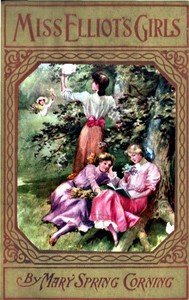
Miss Elliot's Girls: Stories of Beasts, Birds, and Butterflies — Edition Insights
Edition facts
Read the Text
GREENY, BLACKY, AND SLY-BOOTS.
Sammy Ray was running by the parsonage one day when Miss Ruth called to him. She was sitting in the vine-shaded porch, and there was a crutch leaning against her chair.
"Sammy," she said, "isn't there a field of tobacco near where you live?"
"To-morrow morning look among the tobacco plants and find me a large green worm. Have you ever seen a tobacco worm?"
"I've killed more'n a hundred of 'em this summer," he said. "Pat Heeley hires me to smash all I can find, 'cause they eat the tobacco."
"Well, bring one carefully to me on the leaf where he is feeding; the largest one you can find."
Before breakfast the next morning Ruth Elliot had her first sight of a tobacco worm.
"Take care!" said Sammy, "or he'll spit tobacco juice on you. See that horn on his tail? When you want to kill him, you jest catch hold this way, and"--
"But I don't want to kill him," she said. "I want to keep him in this nice little house I have got ready for him, and give him all the tobacco he can eat. Will you bring me a fresh leaf every, morning?"
While she was speaking she had put the worm in a box with a cover of pink netting. On his way home Sammy met Roy Tyler, and told him (as a secret) that the lame lady at the minister's house kept worms, and would pay two cents a head for tobacco worms. "Anyway," said Sammy, "that's what she paid me."
If there was money to be got in the tobacco-worm business, Roy wanted a share in it; and before night he brought to Miss Ruth, in an old tin basin, eight worms of various sizes, from a tiny baby worm just hatched, to a great, ugly creature, jet black, and spotted and barred with yellow. The black worm Miss Ruth consented to keep, and Roy, lifting him by his horn, dropped him on the green worm's back.
"Now you have a Blacky and a Greeny," the boy said; and by these names they were called.
Roy and Sammy came together the next morning, and watched the worms at their breakfast.
"How they eat!" said Sammy; "they make their great jaws go like a couple of old tobacco-chewers."
"Yes; and if they lived on bread and butter 't would cost a lot to feed 'em, wouldn't it?" said Roy.
"Look at my woodbine worm, boys," Miss Ruth said, as she lifted the cover of another box. "Isn't he a beauty? See the delicate green, shaded to white, on his back, and that row of spots down his sides looking like buttons! I call him Sly-boots, because he has a trick of hiding under the leaves. He used to have a horn on his tail like the tobacco worms."
"Where that spot is, that looks like an eye?"
"Yes; and one day he ate nothing and hid himself away, and looked so strangely that I thought he was going to die; but the next morning he appeared in this beautiful new coat."
"How funny! Say, what is he going to turn into?"
But Miss Ruth was busy house-cleaning. First she turned out her tenants. They were at breakfast; but they took their food with them, and did not mind. Then she tipped their house upside down, and brushed out every stick and stem and bit of leaf, spread thick brown paper on the floor, and put back Greeny and Blacky snug and comfortable.
The next time Sammy and Roy met at the parsonage, three flower-pots of moist sand stood in a row under the bench.
"Winter quarters," Miss Ruth explained when she saw the boys looking at them; "and it's about time for my tenants to move in. Greeny and Blacky have stopped eating, and Sly-boots is turning pale."
"Yes, indeed; look at him."
It was quite true; the green on his back had changed to gray-white, and his pretty spots were fading.
"He looks awfully; is he going to die?"
"Yes--and no. Come this afternoon and see what will happen."
But when they came, Blacky and Sly-boots were not to be seen. Their summer residence, empty and uncovered, stood out in the sun, and two of the flower-pots were covered with netting.
"I couldn't keep them, boys," Miss Ruth said; "they were in such haste to be gone. Only Greeny is above ground."
Greeny was in his flower-pot. He was creeping slowly round and round, now and then stretching his long neck over the edge, but not trying to get out. Soon he began to burrow. Straight down, head first, he went into the ground. Now he was half under, now three quarters, now only the end of his tail and the tip of his horn could be seen. When he was quite gone, Sammy drew a long breath and Roy said, "I swanny!"
"How long will he have to stay down there?"
"Happy fellow! _I_ say. Why, he has done being a worm. His creeping days are over. He has only to lie snug and quiet under the ground a while; then wake and come up to the sunshine some bright morning with a new body and a pair of lovely wings to spread and fly away with."
"Why, it's like--it's like"--
"What is it like, Sammy?"
"Ain't it like _folks_, Miss Ruth?" Grandma sings:--
'I'll take my wings and fly away In the morning,'
"Yes," she said; "it _is_ like folks." Then glancing at her crutch, repeated, smiling: "In the morning."
When the woodbine in the porch had turned red, and the maples in the door-yard yellow, the flower-pots were removed to the warm cellar, and one winter evening Sammy Ray wrote Greeny's epitaph:--
"A poor green worm, here I lie; But by-and-by I shall fly, Ever so high, Into the sky."
He came often in the spring to ask if any thing had happened, and one day Miss Ruth took from a box and laid in his hand a shining brown chrysalis, with a curved handle.
"What a funny little brown jug!" said Sammy.
"Greeny is inside; close your hand gently and see if you feel him."
"How cold!" said the boy; and then: "Oh! oh! he _is_ alive, for he kicks!"
In June Greeny and Blacky came out of their shells, but no one saw them do it, for it was in the night; but Sly-boots was more obliging. One morning Miss Ruth heard a rustling, and lo! what looked like a great bug, with long, slender legs, was climbing to the top of the box. Soon he hung by his feet to the netting, rested motionless a while, and then slowly, slowly unfolded his wings to the sun. They were brown and white and pink, beautifully shaded, and his body was covered with rings of brown satin. Blacky and Greeny were not so handsome. They had orange-spotted bodies, great wings of sober gray, and carried long flexible tubes curled like a watch-spring, that could be stretched out to suck honey from the flowers.
At sunset Miss Ruth sent for the boys. She placed the uncovered box where the moths waited with folded wings, in the open window. Up from the garden came a soft breeze sweet with the breath of the roses and petunias. There was a stir, a rustle, a waving of dusky wings, and the box was empty.
So Greeny and Blacky and Sly-boots "took their wings and flew away," and the boys saw them no more.
THE PATCHWORK QUILT SOCIETY.
The minister's wife came home from a meeting of the sewing society one afternoon quite discouraged.
"Only nine ladies present!" she said, "and very little accomplished; and the barrel promised to that poor missionary out West, before cold weather--I really don't see how it is to be done."
"What work have you on hand?" Miss Ruth inquired.
"We have just made a beginning," Mrs. Elliot answered with a sigh. "There's half a dozen fine shirts to make, and a pile of sheets and pillowcases, dresses and aprons for four little girls, table-cloths and towels to hem, and I know not what else. We always have sent a bed-quilt, but this barrel must go without it. It's a pity, too, for they need bedding."
"Why, so it is," said Miss Ruth. "Susie,"--to a little girl sitting close beside her,--"why can't some of you girls get together one afternoon in the week and make a patchwork quilt to send in the barrel?"
Susie put her head on one side and considered.
"Where could we meet, Aunt Ruth?"
"Here in my room, Susie, if mamma has no objection."
"Certainly not," Mrs. Elliot said; "but are you well enough to undertake it, Ruth?"
"Yes, indeed, Mary; I shall really enjoy it."
"And would you cut out the blocks for us, and show us how to keep them from getting all _skewonical_, like the cradle-quilt I made for Amelia Adeline?"
Amelia Adeline was Susie's doll.
"Yes; and I could tell you stories while you were working. How would that do?"
"Why, it would be splendid!" said the little girl. "There comes Mollie, I guess, by the noise. Won't she be glad? Say, Mollie!--why, what a looking object!"
This exclamation was called forth by the appearance of the little girl, who had been heard running at full speed the length of the piazza, and now presented herself at the door of Miss Ruth's room, her face flushed, her hair in the wildest confusion, and the skirt of her calico frock quite detached from the waist, hanging over her arm.
"Wasn't it lucky that the gathers ripped?" she cried, holding up the unlucky fragment. "If they hadn't, mamma, I should be hanging, head down, from the five-barred gate in the lower pasture, and no body to help me but the cows. You see, I set out to jump, and my skirt got caught in a nail on the post."
"O Mollie!" said her mother, "what made you climb the five-barred gate?"
"'Cause she's a big tom-boy," said Lovina Tibbs, who had come from the kitchen to call the family to supper. "Ain't yer 'shamed of yerself, Mary Elliot?--a great girl like you, most ten years old, walkin' top o' rail fences and climbin' apple-trees in the low pastur'!"
"No, I'm not!" said Mollie, promptly.
"Hush, Mollie," said Mrs. Elliot. "Lovina, that will do. Wash your face and hands, Mollie, and make yourself decent to come to supper."
An hour later, seated in the hammock, the girls discussed their aunt's plan.
"We'll have the Jones girls," said Susie, "and Grace Tyler, and Nellie Dimock, she's such a dear little thing; and I suppose we must ask Fan Eldridge, because she lives next door, though I dread to have her come, she gets mad so easy; but mamma wouldn't like to have us leave her out; and then, let's see--oh! we'll ask Florence Austin, the new girl, you know."
"Would you?" said Mollie, doubtfully. "We don't know her very well, and she dresses so fine and is kind of _citified_, you know. Ar'n't you afraid she'll spoil the fun?"
"No," said Susie, decidedly. "Mamma said we were to be good to her because she's a stranger; and I think she's nice, too--not a bit proud, though her father is so rich."
"Well," Mollie assented, who, though thirteen months older than her sister, generally yielded to Susie's better judgment; "let her come, then. That makes six besides us, and Aunt Ruth said half a dozen would be plenty. Sue, I think it's going to be real jolly, don't you?"
THE STORY OF DINAH DIAMOND.
Miss Ruth Elliot was the minister's sister. And two years before, when she came to live in the parsonage, an addition of two rooms was built for her on the ground floor because she was an invalid, and lame, and could not climb the stairs.
They were pretty rooms, with soft carpets, pictures on the walls, and in the winter time the sun shining in all day at the south window and the glass door. In summer with this door wide open and the piazza cool and shady with woodbine and clematis, you would have agreed with the little girls who made up Ruth Elliot's sewing circle, that first Wednesday afternoon, that they were "just lovely!"
All were there--the Jones' twins, Ann Eliza and Eliza Ann, tall girls as like each other as two peas and growing so fast one could always see where their gowns were let down; Grace Tyler with curly black hair and rosy cheeks; Nellie Dimock, a little dumpling of a girl with big blue eyes and a funny turned up nose; Fannie Eldridge, looking so sweet and smiling, you would not suspect she could be guilty of the fault Susie had charged her with; and Florence Austin, whose father had lately purchased a house in Green Meadow, and with his family had come to live in the country. Last of all, the minister's two little daughters, whom you have already met.
Ruth Elliot was sitting at a table covered with piles of bright calico pieces cut and basted for sewing, and when each girl had received a block with all necessary directions for making it, needles were threaded, thimbles adjusted, and the Patchwork Quilt Society was in full session.
"Now, Aunt Ruth," said Susie, "you promised to tell us a story, you know."
"Yes; tell us about Dinah Diamond, please," said Mollie.
"You and Susie have heard that story before, Mollie."
"That does not make a bit of difference, Auntie. The stories we like best we have heard over and over again. Besides, the other girls haven't heard it. Come, Aunt Ruth, please begin."
And so, while all sat industriously at work, Ruth Elliot related to the little girls
THE TRUE STORY OF DINAH DIAMOND.
"When I was a little girl," she began, "I had a present from a neighbor of a black kitten. I carried her home in my apron, a little ball of black fur, with bright blue eyes that turned yellow as she got bigger, and a white spot on her breast shaped like a diamond. I remember she spit and clawed at me all the way home, and made frantic efforts to escape, and for a day or two was quite homesick and miserable; but she soon grew accustomed to her surroundings, and was so sprightly and playful that she became the pet of the house.
"The first remarkable thing she did, was to set herself on fire with a kerosene lamp. We were sitting at supper one evening, when we heard a crash in the sitting-room, and rushing in, found the cloth that had covered the center table and a blazing lamp on the floor. It was the work of an instant for my father to raise a window, wrap the lamp in the table-cloth, and throw both into the street. This left the room in darkness, and I don't think the cause of the accident occured to any of us, till there rushed from under the sofa a little ball of fire that flew round and round the room at a most astonishing pace.
"'Oh, my kitten! my kitten!' I screamed. 'She's burning to death! Catch her! Catch her! Put her out! Throw cold water on her! Oh, my poor, poor Dinah!' and I began a wild chase in the darkness, weeping and wailing as I ran. The entire family joined in the pursuit. We tumbled over chairs and footstools. We ran into each other, and I remember my brother Charlie and I bumped our heads together with a dreadful crash, but I think neither of us felt any pain. They called out to each other in the most excited tones: 'Head her off there! Corner her! You've got her! No, you haven't! There she goes! Catch her! Catch her!' while I kept up a wailing accompaniment, 'Oh, my poor, precious Dinah! my burned up Dinah Diamond,' etc.
"Well, my mother caught her at last in her apron and rolled her in the hearth rug till every vestige of fire was extinguished and then laid her in my lap.
"Don't laugh, Mollie," said tenderhearted Nellie Dimock--"please don't laugh. I think it was dreadful. O Miss Ruth, was the poor little thing dead?"
"No, indeed, Nellie; and, wonderful to relate, she was very little hurt. We supposed her fine thick coat kept the fire from reaching her body, for we could discover no burns. Her tongue was blistered where she had lapped the flame, and in her wild flight she had lamed one of her paws. Of course her beauty was gone, and for a few weeks she was that deplorable looking object--a singed cat. But oh, what tears of joy I shed over her, and how I dosed her with catnip tea, and bathed her paw with arnica, and nursed and petted her till she was quite well again! My little brother Walter ("That was my papa, you know," Mollie whispered to her neighbor), who was only three years old, would stand by me while I was tending her, his chubby face twisted into a comical expression of sympathy, and say in pitying tones: 'There! there! poo-ittle Dinah! I know all about it. How oo must huffer' (suffer). The dear little fellow had burned his finger not long before and remembered the smart.
"I am sorry to say that the invalid received his expressions of sympathy in a very ungracious manner, spitting at him notwithstanding her sore tongue, and showing her claws in a threatening way if he tried to touch her. As fond as I was of Dinah, I was soon obliged to admit that she had an unamiable disposition."
"Why, Miss Ruth, how funny!" said Ann Eliza Jones. "I didn't know there was any difference in cats' dispositions."
"Indeed there is," Miss Ruth answered: "quite as much as in the dispositions of children, as any one will tell you who has raised a family of kittens. Well, Dinah made a quick recovery, and when her new coat was grown it was blacker and more silky than the old one. She was a handsome cat, not large, but beautifully formed, with a bright, intelligent face and great yellow eyes that changed color in different lights. She was devoted to me, and would let no one else touch her if she could help it, but allowed me to handle her as I pleased. I have tucked her in my pocket many a time when I went of an errand, and once I carried her to the prayer-meeting in my mother's muff. But she made a serious disturbance in the midst of the service by giving chase to a mouse, and I never repeated the experiment.
"Dinah was a famous hunter, and kept our own and the neighbors' premises clear of rats and mice, but never to my knowledge caught a chicken or a bird. She had a curious fancy for catching snakes, which she would kill with one bite in the back of the neck and then drag in triumph to the piazza or the kitchen, where she would keep guard over her prey and call for me till I appeared. I could never quite make her understand why she was not as deserving of praise as when she brought in a mole or a mouse; and as long as she lived she hunted for snakes, though after a while she stopped bringing them to the house. She made herself useful by chasing the neighbors' hens from the garden, and grew to be such a tyrant that she would not allow a dog or a cat to come about the place, but rushed out and attacked them in such a savage fashion that after one or two encounters they were glad to keep out of her way.
"Once I saw her put a flock of turkeys to flight. The leader at first resolved to stand his ground. He swelled and strutted and gobbled furiously, exactly as if he were saying, 'Come on, you miserable little black object, you! I'll teach you to fight a fellow of my size. Come on! Come on!' Dinah crouched low, and eyed her antagonist for a moment, then she made a spring, and when he saw the 'black object' flying toward him, every hair bristling, all eyes, and teeth, and claws, the old gobbler was scared half out of his senses, and made off as fast as his long legs would carry him, followed by his troop in the most admired disorder.
Miss Elliot's Girls opens not with a conventional narrator but with a specific, sensory detail: a child's reaction to a "great, horrid green worm." This immediate plunge into the natural world sets the tone for a work that blends close observation of insects, birds, and animals with a framing story of storytelling itself. The excerpts reveal a structure where chapters are often launched by a child's question or a remembered incident, leading into extended natural history lessons delivered by the character Miss Ruth, a lame woman who keeps caterpillars and ants in boxes. The narrative moves fluidly between the children's colloquial dialogue—Sammy's "I've killed more'n a hundred of 'em"—and Miss Ruth's more formal, explanatory passages, creating a dual register that mirrors the book's educational purpose.
The Frame of the Lame Storyteller
The excerpts establish Miss Ruth as a physically limited but intellectually active figure: she is introduced sitting in a "vine-shaded porch" with a crutch leaning against her chair. This detail is not incidental; it positions her as an observer rather than a participant in the outdoor world she describes. Her lameness becomes a structural device, justifying why the children bring specimens to her rather than exploring themselves. The narrative thus hinges on a series of deliveries—Sammy brings a tobacco worm, Roy brings eight worms in a tin basin—each triggering a new lesson. This pattern of arrival and explanation recurs throughout the excerpts, giving the book a rhythm of collection and commentary that is both pedagogical and domestic.
Conversational Science and the Children's Voices
The children's language is consistently colloquial and specific. Sammy describes the worms' eating as "they make their great jaws go like a couple of old tobacco-chewers," while Roy demands a horse story because he's "tired of hearing about cats and ants." These interjections ground the scientific content in everyday speech. Miss Ruth, in turn, adapts her explanations to her audience: she calls the ants "the little people" and describes a queen ant laying off "all her flounces and furbelows." The excerpts show a careful calibration of tone—technical enough to convey facts about ant species ("Rufians and Fuscans") but framed within a conversational back-and-forth that includes Susie's vow never to step on an anthill again and Nellie's plan to listen for ant conversations.
Recurring Images of Transformation and Rescue
A notable pattern in the excerpts is the emphasis on transformation and rescue. The tobacco worms are named Greeny, Blacky, and Sly-boots, and their metamorphosis is anticipated. The ant anecdote, drawn from Du Pont de Nervours, describes ants rescuing companions from water, with detailed actions: "seized them with their pincers and brought them to land" and "licked and rubbed them quite dry." Miss Ruth herself rescues a carpenter ant's body, feeling "as though I were looking on at a funeral." These scenes of care and change recur across different species, suggesting a thematic interest in the fragility and resilience of small creatures. The children's responses—Sammy's casual killing of worms versus Miss Ruth's desire to keep them—highlight a tension between destruction and preservation that the narrative gently resolves in favor of observation.
Movement Between Indoor and Outdoor Spaces
The excerpts repeatedly shift between the domestic interior—Miss Ruth's porch, her boxes and bowls—and the outdoor world of fields, pastures, and ant hills. This movement is literal: the boys drive "old Brindle home from pasture" and bring specimens from tobacco fields. But it is also conceptual, as Miss Ruth's stories transport the children to Texas and Florida to describe agricultural ants and umbrella ants. The narrative itself moves from the specific (a single tobacco worm) to the general (the classification of ant species), then back to the immediate (Susie's resolution to avoid anthills). This oscillation between the local and the faraway, the microscopic and the global, gives the excerpts a layered geography that mirrors the book's aim to expand the children's world from their New England setting.
The Role of Named Children in Structuring Inquiry
The excerpts introduce a small cast of named children—Sammy, Roy, Susie, Nellie—each of whom prompts a different line of inquiry. Sammy's initial delivery of the worm leads to the naming of Greeny and Blacky; Roy's demand for a horse story shifts the subject; Susie's ethical reflection on ants closes a lesson. These children are not interchangeable; their distinct voices and interests drive the narrative forward. The excerpts suggest that the book's structure depends on these interruptions and redirections, making the educational content feel emergent rather than pre-planned. The children's questions—"But they can't talk, Auntie?"—are the engine of explanation, and their reactions ("It's all wonderful") provide closure.
Readers approaching Miss Elliot's Girls should attend to how the excerpts frame natural history as a social activity, mediated by a disabled adult and driven by children's curiosity. The book's structure—alternating between dialogue and exposition, between the porch and the field—invites a reading that values process over conclusion. The excerpts offer no single plot but a series of encounters, each opening onto a wider world of observation and care.
I keep thinking about how the storyteller in Miss Elliot's Girls sits quietly, letting the creatures speak through her gentle descriptions. It reminded me of another bedside voice, softer than fact, almost like my grandmother's hands turning pages. There is that same warmth in Uncle Wiggily's rolling hoop — Text and Context—a hoop rolling not toward narrative, but toward memory. I haven't forgotten either one.
Joseph Robinson
1 month agoGrace Walker
1 week agoCarter Thomas
2 weeks agoAva Williams
1 month ago-
Heather Jones - 3 weeks ago
The concept is promising, but the execution falls short. The stories feel overly moralistic and dated, and the writing is dense for children. My kids lost interest quickly. If you're looking for a modern nature book for kids, there are better options. -
Ebony Farley - 2 weeks ago
A delightful collection of stories that bring the natural world to life for young readers. Miss Elliot's vivid descriptions of beasts, birds, and butterflies are both educational and enchanting. Perfect for bedtime or classroom read-alouds. My children were captivated from the first page! -
Tanya Tyler - 2 weeks ago
A charming Victorian-era book with lovely nature tales. The stories are engaging, but the language feels outdated for today's young readers. Still, it's a nice way to introduce children to classic literature and the wonders of nature. Recommended for older kids or adults who appreciate historical children's books.
What did you think of this book?
Answer a few questions and save a private reflection on this device.
Matthew Scott
3 weeks ago