1

Uncle Wiggily's rolling hoop — Text and Context
(0 User reviews)
165
Project Gutenberg
2024
Not confirmed
Animals -- Juvenile fiction; Humorous stories, American; Children's stories; Wit and humor, Juvenile; Rabbits -- Juvenile fiction; Uncle Wiggily (Fictitious character) -- Juvenile fiction; Tricksters -- Juvenile fiction
Readers of public-domain and historical texts
Project Gutenberg digital edition
en
Edition facts
Words
5,815
Reading time
26 min
Text sections
4
This digital edition of Uncle Wiggily's rolling hoop — Text and Context is described by source-level measurements including 5,815 words, 26 min estimated reading time, and 4 detected text sections.
The text analysis averages about 15.0 words per sentence, while the detected sections provide another way to judge how the source is divided.
Project Gutenberg metadata also associates the work with “Animals -- Juvenile fiction,” connecting these edition facts with the source record’s subject description.
Source:
Project Gutenberg record #72746
An editorial note on Howard R. Garis's wordplay, repetitive comic structures, and the bunny gentleman's distinctive voice in three linked stories about a rolling hoop, a snappy shark, and a bob sled.
Read the complete public-domain text at its original source.
Read on Project GutenbergHoward R. Garis opens Uncle Wiggily's Rolling Hoop with a characteristic blend of mild peril and verbal play: a runaway hoop tangles itself around the bunny gentleman's legs, and the more he tries to stand, the more he sits down. This comic inversion—effort producing the opposite result—recurs throughout the three stories collected here. Garis builds each episode around a simple physical predicament (a hoop, a shark, a sled) and lets Uncle Wiggily's polite, slightly flustered speech carry the humor. The narrator addresses the reader directly with exclamations like “Oh, Susie, my dear!” and the bunny himself “twinkles his pink nose” before an adventure arrives. These small, repeatable gestures give the prose a rhythmic, almost ritual quality suited to very young listeners.
Repetition as Structure
Garis relies on a tight pattern: Uncle Wiggily wishes for an adventure, something unexpected appears, and the bunny tries to extricate himself with dignity. The rolling hoop story follows this template exactly. The narrator signals each new turn with the phrase “all of a sudden,” and the bunny’s response is often a polite understatement—“I am afraid Susie, my dear”—even as he becomes physically entangled. This repetition is not a flaw but a deliberate feature of the bedtime-story format. Each story in the volume (the title tale, “Uncle Wiggily and the Snappy Shark,” and “Uncle Wiggily’s Bob Sled”) reuses the same structural bones, allowing a child to anticipate the shape of the comedy while the specific obstacle changes.
Diction and the Bunny Gentleman’s Voice
Uncle Wiggily speaks in a formal, slightly old-fashioned register that contrasts with the slapstick situations. He calls other characters “my dear” and uses complete, courteous sentences even when tangled in a hoop or facing a shark. This mismatch between his genteel language and his physical predicament is the primary source of humor. Garis also gives the bunny a signature physical tic: “twinkling his pink nose” appears as a prelude to thought or action. The narrator’s own voice is chatty and exclamatory, breaking the fourth wall with asides like “Oh, Susie, my dear!” These interjections create a sense of shared amusement between storyteller and listener, reinforcing the oral-performance origins of the series.
Description and the Limits of the Excerpts
The available excerpts show only the opening of the first story, so the full range of Garis’s descriptive choices is partially obscured. What is visible: the setting is lightly sketched—a generic outdoor space where a hoop can roll and a bunny can hop. Details are functional rather than atmospheric. The shark story and bob sled story are not excerpted, so it is unclear whether the shark is a literal fish or a toy, or how the bob sled incident unfolds. Readers should note that the catalog lists “Tricksters” as a subject, but the excerpts do not reveal any trickster character; the bunny himself may be the one who “gets mixed up,” as the subtitle suggests. Without the full text, the degree of agency or deception in the plots remains uncertain.
The Role of the Illustrations
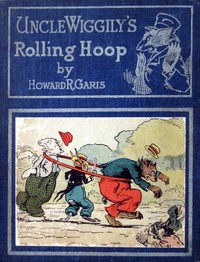
Lang Campbell’s illustrations are a central feature of this edition, though the digital text includes only the captions and references to “funny pictures.” The front matter promises “large color pictures throughout,” and the publisher’s advertisements emphasize the visual appeal. In the excerpt, the narrator’s exclamation “Oh, Susie, my dear!” may correspond to a picture of the hoop tangling the bunny. Garis’s text often describes actions that would be clarified by the illustrations—such as exactly how the hoop wraps around Uncle Wiggily’s legs. The interplay between word and image is likely crucial to the comedy, especially for pre-literate children who follow the pictures while an adult reads aloud. The absence of the illustrations in this digital version means some humor is lost.
Readers encountering Uncle Wiggily's Rolling Hoop in this digital edition should be aware that the text was designed to be read aloud, with a strong rhythm and repeated catchphrases. The three stories are short and structurally identical, making the volume ideal for a single sitting. Pay attention to the bunny’s polite speech and the narrator’s interjections—these are the fingerprints of Garis’s style. The illustrations, though absent here, were integral to the original experience.
I kept thinking about how Garis lets the bunny gentleman’s voice tumble along, playful yet steady. It reminded me of something quieter I found later, in the guide to Doctor Papa — that same gentle patience with repetition, as if each loop were a small comfort. Doctor Papa — A Reader’s Guide lingered that way for me, like a warm cup held a bit too long.
There are no reviews for this eBook.
There are no comments for this eBook.
Reader reflection
Your personal reading reflection
Build a private reading journal entry for this title.
Your progress
0
/
10
2
What was your overall reaction to the book?
3
Is this a title you would suggest to others?
4
How much effort did this book require?
5
Is this a title worth rereading?
6
Did the book meet your expectations?
7
How closely did the book connect with your experience?
8
How clear did the writing feel?
9
Which lesson or insight stayed with you?
10