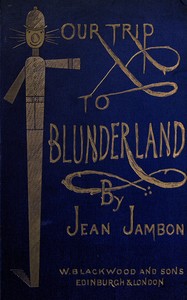
Our trip to Blunderland — Story, Setting & Ideas

(1 User reviews)   262
Macdonald, J. H. A. (John Hay Athole), 1836-1919, Doyle, Charles Altamont, 1832-1893 [Illustrator] Project Gutenberg 2024
Fantasy fiction; Children's stories; Boys -- Juvenile fiction; Imaginary places -- Juvenile fiction; Carroll, Lewis, 1832-1898 -- Parodies, imitations, etc.; Alice (Fictitious character from Carroll) -- Juvenile fiction Readers of public-domain and historical texts
Project Gutenberg digital edition en

Edition facts

Words: 39,122
Reading time: 171 min
Text sections: 8
Three boys—Norval, Jaques, and Ranulf—meet Alice and journey to Blunderland, a parody of Wonderland filled with legal absurdities, puns, and chaotic courtroom scenes, illustrated by Charles Doyle.
Share

Read the Text

and said, “Perhaps if Alice was here, she would tell us how to do it.”

[Sidenote: HOW TO DO IT.]

“Of course I would,” said a sweet voice behind them; and, turning round, who should they see but little Alice herself, looking exactly as she does on page 35, where she is getting her thimble from the Dodo?

“Oh, how awfully jolly!” cried Norval; “will you help us?” He was very much surprised, not at seeing Alice, but at not being surprised.

“Indeed I will,” said she, “although I don’t know, you know, whether boys can manage it.”

Ranulf was just going to say, saucily, “A great deal better than girls, I should think,” when Norval, who was older, and knew better how to behave, checked him, and said—

[Sidenote: BY ORDER.]

“But, Alice, dear, surely if it’s done by going to sleep, boys can do that as well as girls.”

“Well, so they can,” said she; “but then, you see, everybody who goes to sleep doesn’t get to Wonderland.”

“Oh, but perhaps,” said Jaques, “if you will go to sleep too, you will come with us, and show us the way.”

“Ah! I can’t do that to-day,” said Alice, looking very grave; “for, you see, when I came to you I was just going to give Dollys their dinner—such a nice dinner! cake and currants; and it would be cruel to leave them looking at it till I came back.”

Now Norval suddenly remembered that he knew some boys whose uncle was a Director at the Aquarium, and who, when he could not go with them and pass them in himself, gave them a written order; so, turning to Alice, he said—

“Oh, but if you would give us a pass, it might help us.” And sitting down at the writing-table, he wrote in stiff letters, imitating the papers he had seen, and laying the pass before her, said, “Now, write ‘Alice’ there ever so big, and put a grand whirly stroke under it.”

Alice obeyed, and the pass was ready.

“Now then,” said she, “you had better go to sleep.”

Norval threw himself down on a sofa; Jaques and Ranulf coiled themselves up on the rug.

Norval could not resist the temptation to keep one eye half open, that he might see what Alice did. But she, noticing this, held up her little forefinger, and said, “Come, come, that won’t do.” Thus rebuked, Norval shut his other eye.

“Now, all go to sleep at once,” said Alice.

[Sidenote: PLAGUEY BOYS.]

“I’m nearly asleep already,” said Jaques.

“That’s talking, not going to sleep,” said Alice.

All was still for a little, then Jaques half uncoiled himself and looked at Ranulf.

Ranulf uncoiled himself and looked at Norval.

Norval raised his head, and looked at Jaques.

On finding that they were all awake, the three burst out laughing.

“That’s laughing, not going to sleep,” said Alice.

Down they all flopped again, and then Alice, to help them, said, “Hushaby baby, on the tree-top!”

“I’m not a baby,” said Ranulf, much offended, as he was nearly six.

“I’m not on a tree-top,” said Jaques.

“You’ve waked me up,” said Norval.

[Sidenote: WE’LL BE GOOD.]

“That’s chattering, not going to sleep,” said Alice.

“I’m sure I must be asleep now,” said Norval.

“So am I,” said Jaques.

“And me too,” said Ranulf.

“That’s talking nonsense, not going to sleep,” said she. “I see it’s no use; Alice’s way won’t do with wild rogues like you, and I really must go back to Dollys.”

“What _are_ we to do?” said Norval; “we can’t fall asleep. Don’t you think we could get to the funny places you went to without going to sleep?”

“Will you do what I tell you?” asked Alice, holding up her little forefinger in a dignified kind of way.

Jaques had some misgivings about compromising his position as a small lord of the creation by agreeing to do what a little girl told him; but his anxiety to see some wonders prevailed, and they all said that they would obey.

“Shut your eyes, then, and don’t open them till I tell you, and perhaps something will happen.”

[Sidenote: AN EYE-OPENER.]

Norval rolled down from the sofa to the side of his brothers. Then all squeezed up their eyes quite tight, and although they heard a curious rumbling noise, did not open them.

“That’s right,” said Alice; “you would have spoiled everything if you had peeped. Boys who don’t do what they are told spoil everything, and themselves besides. Now you may look!”

They had squeezed their eyes so tight that it took ever so long to get them unfastened. Jaques got his open first, and saw that little Alice was gone.

“Oh, Alice, where are you?” he cried.

A distant voice replied, “Off to Dollys!”

[Sidenote: OVER THE SLEEPERS.]

Just as he was going to say, “What a shame, when I squeezed so hard!” Norval and Ranulf got their eyes open, and before Jaques could speak, they gave a wild shout, “Hurrah! hurrah! hurrah!” Jaques’ head had been looking the wrong way, but when he turned round he saw what the others had seen—

[Sidenote: FUNNY BOBS.]

only they were rather different from other bicycles, as, in place of the small hind-wheels, there were funny little fellows, made up of a head and three legs; and as they stood on one foot, with the other two in the air, and their noses thrust through the end of the bar, they looked very comical. Still more funny was it when the boys went forward to look closer, and the little three-legged men made them a bow, which they did by touching their caps with one leg, bobbing forward on another, and back again. The wheels and treddles were made of gold, the seats were lined with crimson velvet, and the little men had blue tights and silver caps and shoes; so everything looked very smart. The boys could not understand how the bicycles stood upright without anything to hold the wheels, and began talking about them, wondering whether they could move of themselves. They had scarcely spoken of this, when, as if to show off their powers, the little men began to turn round on their three legs, and move slowly about the room. They steered their way among the furniture most cleverly, and at last as each stopped beside one of the boys they all touched their caps, and bobbed from one leg to another, as before.

“Are we to get up?” said Jaques, timidly.

[Sidenote: OFF THEY GO.]

Bob went all the little men.

“Does that mean yes?” said Norval.

“But where are we going?” said Ranulf.

“To Wonderland, of course,” said Jaques.

“All right,” said the other two, and they all scrambled up on the bicycles.

The moment they were seated, the three little men gave a shrill whistle, as a railway engine does before it starts, and off they went at a tremendous pace. The boys had barely time to think how hard the drawing-room wall would be, when the whole party went straight through it as if it had been, like circus hoops, filled in with paper. Norval went across the library and out at the window, but papa did not seem to notice him; he only got up and closed the sash, as if he had felt a draught. Jaques passed through the butler’s pantry, but the butler only scratched his ear, as if something had tickled him. Ranulf shot at a slant through the nursery, clutching a penny trumpet off the table as he passed, but nurse only gave a shiver, and said, “Deary me, I do feel so queasy queer!”

[Sidenote: DISTANCE LENDS.]

They were going so fast, that Norval, looking round the moment they were outside the house, saw papa’s head, not bigger than a black pin’s, looking out of a window, that seemed smaller than a halfpenny stamp; and Jaques caught sight of Oscar, the house dog, who looked like a comma with its tail wagging. Besides, they kept mounting up in the air as well as going on, so that the fields looked no bigger than the squares of a chess-board, and the trees between them, in their autumn tints, like rows of brass nails on a green-baize door. Before they could count fifty, the world itself, when they looked back, was like one of those funny worsted balls that show a number of different colours. The little men were spinning so fast that their silver caps, blue hose, and bright shoes ran into circles, till they looked like silver wheels with a blue enamel ring on them.

“Isn’t it funny that we aren’t frightened?” said Jaques.

[Sidenote: FAST IDEAS.]

“I think we would be if we had time,” said Norval (who was the thinking one of the three), “only we are going so fast that there’s no time to be frightened.”

“Perhaps it’s because we’re asleep like Alice, after all,” said Ranulf, looking very wise.

“Oh no; because you see when people are asleep they are still, and we are going so fast that it would be sure to wake us,” replied Jaques.

“But we can be still and go fast all the same, can’t we?” said Ranulf.

“Oh no, you silly!” said Jaques.

“Oh yes,” said Ranulf; “because we can go still faster; and if we can go still faster, why can’t we go still fast?”

“Oh yes, to be sure,” said Jaques; “and besides, of course, a man can be fast and still at the same time, for if he is made fast with rope he must be still.”

“And we _are_ going fast still,” said Norval, as the bicycles flew on; “but I don’t see yet how we can be still and fast both.”

[Sidenote: A STEADY SWELL.]

The three seemed likely to get into a regular muddle about this, when their attention was suddenly called off by Jaques catching sight of something that looked first like a new threepenny-piece, and in another second like a big shining tin plate.

“What’s that?” said Jaques. While he was saying this, it had grown as big as a drum.

“Perhaps it’s a giant’s dish,” said Ranulf. It was now as big as a circus.

“It’s getting too big for that,” said Jaques. By this time it was as large as a race-course, and in another second it was too great to be like anything.

[Sidenote: CRUSTY CRESCENT.]

Norval, who had been thinking, was just going to say, “Perhaps it’s the moon,” when the Man in the Moon put his head out at one side, and looking as grumpy as possible, called out—“Hi, you rascals! what do you want here?” He had evidently been wakened out of a nap by the whirr of the bicycles, for he wore a big red nightcap, and had got only one eye open.

“We aren’t rascals,” said Jaques; “if you say that, we’ll tell papa.”

“Oh,” said Norval, “are you the fellow that came down too soon?”

[Sidenote: NEARLY MOON-STRUCK.]

Ranulf broke in—“I think you’ve got up too soon this morning. By the bye, did you ever find the way to Norwich?”

The Man in the Moon got quite red with rage at this, opened his other eye, and aimed a blow at Ranulf with a big stick.

“Ha!” said Jaques, “that’s one of the sticks you gathered on Sunday, you villain!”

As his arm made the blow, it came nearer the boys; and the stick, which had looked only like a porridge-stick, got as big as Nelson’s Monument. Ranulf would have been knocked to pieces, but the little man at the back of the bicycle gave a sudden dart to one side; the Man in the Moon overbalanced himself, and if his wife had not caught him by the legs he would have tumbled off the moon altogether. In struggling to get on again his red nightcap fell off, and a breeze of wind carrying it away, left it sticking on one of the moon’s horns.

They were now getting so near the moon that they began to wonder how they were to pass it.

[Sidenote: KEEP YOUR SEATS.]

“Jump over, to be sure,” said Jaques.

“Oh, that would be a tremendous jump!” replied Ranulf.

“Not at all,” said Norval; “you know the cow jumped over the moon, so it can’t be very difficult after all.”

The bicycles began to move a little slower, and the boys thought they were going to stop, but it turned out that the little men were only gathering themselves together, like good hunters, for the spring; for in a moment they gave a whistle, as a train does when it goes into a tunnel, and the bicycles bounding up, went right over the top of the moon, the boys keeping their seats in a way that it would be well if some Members of Parliament could imitate.

[Sidenote: ECHO ANSWERS.]

As they passed, the Man in the Moon, who had come up after his nightcap, shouted, “Don’t you come here again!” and picked up a stone as big as four hayricks to throw after them. But before he could do so, his wife, who had come behind him, and who had a nose as big as a ship’s long-boat, eyes like paddle-boxes, and a mouth like the entrance of a harbour, seized him by the arm, boxed his ears, and said in a voice loud enough to be heard hundreds of miles off—

“Would you hurt the dear little things, you old villain?”

“Old villain! ’ld villain! villain! ’illain! ’lain! ’lan! ln!” cried the echoes in the stars.

The Man in the Moon dropped the big stone on his own toes, and muttering, “Petticoat government again!” pulled his nightcap over his ears, shrugged his shoulders, and went home meekly to breakfast.

“I wonder if we’re going the same way the cow went!” said Ranulf; “if we are, perhaps we may get a drink of milk—I’m so thirsty.”

“And a beefsteak,” said Jaques; “for I’m hungry.”

“Faugh!” said Norval; “what would papa say if he heard of our eating cow-beef in Fairyland? and as for milk, if she runs as fast as we do, she must be run dry long ago.”

[Sidenote: MIST-ERIE.]

The pace was now greater than ever, so that the stars flew past them like sparks from a smith’s anvil. They had been going through darkness for some time, when they perceived a dim light in front; and soon they saw that it was a grey cloud, into which the bicycles plunged, moving more slowly, till they came to a walk. While they were in the cloud, the boys felt that they had come to ground; and in a minute or two they passed through it, and found themselves in a very bleak, cold-looking place—no grass, no trees, no flowers, nothing but stones and sand, and an old woman walking in front of them, thick fog enveloping all round. Ranulf was almost going to cry, it looked so dreary; but Norval told him to remember that papa often said, “Whatever happens, don’t cry, but be brave boys; things are always made worse by crying.” So he gave three big gulps and was all right. But they began to think in themselves that if they had known Fairyland was like this, they would have preferred to stay at home. They had little time to reflect, however, for the old woman tripped her foot against a stone and fell down on her nose, which was very long. The boys jumped at once to the ground, forgetting all about Fairyland, and rushed to the old woman to help her up.

[Sidenote: BEAK ON ROCK.]

“Poor granny!” said Jaques, “are you very much hurt?”

“Verily muchly,” said she, in a squeaky voice, that sounded like the noise which a piece of paper stuck over a comb makes.

[Sidenote: A PICK-ME-UP.]

It was so funny that they all felt inclined to have a laugh; but they kept it down, and helped the old lady up. Her nose was so long that their handkerchiefs were too small to tie it up, so they fastened them together and bandaged it as well as they could. They were going back to the bicycles, when she said—

“Don’t go away, dears.”

Norval said, “We wanted to get on to the nice part of Fairyland, but if you would like us to stay till you feel better, we will.”

“Yes, of course we will,” said Jaques; “won’t we, Ranny?” And Ranulf gave a big nod.

[Sidenote: TRANSFORMATION.]

[Sidenote: FAIRY-EST OF ALL.]

Then the old lady, patting Ranulf on the head, replied, “You want to get to the nice part of Fairyland? So you shall, for those who are kind are sure to get what is nice and pleasant at the proper time.” While speaking, she seemed to get enveloped in a kind of mist, through which the boys could only trace her figure dimly. To their great surprise, the fog that was all round and above them began to weave into lines; and these plaited themselves together quickly, till they formed a vast trellised dome. Then light began to break through, and the dark bars became transparent gold. Lovely plants rose from the top of the dome, twining themselves in and out all the way down. Each had hundreds of buds, which, as they reached the ground, burst into leaves and flowers in dense profusion—here a thread of blue, here of red, here of white, which, mingling with the golden trellis, produced a charming effect. The ground, which had been rough and stony, smoothed itself into stripes of silver sand. The stones became precious ones of all colours, and ranged themselves along the stripes of silver, making beautiful, shining walks. In the plots between the walks, the most lovely grass appeared, soft and delicate, like velvet; and from each there rose a crystal fountain, playing waters of different bright colours; while all around richly laden fruit-trees sprang up, with many splendid-coloured birds on the branches, which began to fly in all directions, whistling and singing most sweetly. All this time the mist remained round the old woman, only turning to a beautiful rose colour. When the fountains and trees were rising, the boys gazed in wonder and delight. Ranulf proposed to pluck some fruit and eat it, but Norval said they must not do that without leave. Presently the rose-coloured mist began to get thin, and, clearing away, they saw a beautiful form appearing—a regular real fairy, standing perfectly still in the middle of the canopy, shining so bright that though everything else was beautiful, she was the loveliest of all, as she stood in the midst of a bouquet of flowers formed of glittering jewels. For there was a bright shining in her face that outshone all else—a something so beaming, so winning, so unlike anything to be seen in the world of every day, that you must just try to think of what cannot be thought of, before you will get any idea of it. Her robe was dazzling white, and the swan-like neck and rounded arms vied in delicate beauty with the strings of gorgeous pearls that formed the only sleeves of her shining dress. The slender waist was circled by a band of glittering precious stones, and her skirt, falling to the knee, was one blaze of silver light, the fringe at the edge sparkling with brilliants. A tiara of diamonds crowned her head, and lovely golden hair hung below her waist.

Jaques’ mouth and eyes opened wide, and Ranulf showed two large dimples in his cheeks as these wonders came to view. Norval was the first to remember what he was about, and said, “Come along, boys; we must go and shake hands, you know, and say, How do you do?” So they all went forward. As they came near, a lovely smile broke over the fairy’s face, and she held out her hand, saying, “I am so glad to see you, dear boys; and still more to see that you know how to behave like little gentlemen.” Her voice was clear as a silver bell, and her hand very curious to touch, but so nice. She went on, as she stooped down and smoothed Ranulf’s hair, “You will see every day the advantage of being good and brave. Do you know what would have happened if you had not helped me, when I was the old woman?”

[Sidenote: BELLE FROM BELDAM.]

In the preface to Our Trip to Blunderland, the author, writing as Jean Jambon, declares his ambition to have “half his understanding of how to do it” compared to Carrollus Primus—Lewis Carroll. The book is a direct parody of the Alice books, with three boys instead of one girl, and a journey that mirrors but distorts Alice’s adventures. The opening finds Norval, Jaques, and Ranulf debating how Alice got through the looking-glass, with Norval insisting “she didn’t go through it; she only thought she did.” Their skepticism sets the tone for a story that constantly questions and literalizes the absurdities of its model.

Three Boys and a Parody Premise

The story begins with three brothers—Norval, Jaques, and Ranulf—who have been reading about Alice and wonder if they could replicate her adventures. Their conversation reveals distinct personalities: Norval is the eldest and most rational, Jaques is eager but easily frustrated, and Ranulf is the youngest, often puzzled but persistent. When Alice herself appears, she offers to help, and the boys are whisked away to Blunderland. Unlike Alice’s solitary dream, this is a group excursion, and the boys’ interactions add a layer of sibling dynamics to the nonsense. The parody is explicit: the preface acknowledges “ALICEnce” has been taken, and the boys’ names are borrowed from Shakespeare and Scott, hinting at a literary playfulness that runs throughout.

Legal Absurdities in the Courtroom

A central episode is a trial that parodies the Queen of Hearts’ courtroom from Alice’s Adventures in Wonderland. Here, the proceedings are even more chaotic: the plaintiff is locked in a box (a “Jack in the box”), the jury is thrown over the partition, and the clerk’s answers are a cascade of puns on “long” and “thyme.” When asked how long he has known the prisoner, John Doe replies, “Various lengths. I have known her from 2 feet 3 inches long to 5 feet 7½ inches long.” The boys struggle to follow the logic, with Ranulf sighing, “Doe and hart, hart and doe; I don’t think I’ll ever understand it.” The humor relies on legal jargon twisted into wordplay, and the boys’ literal-mindedness highlights the absurdity.

Illustrations by Charles Doyle

The book features sixty illustrations by Charles Altamont Doyle, father of Arthur Conan Doyle. Doyle’s style is whimsical and detailed, complementing the text’s playful tone. The preface notes that the story was told in the author’s nursery, and the illustrations capture that domestic, intimate feel. Unlike Tenniel’s iconic Alice drawings, Doyle’s work is less polished but more fantastical, with elongated figures and surreal details. The illustrations are integral to the reading experience, often depicting the boys in exaggerated poses or the bizarre courtroom scenes. They ground the parody in a visual world that is both familiar and strange, echoing the text’s blend of homage and invention.

Our Trip to Blunderland rewards readers who enjoy wordplay and legal satire. The boys’ journey is less a coherent narrative than a series of set pieces, each riffing on a different aspect of Carroll’s work. Pay attention to the puns—they are the engine of the humor. The illustrations by Charles Doyle offer a visual counterpoint to the text, and the preface provides a candid glimpse into the author’s intentions. This is a book best read aloud, with a willingness to laugh at the absurdities of language and logic.

There’s a peculiar warmth in the courtroom chaos of Our Trip to Blunderland, that feeling of rules gone gently haywire. It reminded me, somehow, of an older collection I once browsed, where the mischief felt just as tender and whimsical. The Brownies and Other Tales — Inside the Classic carries that same quiet, slightly sideways logic, like a memory of playing pretend long after supper.

Joseph Hall
5 days ago

5
5 out of 5 (1 User reviews )

Add a Review

Your Rating *
  • ...
    Deborah Huerta - 3 weeks ago
    Our Trip To Blunderland is an enjoyable read with plenty of creative ideas and humorous moments. The story flows well and the characters are likable. However, some of the jokes feel repetitive, and the plot could have been tighter in the middle. Still, it's a decent pick for a lazy afternoon.

  • ...
    Laura Cochran - 3 weeks ago
    Our Trip To Blunderland is a delightful and whimsical adventure that had me laughing out loud from start to finish. The imaginative world-building is superb, and the characters are quirky and endearing. It's the perfect escape from reality, full of clever humor and unexpected twists. I highly recommend this book to anyone looking for a fun, light-hearted read that will leave you smiling.

  • ...
    Alexandria Moore - 1 week ago
    Our Trip To Blunderland had a promising concept, but the execution fell flat for me. The humor is forced and the story lacks depth, making it difficult to stay engaged. The characters are one-dimensional, and the plot meanders without clear direction. I wanted to like it, but ultimately it felt like a missed opportunity.


Reader reflection

How will you remember this book?

Save your reaction, strongest insight, and memorable passage.

Your progress 0 / 10
1

Have you finished this book?

2

How much did you enjoy the reading experience?

3

Is this a title you would suggest to others?

4

How easy was the book to follow?

Related eBooks