Outward Bound Or, Young America Afloat: A Story of Travel and Adventure — Story, Setting & Ideas
Edition facts
Calculated from edition completeness, EPUB availability, text structure and catalogue metadata. Not a user rating.
Read the Text
"There are no such peaches this side of New Jersey; and you can't get them, for love or money, at the stores. All we have to do is, to fill our pockets, and keep our mouths closed--till the peaches are ripe enough to eat," said Robert Shuffles, the older and the larger of two boys, who had just climbed over the high fence that surrounded the fine garden of Mr. Lowington.
"What will Baird say if he finds it out?" replied Isaac Monroe, his companion.
"Baird," the gentleman thus irreverently alluded to, was the principal of the Brockway Academy, of which Shuffles and Monroe were pupils in the boarding department.
"What will he say when he finds out that the King of the Tonga Islands picks his teeth with a pitchfork?" added Shuffles, contemptuously. "I don't intend that he shall find it out? and he won't, unless you tell him."
"Of course, I shall not tell him."
"Come along, then? it is nearly dark, and no one will see us."
Shuffles led the way down the gravelled walk, till he came to a brook, on the bank of which stood the peach tree whose rich fruit had tempted the young gentlemen to invade the territory of Mr. Lowington with intent to plunder.
"There they are," said the chief of the young marauders, as he paused behind a clump of quince bushes, and pointed at the coveted fruit. "There's no discount on them, and they are worth coming after."
"Hark!" whispered Monroe. "I heard a noise."
"I don't know. I'm afraid we shall be caught."
"No danger; no one can see us from the house."
"But I'm sure there's some one near. I heard something."
"Nonsense! It was only a dagger of the mind, such as Baird talks about," answered Shuffles, as he crawled towards the peach tree. "Come, Monroe, be quick, and fill your pockets."
This peach tree was a choice variety, in whose cultivation the owner had been making an elaborate experiment. Mr. Lowington had watched it and nursed it with the most assiduous care, and now it bore about a dozen remarkably large and beautiful peaches. They were not quite ripe enough to be gathered, but Shuffles was confident that they would "mellow" in his trunk as well as on the tree. The experiment of the cultivator had been a success, and he had already prepared, with much care and labor, a paper explanatory of the process, which he intended to read before the Pomological Society, exhibiting the fruit as the evidence of the practicability of his method. To Mr. Lowington, therefore, the peaches had a value far beyond their intrinsic worth.
Shuffles gathered a couple of the peaches, and urged his companion to use all possible haste in stripping the tree of its rich burden.
"Hallo, there! What are you about?" shouted some one, who hastened to make his presence known to the plunderers.
Monroe began to retreat.
"Hold on!" interposed Shuffles. "It's no one but Harry Martyn."
"He can tell of us just as well as anybody else."
"If he does, he will catch it."
"What are you doing?" demanded Harry Martyn,--who was a nephew of Mr. Lowington, and lived with him,--as he crossed the rustic bridge that spanned the brook.
"Don't you see what I'm doing?" replied Shuffles, with an impudent coolness which confounded Harry.
"Stop that, Shuffles!" cried Harry, indignantly. "My uncle wouldn't take ten dollars apiece for those peaches."
"That's more than he'll get for them," added Shuffles, as he reached up and gathered another peach.
"Stop that, I tell you!" said Harry, angrily, as he stepped up, in a menacing attitude, before the reckless marauder.
"Shut up, Harry! You know me, and when I get all these peaches, I've got something to say to you."
Shuffles was about to gather another of the peaches, when Harry, his indignation overcoming his prudence, grasped his arm, and pulled him away from the tree.
"What do you mean, Harry Martyn?" exclaimed Shuffles, apparently astonished at the temerity of the youth. "I can't stop to lick you now; but I'll do it within twenty-four hours."
"Well, don't you touch those peaches, then."
"Yes, I will touch them. I intend to have the whole of them; and if you say a word to your uncle or any one else about it, I'll pulverize that head of yours."
"No, you won't! You shall not have those peaches, anyhow," replied the resolute little fellow, who was no match, physically, for Shuffles.
"If you open your mouth----"
"Hallo! Uncle Robert! Help, help! Thieves in the garden!" shouted Harry, who certainly had no defect of the lungs.
"Take that, you little monkey!" said Shuffles, angrily, as he struck the little fellow a heavy blow on the side of the head with his fist, which knocked him down. "I'll fix you the next, time I see you."
Shuffles consulted his discretion rather than his valor, now that the alarm had been given, and retreated towards the place where he had entered garden.
"What's the matter, Harry?" asked Mr. Lowington, as he rushed over the bridge, followed by the gardener and his assistants, just as Harry was picking himself up and rubbing his head.
"They were stealing your peaches, and I tried to stop them," replied Harry. "They have taken some of them now."
Mr. Lowington glanced at the favorite tree, and his brow lowered with anger and vexation. His paper before the "Pomological" could be illustrated by only nine peaches, instead of thirteen.
"Who stole them, Harry?" demanded the disappointed fruit-grower.
The nephew hesitated a moment, and the question was repeated with more sternness.
"Robert Shuffles; Isaac Monroe was with him, but he didn't take any of the peaches."
"What is the matter with your head, Harry?" asked his uncle, when he observed him rubbing the place where the blow had fallen.
"Shuffles struck me and knocked me down, when I called out for you."
"Did he? Where is he now?"
"He and Monroe ran up the walk to the back of the garden."
"That boy shall be taken care of," continued Mr. Lowington, as he walked up the path towards the point where the marauders had entered. "The Academy is fast becoming a nuisance to the neighborhood, because there is neither order nor discipline among the students."
The thieves had escaped, and as it would be useless to follow them, Mr. Lowington went back to the house; but he was too much annoyed at the loss of his splendid peaches, which were to figure so prominently before the "Pomological," to permit the matter to drop without further notice.
"Did he hurt you much, Harry?" asked Mr. Lowington as they entered the house.
"Not much, sir, though he gave me a pretty hard crack," answered Harry.
"Did you see them when they came into the garden?"
"No, sir? I was fixing my water-wheel in the brook, when I heard them at the tree. I went up, and tried to prevent Shuffles from taking the peaches. I caught hold of him, and pulled him away. He said he couldn't stop to lick me then, but he'd do it within twenty-four hours. Then he hit me when I called for help."
"The young scoundrel! That boy is worse than a pestilence in any neighborhood. Mr. Baird seems to have no control over him."
Suddenly, and without any apparent reason, Mr. Lowington's compressed lips and contracted brow relaxed, and his face wore its usual expression of dignified serenity. Harry could not understand the cause of this sudden change; but his uncle's anger had passed away. The fact was, that Mr. Lowington happened to think, while his indignation prompted him to resort to the severest punishment for Shuffles, that he himself had been just such a boy as the plunderer of his cherished fruit. At the age of fifteen he had been the pest of the town in which he resided. His father was a very wealthy man, and resorted to many expedients to cure the boy of his vicious propensities.
Young Lowington had a taste for the sea, and his father finally procured a midshipman's warrant for him to enter the navy. The strict discipline of a ship of war proved to be the "one thing needful" for the reformation of the wild youth; and he not only became a steady young man, but a hard student and an accomplished officer. The navy made a man of him, as it has of hundreds of the sons of rich men, demoralized by idleness and the absence of a reasonable ambition.
When Mr. Lowington was thirty years old, his father died, leaving to each of his three children a quarter of a million; and he had resigned his position in the navy, in order to take care of his property, and to lead a more domestic life with his wife and daughter than the discipline of the service would permit.
He had taken up his residence in Brockway, the early home of his wife. It was a large town on the sea shore, only a few miles from the metropolis of New England, thus combining all the advantages of a home in the city and in the country. For several years he had been happy in his peaceful retirement. But not wealth, nor even integrity and piety, can bar the door of the lofty mansion against the Destroyer of the race. His wife died of an hereditary disease, which gave no indication of its presence till she had passed her thirtieth year. Two years later, his daughter, just blooming into maturity, followed her mother down to the silent tomb, stricken in her freshness and beauty by the same insidious malady.
The husband and father was left desolate. His purest and fondest hopes were blighted; but, while he was submissive to the will of the Father, who doeth all things well, he became gloomy and sad. He was not seen to smile for a year after the death of his daughter, and it was three years before he had recovered even the outward semblance of his former cheerfulness. He was rich, but alone in the world. He continued to reside in the home which was endeared to him by the memories of his loved and lost ones.
When his wife's sister died in poverty, leaving two children, he had taken them to his home, and had become a father to them. Harry Martyn was a good boy, and Josephine Martyn was a good girl; but they were not his own children. There was something wanting--an aching void which they could not fill, though Mr. Lowington was to them all that could be asked or expected of a parent.
Mr. Lowington busied himself in various studies and experiments; but life had ceased to be what it was before the death of his wife and daughter. He wanted more mental occupation; he felt the need of greater activity, and he was tempted to return to the navy, even after his absence of ten years from the service; but this step, for many reasons, was not practicable. At the time when his garden was invaded by the vandal students from the Brockway Academy, he was still thinking what he could do to save himself from the inglorious life of ease he was leading, and, at the same time, serve his country and his race.
Shuffles had robbed his garden of some of his choicest fruit; had struck his nephew a severe blow on the head, and threatened to inflict still greater chastisement upon him in the future. Mr. Lowington was justly indignant; and his own peace and the peace of the neighborhood demanded that the author of the mischief should be punished, especially as he was an old transgressor. It was absolutely necessary that something should be done, and the retired naval officer was in the right frame of mind to do it. Just then, when he was wrought up to the highest pitch of indignation, his anger vanished. Shuffles at sixteen was the counterpart of himself at fifteen.
This was certainly no reason why the hand of justice should be stayed. Mr. Lowington did not intend to stay it, though the thought of his own juvenile depravity modified his view, and appeased his wrath. He put on his hat and left the house. He walked over to the Academy, and being shown to the office of the principal, he informed him of the depredations committed in his garden.
"Who did it, Mr. Lowington?" demanded the principal, with proper indignation in his tones and his looks.
"I need not have asked. That boy gives me more trouble than all the others put together," added Mr. Baird, with an anxious expression. "And yet what can I do with him?"
"Expel him," replied Mr. Lowington, laconically.
"I don't like to do that."
"It would be an injury to me."
"It would offend his father, who is a person of wealth and influence. When Shuffles came to Brockway ten other boys came with him. He was expelled from another institution, which so incensed his father that he induced the parents of ten others to take their sons out, and send them to me. If I expel Shuffles, I shall lose about a dozen of my students, and I can't afford to do that."
"But must the neighborhood suffer from his depredations?"
"I will talk with the boy; I will keep him in his room for a week."
"I'm afraid the boy needs severer measures. If this were the first, or even the third time, I would, not say so much."
"My dear sir, what can I do?"
"The boy needs strict discipline. If I were still in the navy, and had him aboard my ship, I could make a man of him."
"I don't think anything can be done."
"Something must be done, Mr. Baird. My garden shall not be robbed with impunity."
"I will do what I can, Mr. Lowington."
But the owner of the stolen fruit was by this time satisfied that nothing would be done. The principal of the Brockway Academy had not force nor influence enough to control such a boy as Shuffles. Mr. Lowington took his leave, determined to apply to another tribunal for the correction of the evil. That night the peach thieves were arrested, and put in the lock-up. The next day they were tried, found guilty, and sentenced to pay a fine and costs, which Mr. Baird promptly paid. Within a week Mr. Lowington's stable was burned to the ground. Shuffles was seen near the building just before the fire broke out; but it could not be proved that he was the incendiary, though no one doubted the fact. He was arrested, but discharged on the examination.
"You see how it is, Mr. Lowington," said the principal of the Academy, as the two gentlemen met after the examination. "It would have been better for you if you had not prosecuted the boy for stealing the peaches."
"I don't think so," replied Mr. Lowington. "I must do my duty, without regard to consequences; and you will pardon me if I say you ought to do the same."
"If I expel the boy he would burn the house over my head."
"Then you think he burned my stable?"
"I don't know; it cannot be proved that he did."
"I have no doubt of the fact. I have no ill will against the boy. I only desire to protect myself and my neighbors from his depredations."
"I think you were very unfortunate in the method you adopted, Mr. Lowington," replied the principal of the Academy. "It has reacted upon yourself."
"Shall this boy steal my fruit and burn my buildings with impunity?" added Mr. Lowington, with considerable warmth.
"I applied to you for redress, Mr. Baird."
"I told you I would talk with the boy."
"Such a reprobate as that needs something more than talk."
"What would you do with him, sir?" demanded Mr. Baird, earnestly.
"I hardly know. I should certainly have expelled him; but that, while it protects the Academy, does not benefit the boy."
"It would only harden the boy."
"Very likely; and his remaining will harden a dozen more by his influence. Mr. Baird, I shall be obliged to take my nephew out of your institution," added Mr. Lowington, seriously.
"Why so?" asked Mr. Baird, who was touched in a very tender place.
"Because I am not willing to keep him under the influence of such an example as this Shuffles sets for his companions. As the matter now stands, the young rascal has more influence in the Academy than you have. You cannot manage him, and you dare not expel him. The boy knows this, and he will not leave his advantage unused."
"I hope you won't take Harry out of the school," said Mr. Baird.
"Others may do the same."
"I cannot help it; with my view of the matter, they can hardly do otherwise."
"But you see, sir, what the effect of this step must be."
"Mr. Baird, I must be frank with you. You have declined to expel Shuffles, while you know that his influence is bad. You asked me what you should do? and I told you. Now, you prefer to retain Shuffles, but you must lose others. Permit me to say that you should do your duty without regard to consequences."
"I cannot afford to lose my scholars."
"Your position is a difficult one. I grant, Mr. Baird; but without discipline you can do nothing for yourself or the boys."
Mr. Lowington went home, Harry was taken from the Academy, and a dozen parents and guardians followed the example of the advocate for discipline. Mr. Baird was in despair. The institution was falling to pieces for the want of discipline. The principal had not the nerve to enforce order, even with the limited means within his reach. He went to see Mr. Lowington and begged him to assist in stemming the tide which was setting against the Brockway Academy. The retired naval officer became deeply interested in the subject of school discipline in general, especially in its connection with the education of rich men's sons given to insubordination. He pitied poor Mr. Baird in his perplexities, for he was a good man and an excellent teacher.
In the mean time Shuffles grew worse instead of better. Finding that he could have his own way, that the principal was no match for him, his influence for evil was stronger than Mr. Baird's for good. The worthy schoolmaster had finally resolved to expel his troublesome student, when Mr. Lowington one day surprised him by offering to buy out the Academy at a price far exceeding its value. He gladly accepted the offer as the best solution of the problem, and the naval officer became principal of the Brockway Academy.
Mr. Lowington did not expel the refractory pupil at once. He waited for an overt act; but Shuffles found the anaconda of authority tightening upon him. He attempted to vindicate himself before his fellow-students by setting fire to a haystack on the marsh, belonging to the new principal. A searching investigation followed, and Shuffles was convicted. Mr. Lowington wrote to the boy's father, announcing his expulsion. Mr. Shuffles went to Brockway full of wrath, and threatened the new head of the institution with the loss of a large number of his scholars if he disgraced his son by expelling him. If the boy had done wrong,--and he supposed he had,--let him be talked to; let him be confined to his room for a day or two; but he must not be expelled; it was a disgrace to the boy.
The principal was as firm as a rock, and Mr. Shuffles was calm when he found that threats were unavailing. Mr. Lowington pointed out to his visitor the perils which lay in the path of his son. Mr. Shuffles began to be reasonable, and dined with the principal. A long and earnest consideration of the whole matter took place over the dessert. The fiat of expulsion was revoked, and young Shuffles was turned over to the ex-naval officer, with full power to discipline him as he thought best. Mr. Lowington had converted the father, and he hoped he should be able to convert the son.
After dinner, Mr. Shuffles went down the bay with his host in the yacht. On the way they passed the school ship Massachusetts, to which boys are sentenced by the courts for crime and vagrancy, and on board of which they are disciplined and educated. Mr. Lowington explained the institution to his guest.
"An excellent idea," said Mr. Shuffles.
"It is just the place for your son," replied Mr. Lowington.
"But it is for criminals."
"Robert is not a criminal."
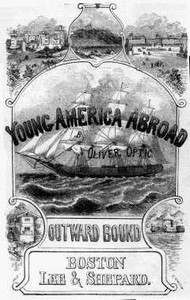
The academy ship Young America is both setting and character in Oliver Optic's 1866 novel. The narrative moves between the formal discipline of a floating school and the clandestine plotting of a student secret society called the Chain League. Early scenes establish a rhythm of watches, prayers, and muster, but also introduce a darker undercurrent: a conversation on the top-gallant forecastle reveals that the league's penalties include threats of being thrown overboard. The ship's physical spaces—the hatch, the forecastle, the yard-arm—become stages for both official order and rebellious schemes.
The Ship as a Contained World
The Young America carries eighty-seven boys, but the story focuses on a few key figures. The preface describes the vessel as having “a little world, with all the elements of good and evil, within her wooden walls.” This is not merely a metaphor: the narrative repeatedly returns to the ship's physical layout to define scenes of authority and transgression. The principal addresses the crew from the hatch; secret meetings occur on the top-gallant forecastle, a spot noted for having “no railing.” The ship's routine—watches, meals, prayers—structures the boys' days, but the text also shows how easily that routine can be subverted when boys gather in less supervised areas.
The Chain League's Mechanics
The secret society called the Chain League is introduced through a tense dialogue between Shuffles and Wilton. Shuffles outlines a penalty for betrayal: “you will fall overboard accidentally, some night when you are on the lookout, or out on the yard-arm.” The league's appeal to Shuffles is described as “the clap-trap of the secret league,” and the narrator notes that its inspiration comes from “a secret political organization in Europe” and from “Venetian tales” of “bravos, assassins, and decayed princes.” The league is thus a literary construct within a literary work, blending imported melodrama with the shipboard hierarchy. Wilton's reluctance—and his relief when the watch ends—shows that not all boys are drawn to this drama.
Discipline and Its Public Performance
The morning after the league's discussion, the principal calls Shuffles forward during muster. The scene is staged: Shuffles “came forward” and “took position by the side of the principal,” and the principal instructs him to “repeat after me.” The public nature of the correction is emphasized—all hands are present. Shuffles's earlier “becoming exhibition of meekness” contrasts with his earlier boldness, suggesting that the ship's discipline relies on visible submission. The text does not reveal the full outcome of this scene in the excerpts, but the pattern is clear: the ship's order is maintained through ritualized confrontations that the entire crew witnesses.
Movement Between Public and Private Spaces
The narrative frequently shifts between the collective and the private. After the tense forecastle conversation, the boys “went down and mingled with their shipmates, who were talking about what they should do and what they should see in Ireland.” The transition from the isolated, dangerous talk of the league to the ordinary chatter of future travels is abrupt. Similarly, the ship's daily schedule—watches, breakfast, prayers, muster—provides a public rhythm that the secret league must work around. The text uses these movements to show how the boys navigate between the official life of the ship and their own hidden alliances, with the ship's architecture enabling both.
Readers attentive to the ship's geography will notice how Optic uses specific locations—the forecastle, the hatch, the yard-arm—to mark shifts between authority and conspiracy. The excerpts offer only fragments of the Chain League's full arc, but they establish a pattern of tension between the school's reformatory mission and the boys' appetite for secret societies. The story rewards attention to how the physical vessel shapes both the routine and the rebellion.
Years between them, yet the same salt air clings to both. Outward Bound taught me how a ship’s wooden walls hold a boy’s whole moral universe. Then, reading of Nelson and the grateful Indian, I felt that familiar sea-soaked kinship—not adventure for its own sake, but the quiet shaping of character against the tide. The Story of Nelson also "The Grateful Indian", "The Boatswain's Son" — Text and Context whispers the same old truth.
Evelyn Thompson
4 weeks ago-
Amanda Wesley Campbell - 3 weeks ago
Outward Bound is a classic coming-of-age sea story that combines adventure with moral lessons. The characters are likable and the journey is exciting, but the pacing can drag in parts, and the language is quite dated. Still, it offers a glimpse into 19th-century life and seamanship. Good for dedicated readers of historical fiction, but might not hold the attention of those expecting fast-paced action. -
Tamara Elliott - 1 week ago
A thrilling maritime adventure that captures the spirit of youthful exploration! The story follows young Americans on a voyage filled with storms, new experiences, and camaraderie. The descriptions of sailing are vivid, and the plot is engaging with plenty of twists. It's a wholesome tale that teaches persistence and teamwork. Perfect for boys who dream of the sea. A real page-turner from start to finish. -
Christine Crawford - 4 days ago
This book is a product of its time, filled with stereotypes and jingoistic attitudes that are hard to stomach today. The plot is predictable and the characters are cardboard. The adventure aspects are undercut by lengthy moralizing passages. There are far more engaging and modern adventure stories for young readers. Unless you're researching old children's literature, it's best to skip this one.
Your personal reading reflection
Build a private reading journal entry for this title.
Camila Thomas
1 month ago