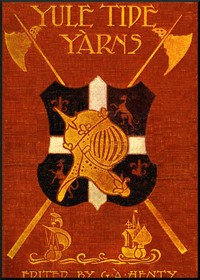
Yule-Tide Yarns — Key Ideas to Explore
Edition facts
Read the Text
y had dropped the French prefix, and now simply called themselves Vignerolles. Their branch of the family had been the younger one. The Barons de Vignerolles had remained Catholics, and had possessed their wide estates in peace, being among the largest landowners in Provence. The connection between the two branches had been always maintained, and from time to time members of the English branch went out for a visit to the ancestral château, where they were always hospitably entertained; the fact that they had gone into trade, which would have been considered a terrible disgrace in France, being condoned on the ground that being among a nation of traders it was only natural they should do as their neighbours did.
Once or twice only had members of the senior branch paid a visit to London, and then not from any desire for travel, but simply because they were members of their embassy in London. These had brought back news that the Vignerolles held a high place in the Huguenot colony, that they lived in a fine old house at Hampstead, and were generally liked and respected among the great families who lived near them.
The _Tartar_ had for the last three years been on the Mediterranean station. Although the English people regarded with the utmost horror the events that were taking place in France, there was no open breach between the two nations, and it was only when the king was brought to trial, and executed on 21st January 1793, that the popular feeling reached a height that rendered war inevitable; the French ambassador was ordered to leave England, and on 1st February the National Convention declared war.
During the three previous years Vignerolles had twice been granted a fortnight's leave of absence to visit the château of his distant kinsman, and he had thoroughly enjoyed his stay there. The midshipman was as strange to the baron and his family as they were to him. The baron was a typical specimen of French noble: he was kindly by nature, and an easy lord to his tenants; but he exercised all the seigneurial rights of his ancestors, regarded the lower class with supreme contempt, and was an uncompromising opponent of the changes that were being instituted by the States-general.
"They are ruining France!" he exclaimed. "The idea of a parliament of advocates and doctors, men of low birth, giving laws to France, and treating the chambers of the lords and clergy as if they were of no account, is monstrous. Were I the king I would send down a couple of regiments, close the chamber, and hang a score of their leaders."
Still greater did his indignation become when he heard of the capture of the Bastile, and that the king had been brought by the mob from Versailles to Paris. He himself at once posted off to the capital, and was one of the party of nobles who had implored the king to call upon the army to restore order, or at least to bring in two or three regiments to form a royal guard. He was one of those who had fought to the last against the mob when they stormed the Tuileries, and had been left for dead. The two valets he had taken with him had at night carried off his body, which they were permitted to do by the mob, under the belief that he was dead. He had, however, recovered, and finding that the king had refused to countenance any attempt to rescue him by force, had returned to his château. He was no longer violent, but remained in a state of the most profound depression, seldom speaking, and wandering about the house murmuring, "Poor France, poor France!"
In vain his friends represented to him that the nobles were everywhere being seized, and that for the sake of his wife and girls he ought to cross the frontier into Italy while there was yet time. He only replied, "It shall never be said that a de Vignerolles fled before this canaille. They can murder us, but they cannot make cowards of us." The baroness was a bright and kindly woman, and her daughters charming girls, though with some little of their father's pride of ancestry. The formal service of the house, the strict etiquette, and what the midshipman considered ridiculous pomposity, surprised and amused him as much as did his utter disregard of ceremony, his lively ways, merry and unrestrained laughter, amuse his far-away cousins. The baron, who might have been offended by it, paid no attention to what was going on around him, and his presence acted rather as a damper upon his visitor's high spirits; but when alone with the girls and their mother, he was free to say and do what he liked, and they felt their life, which was now an anxious one, brightened by his visits.
When Peter Vignerolles was appointed to the command of the newly captured schooner, the captain of the _Tartar_ said to him: "As senior midshipman I should in any case have given you the command of the _Alert_, but I know that you will be specially pleased to be in command of her now. There can be no question that the position of your friends at the château is a most precarious one, and the baron himself must be mad to compel his family to run such a frightful risk. If he likes to throw away his own life, well and good; but he has no right to expose his family to such frightful dangers; and he has not the excuse of ignorance, for scores of noble ladies have been murdered by this bloodthirsty mob. It may be that at the last moment there will be a chance for them to escape, and if you can in any way assist them to do so without running too much risk, I think that you will be justified in acting.
"I do not authorise you to take any action, because I know nothing of the circumstances; but our general instructions always have been to give shelter to French royalists, and to carry them to the nearest port where they can be landed with safety to themselves, and I certainly should not myself hesitate to send a boat ashore to take them off. You know the first time that you paid them a visit after we came out here you brought the baroness and her two daughters to see the frigate, and I feel therefore personally interested in them, and shall be glad to hear that they have made their escape; so that if you get a message saying that they will come down to the shore you will be more than justified in sending a boat for them, and even in running a certain amount of risk. However, I must leave the matter to your discretion."
"Thank you, sir; but I am afraid that the baron will neither take any step for his own safety, nor permit them to leave the château without him; still I shall do anything that I possibly can to look after them."
"I shall send young Harding with you, and the boatswain's mate. If you capture any prizes you had best turn the crews adrift in their own boats with a couple of oars; we don't want to cumber ourselves with prisoners. You had better keep the prizes with you until we come across you again; in that case five men would be enough to man one of them, while if you were to send them down to Gibraltar you would want a petty officer and eight or ten men. Don't cumber yourself with worthless prizes, burn or sink any small craft; but, of course, if you get hold of a ship returning full of goods from one of their colonies, she would be worth convoying there at once."
And so Peter Vignerolles had sailed away in the _Alert_, the crew being as pleased as he was at the prospect of an expedition on their own account away from the frigate.
"It is disgusting--isn't it, Peter?" Harding, who was two years junior to Vignerolles, said, after he too had taken a look at the château through the glass--"to think that your friends are there, and that the 'reds' from Marseilles may go up there any day and drag them off to prison."
"The brutes!" Peter said savagely. "Look here, Harding; I mean to land to-night and go up and see the ladies. I shall not see the baron. I regard him as half-cracked, and he would be just as likely as not to take it into his head that now the two countries are at war, it would be his duty to hand me over to the authorities. Besides, it is just as well to keep him in the dark about it altogether. I want to let them know that I am in command of this schooner. Of course I am supposed to cruise generally along the French coast; but I intend to keep pretty close here, of course running out to sea and picking up any craft that are making for Marseilles or Cette. The _Tartar_ will be watching Toulon, and although my orders are for general cruising, I know by what the captain said that he will not be put out if I keep a good deal in this neighbourhood, where, indeed, I have a better chance of picking up prizes than I should have if I went farther west. Anyhow, I want to let them know that we are here, and shall be ready to take them off if necessary. If they want to speak to us, I shall tell the girls to hang out a red curtain from their window; if they want to come off, they are to hang out a white one. We can make them out plainly enough with a glass from here. Of course I cannot guarantee that we shall be here when we are most needed, for no doubt the gunboats from Cette and Marseilles will both be patrolling the coast; besides, we may be a hundred miles away in pursuit of a prize. However, it will be a satisfaction for me to know that I have done all that is possible, and it may be some comfort to them to know that if they can find their way down to the shore, and signal from there when they see us, they will have a chance of escape."
"Will you go in disguise?"
"Yes. We took two or three suits of clothes from that fishing-boat that we overhauled yesterday. I did so on purpose. You see, if one was going on such a business among what you might call civilised people, I should go in uniform, for then if I were caught I should not be shot as a spy; but among these ruffians the uniform would be no protection for me, and I shall therefore go in one of the fishermen's suits. You see I speak French as well as English, and shall run very small risk. Of course I shall take a brace of pistols and a good heavy stick, and if any one interferes with me they must take the consequences."
After proceeding a mile farther along the coast the schooner's head was turned seaward, and she ran twenty miles off the coast. Just as Vignerolles was about to give the order to bring her head round again, the look-out from the cross-trees shouted down, "A sail on the weather-bow."
"What does she look like?" Peter asked.
"I can't make her out yet, sir, her upper sails are only just up, but I should say that she was a large craft."
Peter gave the order to lower the top-sails. "We had better keep out of her sight as long as we can, Harding; she may be a French frigate or man-of-war making for Toulon, and as she has the wind pretty nearly free, it would be as well to give her a wide berth. If she is a merchantman, we will sail out to meet her. It is not likely that she has got news yet of war being declared, and she won't suspect any harm until too late."
It was some time before the man at the mast-head again hailed them.
"She is a three-masted ship, sir, but I don't fancy from the cut of her sails that she is a ship of war."
"I will come up and have a look at her myself," Peter said, and slinging his glass over his shoulder he made his way aloft.
"Yes, she is certainly a trader," he said, after a long look at her. "Let her go two points more off the wind. Mr. Harding, we shall cross her course a little ahead of her, and that will put Cette nearly dead astern of us, and she will suppose that we have only just come out and are making for Corsica."
The top-sails were hoisted again, and the schooner ran along fast, for the breeze just suited her, being sufficiently strong to carry all sail with comfort. They rose the other ship fast. There was no longer any doubt whatever as to her being a trader. They could presently make out that she carried twelve guns, six on each side. Peter went to the man at the wheel--
"Keep her up a point," he said; "we will pass a couple of cable lengths under his stern."
In the meantime the guns had been loaded, and all the crew save ten ordered to sit down under the shelter of the bulwarks, so that those watching her should not see that she carried more hands than the usual company of a craft of her size. The manner in which the vessel kept on her course without making any alteration in her sail spread, showed that there was no suspicion whatever in the minds of her officers that she was an enemy. The _Alert_ was flying the French flag.
"Get the ensign ready for hoisting," Peter said, when within a quarter of a mile of the Frenchman. The course had been accurately laid, and she crossed the trader's stern at a distance of some ten lengths; then the helm was put up, the sheets eased off, and in half a minute she was in the Frenchman's wake, laying her course north. "Bring her up alongside of her to windward," Peter ordered, at the same moment the tricolour was lowered and the white ensign run up. The instant this was done loud shouts were raised on board the Frenchman; there was a tramp of many feet, and it was evident that the wildest confusion reigned. The _Alert_ went so fast through the water that in three or four minutes she was alongside. Peter sprang on to the rail and shouted--
"Lower your flag or I will sink you." The order was not obeyed. "Take her alongside," he said to the helmsman; and then to the crew, "Now, men, prepare for boarding her." The sight of the thirty sailors armed to the teeth completed the alarm on board the Frenchman, and their flag came fluttering down just as the sailors sprang on the deck. Numerically the French crew were considerably stronger than the British, but they were taken hopelessly by surprise. A few had caught up arms, and the tarpaulins had been hastily dragged from the guns, but the ammunition had not yet been brought on deck.
"What is the meaning of this, sir?" the French captain exclaimed, as Peter leapt down on to the deck.
"It means, sir, that there is a state of war between England and France, and that you are my lawful prize." The captain uttered a string of French oaths and dashed his cap down on the deck in comic despair. "It is the fortune of war, monsieur," Peter said quietly. "I have no doubt that if you had been prepared you would have offered a gallant resistance, but you see it has been a complete surprise, and of course a very unpleasant one. What ship is this?"
"The _Martinique_, 800 tons burden, laden with coffee and other colonial produce."
"Thank you, captain. She is a prize worth taking; she looks a new vessel."
"It is her first voyage," the captain said.
"How many hands do you carry?"
"Forty-five all told, and, as you see, twelve guns. Ah, monsieur, if we had had time to load and arm ourselves you would have had a different reception."
"No doubt, no doubt; but you see we sail three feet to your two, which more than counterbalances the difference in strength, and it would have been a pity indeed to have knocked such a fine ship about and to have killed a good many of your men when it would have come to the same thing at last. Now, I should like to have a look at your papers."
The prize was indeed a valuable one, for although she had filled up at the French islands, she had previously traded along the South American coast, and was laden to her utmost capacity. The crew had been ordered into the forecastle, and a heavy cable had been coiled against the door.
"We will run in, Harding, to within ten or fifteen miles of the land, then we will lay her to. It will be dark by that time. I will leave you with twelve men in charge of her. You will, of course, bring up ammunition and load the guns. I shall run in and anchor as close as I can to the land--of course showing no lights--and then make my way up to the château. It will take me an hour to go there and an hour to return. I may have some little difficulty in getting speech with them, but certainly in two hours I shall be on my way back. With this wind I ought to get ashore by half-past eight, and by half-past twelve shall be on board again. Show no lights till two o'clock, and then hoist one above another. I shall know by looking at the list the captain gave me, where the _Tartar_ is likely to be to-morrow, and shall make straight for her, and cruise about until she comes up. The ship and her contents are worth, I should say, from twenty to twenty-five thousand pounds. I shall hand her over to the _Tartar_, and let them put a prize crew in her. It would never do to weaken ourselves by sending ten or twelve men in her to Gib. No doubt the _Tartar_ will convoy her till she is off the coast of Spain."
Consulting the list that his captain had given him, he found that the _Tartar_ was to put in for fresh provisions at Genoa, and intended to be back on the following day and take up her station outside the southernmost of the Isles of Hyères.
"It could not be better," he said to Harding. "I doubt with this wind whether she will be there, but we shall only have to keep on east till we meet her."
"Then you won't land the prisoners to-night?"
"No; they would make their way to Marseilles, and it would soon be known that this schooner is English, of which at present they must be in doubt, as we have always kept the French flag flying. If we don't fall in with the _Tartar_ to-morrow we will land them east of Toulon; the authorities there are not so likely to worry themselves over a merchantman being captured as they are at Marseilles."
This arrangement was carried out, and it was just half-past eight when the _Alert_ dropped anchor half a mile off the shore, and repeating his order that no lights should be shown, Peter was rowed ashore by eight well-armed sailors.
"Lie off a couple of hundred yards till you hear my call. You had better drop your grapnel, or you will drift along and have to keep on rowing, and I might have a difficulty in finding you."
G. A. Henty’s Yule-Tide Yarns gathers twelve tales by different authors, each centered on a young person facing danger—often at sea, sometimes in exotic locales. The editor’s hand is light, letting each writer’s voice emerge: John Bloundelle-Burton’s dialogue bristles with threat (“Stab you under the shoulder in a dark alley”), while Robert Leighton builds suspense through sensory detail (“The sight and sounds that met him were such as he had never before encountered”). The collection’s title suggests a fireside audience, but the stories themselves are anything but cozy; they are compact, action-driven narratives where a single choice can mean survival or ruin.
Dialogue as a Tool of Characterization
Across the excerpts, dialogue does more than advance plot—it defines moral boundaries. In the excerpt from “Longitude Ten Degrees,” the pirate Goff speaks with a bluff cordiality (“So ho! my lad… You have come back to your senses, eh?”) that contrasts with his ruthless actions. The boy Ben’s replies are measured and evasive, revealing his inner resolve. Similarly, in “A Flight from Justice,” a character’s threat (“I want your company”) carries an undercurrent of violence that the surrounding description confirms. The authors use direct speech to signal shifts in power: a command, a plea, or a lie can change the course of a scene. Readers attuned to these verbal cues will find the stories reward close attention to who says what, and how.
The Weight of Physical Detail
Descriptive passages in these yarns are lean but pointed. When Ben observes that the pirates “had taken possession of the brig in good earnest,” the phrase “good earnest” carries a double meaning—both thoroughness and grim intent. Later, the smallpox outbreak is rendered through clinical observation: “some of the men were beginning to move languidly and to look haggard and sick.” The authors avoid florid language, instead selecting concrete details that heighten tension. The illustrations listed in the contents—such as “The quartermaster fired his two pistols, and the man fell”—mirror this preference for decisive, visual moments. The physical world is never decorative; it is a stage for action.
Moral Dilemmas and Unspoken Codes
Several protagonists face choices that test their integrity. Ben, though captured, “resolved in his mind still to do what lay in his power to retake the brig,” acting as “a servant of the King.” His loyalty is internal, not proclaimed. In “An Outlaw’s Fortunes,” a character is entrusted with a royal charge (“This is the son of your king. I charge you with his care”), a burden that reshapes the story’s stakes. The authors do not lecture; they embed ethical questions in the action. A reader might ask: What would I do in Ben’s place? The stories provide no easy answers, only the pressure of circumstance and the quiet weight of a promise.
Structure and Pacing in Short Adventure Fiction
Each story in the collection is a self-contained episode, typically opening in medias res and closing with resolution or a pause. The excerpts show a preference for short scenes and rapid shifts: a cabin conversation, a hidden passenger, a sail sighted on the horizon. The authors use time markers (“On the thirteenth day the Aurora was again within sight of the St. Kilda islands”) to compress weeks into paragraphs. This economy of scale means that every detail—a locked chest, a stolen uniform, a woman’s true identity—must earn its place. Readers accustomed to longer novels may find the pace bracing; the stories demand attention but reward it with swift, satisfying arcs.
These twelve yarns share a common DNA: young protagonists, moral pressure, and a world where danger is never far. Readers who enjoy Henty’s own novels will recognize the emphasis on duty and resourcefulness, while those new to Victorian adventure fiction may appreciate the variety of voices. The collection is best read one story at a time, letting each author’s distinct approach to dialogue and description stand on its own. For a deeper experience, compare how different writers handle similar situations—a sea chase, a hidden identity, a moment of decision.
Reading these twelve yarns, I remembered huddling under a blanket as a boy, my flashlight illuminating storm-tossed decks I could almost feel. That same hush of peril and nerve returned when I later found Foxholme Hall, and Other Tales — Themes and Context, where quieter knots of courage unwind at a gentler pace. Both felt like low fires in a cold room—warm enough to sit by, long after the last page turned.
Isaac Thompson
3 weeks agoGrace White
1 week agoGrace Moore
1 week agoDaniel Thompson
3 weeks ago-
Casey Margaret Gonzalez - 3 weeks ago
A delightful collection of Christmas and winter-themed short stories and poems that perfectly captures the cozy, reflective spirit of the season. Each yarn is well-crafted, with a mix of genres—from ghostly tales to heartwarming domestic scenes. The writing is rich and evocative, often with a touch of humor. It’s the kind of book you can dip into on a snowy night by the fire. Highly recommended for anyone who loves 19th-century Christmas literature. -
John Garcia - 2 weeks ago
This collection disappointed me. Despite the promising title, many of the stories are generic and fail to evoke the magic of Christmas. The writing often feels overwrought and the plots are predictable. I particularly disliked the occasional ghost stories, which were more confusing than eerie. The book might have been popular in its time, but to a modern reader, it feels like a relic that doesn't hold up. There are much better Christmas anthologies available. -
Ashley Leach - 1 week ago
Overall, 'Yule-Tide Yarns' is a pleasant holiday read with a nice variety of stories. Some are genuinely enchanting, with vivid descriptions and strong characterizations. However, the quality is inconsistent, and a few stories feel rushed or underdeveloped. Also, the language is sometimes dated, which might deter modern readers. It’s a decent choice for holiday reading if you enjoy classic literature, but don't expect every tale to be a masterpiece.
Your personal reading reflection
Build a private reading journal entry for this title.
Owen Brown
5 days ago