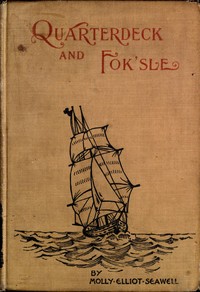
Quarterdeck and Fok'sle: Stories of the Sea — Story, Setting & Ideas
Edition facts
Calculated from edition completeness, EPUB availability, text structure and catalogue metadata. Not a user rating.
Read the Text
I. THE CAPTURE OF THE FORT.
The friendship between Young Brydell and Grubb the marine came about in this way.
One morning in May, just after Admiral Beaumont had finished the beautiful toilet he made at precisely eight o’clock every morning, he threw wide his bedroom shutters to see if the toilet of the navy yard grounds had been made too. For the admiral was possessed by a demon of neatness and order that is apt to develop in a naval officer long used to the perfect cleanliness and discipline of a man-of-war.
The admiral was the tenderest-hearted old fellow in the world, but the strictest sort of martial law prevailed in the matter of tidiness in every part of the navy yard over which he exercised or could claim jurisdiction.
A perpetual warfare raged between him and the nursemaids at the yard. The nursemaids _would_ let the babies roll over on the admiral’s dearly loved grass, and the sight of white dimity sunbonnets, dropped on the gravel paths, was not wholly unknown.
The admiral was a bachelor of long standing and had a wholesome awe of babies and their mammas, although he ordered the babies’ papas about without any awe of them whatever. In vain he tried to negotiate with the officers’ wives, offering as a basis that the babies be permitted a promenade around the main walks between two and four every day, the walks to be immediately rolled afterward. The officers’ wives simply laughed at him, and the babies continued to kick up the gravel, and the admiral retired completely discomfited.
As for the small boys at the yard, they harrowed the admiral’s kind soul to that degree that he gloomily declared he would have the flag half-masted and make the band play a dirge before the very next house in which a boy baby was born. Nevertheless he had been known more than once to have begged small boys off from the avenging birch switch.
To this general antagonism to small boys one exception was made—Young Brydell. He was called Young Brydell because, young as his father, the ensign, was, the boy was actually twenty years younger—being nine, and a beautiful, terrible, lovable imp. Perhaps it was because Young Brydell had no mother that the admiral and everybody else, except Aunt Emeline, winked at the mischief in which he reveled. When Young Brydell drew his first breath his mother had drawn her last—and so from the beginning a tender atmosphere of love and pity seemed to surround him.
However, the escapade in which young Brydell figured that May morning had so many elements of atrocity that the admiral at first determined to punish him just as he would any other malefactor. Grubb was the admiral’s orderly, and on this particular morning he had just knocked at the bedroom door with the letter bag, when he heard something between a roar and a shriek that caused him to dash the door open expecting to find the admiral rolling on the carpet in an epileptic fit.
“Orderly!” shouted the admiral, turning as red as a turkey cock with rage, “direct the pick and shovel squad at once to level that construction, and bring that young gentleman here to me,” pointing out the window to Young Brydell. Grubb then saw what was up.
In the middle of the great lawn, just in front of the admiral’s house, was a dirt fort, constructed with no inconsiderable skill. The turf for about twenty feet square had been ruthlessly torn up to make the glacis, and over it floated a small American flag about as big as a pocket handkerchief.
On top of the glacis stood Young Brydell with a miniature rifle pointed straight at the admiral’s window. Around him lay the bodies of:—
I. Reginald Cunliffe, the captain’s only child and a mother’s darling, who had been repeatedly told not to play with Young Brydell for fear he would get hurt. At that moment the mother’s darling was representing a wounded man and, rolling over in a new jacket was asking in feeble tones for water.
II. Jack Sawyer, the doctor’s son, who personated a dead man with intermittent returns to life to see how the thing was going.
III, IV, V. Dick, Rob, and Steve, young gentlemen belonging to the yard who obeyed Young Brydell implicitly, although at least two years older than he, and who submitted to pose as Indians slain by his victorious hand.
VI. Micky O’Toole, the washerwoman’s boy, who, although directed to fall dead at the first fire, had failed to do so and was crawling forward on all fours, with a knife between his teeth and a tomahawk in his hand to assassinate Young Brydell.
Grubb double-quicked it downstairs, but not so fast that the admiral was not right on his heels. The pick and shovel squad were just passing as Grubb called out to them:—
“The admiral says as how that there construction is to be leveled at once”—
“And that young gentleman sent immediately to me!” bawled the admiral from the doorway.
The squad started toward the middle of the lawn, where the turf had been slaughtered to make Young Brydell a holiday. The admiral, swelling with righteous wrath, remained on the steps, and Grubb, laughing in his sleeve, made a bee line for Young Brydell. Grubb walked as elegantly as any officer and was a fine, tall, handsome fellow to boot.
As the pick and shovel squad approached, Young Brydell, raising his miniature rifle, pointed it straight toward them and shrieked out an expression he had read in a book. “Up, men, and at ’em!”
But the men didn’t “up and at ’em.” They were too much engaged in watching the coming conflict between Grubb’s brawny arm and Young Brydell.
The rifle wasn’t much of an affair, but it had been known to kill a cat twenty feet away. Young Brydell, who had the face of a cherub and the alertness of a monkey, quickly brought the rifle to his shoulder and aimed it straight at the approaching Grubb.
“The admiral says,” shouted Grubb in his big baritone, “as how I’m to bring you immediately to him, and the Lord have mercy on your soul!”
Grubb, in saying this, reached forward to the rickety little flagstaff, meaning to save the flag. But Young Brydell construed it differently and thought Grubb meant to insult the national ensign.
“If you touch that flag, you’re a dead man!” shrieked he in his baby treble; and at the same moment, the toy rifle being at his shoulder, he called out to his demoralized command:—
“Ready—right—oblique—FIRE!”
And bang went the rifle in Grubb’s face!
Grubb put his hand to his ear, and when he brought it away, blood was plentiful on it. A queer look came into his eye. “By the jumping Moses, the monkey’s shot me,” said Grubb, reflectively and scarcely knowing what he was saying.
The admiral, standing on the porch, gave a sort of gasp when the shot rang out—and every man in the pick and shovel squad stood stock still for a moment. The boys, except Micky O’Toole, all ran away immediately.
Grubb was the first to recover himself. Young Brydell had never lost his composure and was now holding the rifle at parade rest, and the rifle was exactly as high as he was.
“You come along!” suddenly cried Grubb, seizing the boy and the rifle too, and forgetting to drop the flag. It hurt Young Brydell’s dignity to be hauled off so summarily in the presence of the public, and it also hurt his shoulder, but he said not a word until he stood before Admiral Beaumont. The admiral was small and lithe and had a pair of light blue eyes that could look through a man and nail him to the wall—and these eyes were fixed upon Young Brydell in a way that would have made him flinch to the marrow of his bones, had he been a man instead of a little lad.
“BOY!” said the admiral, “I sent for you in order to reprove you for your outrageous behavior in tearing up the turf and making ruin and destruction of the government’s lawn. I find you, instead, guilty of a most terrible act—a thing much more serious than any destruction you might do to government property. But for God’s Providence you might be this moment a murderer, boy as you are—for I saw you take deliberate aim at the orderly and fire in his face!”
“Oh, no, sir!” chirped Young Brydell quite cheerfully; “I didn’t mean to shoot, you know; I was just trying to scare Grubb!”
At that, Grubb, who had been standing very rigid, with his handkerchief to his bleeding ear, suddenly smiled broadly and whispered involuntarily under his breath:—
“You see, sir,” continued Young Brydell in a tone of animated argument, “it was like this. We got up early this morning and built the fort—there were seven of us, and it didn’t take half an hour.”
“There were others responsible, then?” asked the admiral, for like everybody else he had taken it for granted that Young Brydell was bound to be the ringleader, if not the sole culprit.
Young Brydell thrust his hands into the pockets of his sailor suit, planted his feet wide apart, and reflected.
“Well, sir,” he said, “there were the others—but I started it. Cunliffe was afraid; he said he knew his mother would punish him, but I told him I’d do something worser for him than his mother would if he didn’t obey orders—because I’m captain of the company; it’s C company, sir, you know, and orders must be obeyed.”
“Go on, sir!” said the admiral sternly.
“Cunliffe was afraid, and so he did as I told him. The other fellows, except Micky O’Toole, said they were afraid of _you_—they say you are a regular Tartar about the grass.”
“They do—do they? Continue, I beg,” replied the admiral with a snort.
“But I told ’em,” cried Young Brydell in a triumphant voice, “that _I’d_ fix _you_. I said: ‘We’ll plant the United States flag on that fort, and won’t anybody, not even the admiral himself, dare to pull it down!’”
The admiral at this coughed and began to twist his gray mustache.
“When I saw Grubb coming, sir, as I tell you, I just wanted to frighten him, but before I knew it, just by accident, sir, the rifle went off, and the first thing I knew the ball had hit Grubb’s ear. But I’m sorry for it, and when I get my ’lowance next week, I’ll give it to him. I get a silver half-dollar every Saturday, sir, from papa, but I think, sir,—I think Grubb deserved what he got for hauling down the flag, and if I’d have thought of it, I’d have peppered his legs for him, sure enough.”
There was a pause after this. The admiral’s keen old eyes looked into Young Brydell’s brown ones, and the man’s eyes had a kind of simplicity in them like a child’s, while the child’s had a determination like a man’s. Grubb still stood with a broad smile on his face, and the blood dripped upon the handkerchief he held to his ear.
“Now,” said the admiral, “will you tell me what you think I ought to do with you and your companions in mischief?”
“I think—I think you oughtn’t to do anything with the other fellows except me and Micky O’Toole, ’cause we led ’em on. Micky didn’t think about the fort first, but as soon as it was started, Micky helped me on and said he didn’t care if he did get a licking.”
“I am not concerned about Micky O’Toole,” said the admiral. “Micky, as I understand, occupies a subordinate position in your company.”
“He’s first sergeant, sir.”
“Micky, I take it, is merely your tool. Very well, sir, I shall report this whole thing to your father, and you must take the consequences. Orderly, make my compliments to Mr. Brydell, and ask him to do me the favor to come here. But stop—your ear.”
“’Tis no matter, sir,” answered Grubb, touching his cap. “I’ll call by the dispensary after I’ve done my message.”
The admiral stepped through the open hall door for his cap, and putting it on as he came out, said to Young Brydell with awful sternness: “Remain where you are until I return.”
“Yes, sir,” answered Young Brydell very respectfully.
CHAPTER II. YOUNG BRYDELL’S CHUMS.
The pick and shovel squad were hard at work, leveling the fort, and the sight of his beloved turf so maltreated made the admiral’s heart ache. But he began to examine the fort. It was very cleverly done, and the admiral’s gray mustache worked in a half-smile as he stood and looked at it. Presently up came Young Brydell’s father, the handsomest, trimmest, young ensign imaginable, but, as Grubb expressed it, “You see trouble in his face.”
“Good morning, Mr. Brydell!” cried the admiral quite jovially. “Have you heard of the doings of your young one?”
“I have, sir,” answered Young Brydell’s young father, looking unhappy, “from the orderly here, whom I asked. Believe me, admiral, the little fellow has not a bad heart; he is only mischievous, and he has no mother”—
“He’s the finest little chap I ever saw,” cried the admiral. “He wasn’t going to shoot, really; the thing went off by accident; he wants to give the orderly all his pocket money and takes the whole blame of this performance on himself. Look at this construction—tolerably ingenious this for a youngster.” The admiral groaned slightly as he said this.
The picks and shovels were fast leveling the fort, but the lines remained still. Young Brydell’s father could not forbear laughing.
“And you’ll give him a hauling over the coals,” said the admiral, “but I positively forbid any other punishment. The little lad has no mother, and we mustn’t forget that.”
“I never forget it,” answered Young Brydell’s father. “I do my best by the child—I keep him with me all I can—but as you say—he has no mother”— The ensign stopped.
“I know all about it,” said the admiral briskly, “so come along and we’ll try and frighten the youngster.”
Mr. Brydell smiled. “I’m afraid we can’t do that, sir,” he said, “but we can promise to take the rifle away, if he isn’t more careful.” This is about what the lecture amounted to after all.
When it was over, and Young Brydell was marching off holding on to his father’s hand, he called out to the orderly who was coming toward them from the dispensary:—
“I say, Grubb, how funny that piece of court plaster looks on your ear.”
Grubb touched his cap in response to the ensign’s salute and answered gravely:—
“It feels a deal funnier than it looks, sir.”
“Now make an apology to the orderly,” said the ensign sternly.
“I’m sorry, Grubb, I’m awful sorry the rifle went off—’cause I’ve got a big scolding from papa and the admiral, too. But you hadn’t any business touching the flag; you know you hadn’t. Come around next Saturday morning and I’ll give you my half-dollar.”
“Thanky, sir,” answered the orderly, “but my feelin’s is too much hurt for to take money from you.”
“Well, then,” said Young Brydell promptly, “I’ll ask you to my birthday party instead. I’m going to have a birthday next week. I’ll be nine years old; and I’m to ask anybody I like, and I’ll ask you and Capps, the watchman, and some other fellows. Will that help your feelin’s?”
“Course it will, sir,” answered Grubb again; “and sailors and marines is so fond o’ one another.” Capps was a retired boatswain who was a watchman at the yard, and as Grubb said this he slightly closed his left eye.
On that understanding they parted. It was Young Brydell’s proud privilege on his birthday to ask his own guests, and he had before included Capps, who was until the advent of Grubb his most intimate friend.
On this Saturday, therefore, there was a table set on the broad back piazza of the ensign’s quarters. Aunt Emeline disapproved of the whole thing, but Cunliffe’s mother, who was a kindly woman, saw that the cake was there with nine candles in it, and Young Brydell sat at the head of the table. All the members of Company C, including Micky O’Toole, first sergeant, were present, and Capps, a bronzed old seaman, and Grubb, who was almost as handsome as the ensign, Young Brydell’s father. His ear still had a red scar, but over a bowl of lemonade Grubb and Young Brydell swore eternal friendship, and the friendship lasted until the end came.
The ensign’s quarters were just back of the admiral’s great roomy house, where he dwelt in solitary magnificence; and Admiral Beaumont, sometimes finding the house lonely and silent,—as houses are where there are no women and children,—would look from his back piazza and often see a lonely little boy, too, in the ensign’s quarters. For Young Brydell was never made to go to school as regularly as the other boys, and was, unluckily, allowed his own way entirely too much—all because he had no mother.
The admiral, feeling sorry for the child and finding a kind of odd and pleasant companionship with him, would send Grubb over with the request that Master Dick be allowed to come over to luncheon, and even Aunt Emeline could not ignore that request. So Young Brydell would go off quite joyfully with Grubb and soon be seated opposite the admiral at the round table in the big dining-room. The two would then exchange reminiscences—Young Brydell pumping the admiral industriously about “When you were on the old _Potomac_, sir,” or “That time you were in the siege of Vera Cruz.”
Behind the admiral’s chair stood Billy Bowline, once captain of the maintop but retired because of deafness. This was a sore point to Billy, who always protested: “I kin hear everything I wants to, and I never missed a call from the day I j’ined the sarvice, and I kin hear the admiral a sight better ’n Grubb, the jirene.”[1] The admiral, though, always roared at Billy so loud that everybody in the yard could hear him bawling.
It was of course agreed that but one career was possible for Young Brydell, and that was the navy. The ensign thought so, and so did the admiral and Grubb and Billy Bowline and Capps, the watchman, who was a chum of Billy’s as well as of Young Brydell’s.
One day, though, a strange thing happened about Capps. Young Brydell, coming along from school, whistling the bugle call, saw Capps sitting in his usual place on the bench in the shade by the ordnance building. Young Brydell called out as usual:—
But Capps did not move. His eyes were closed, and Young Brydell, after playfully prodding him with a slate pencil, went his way. Presently he met Cunliffe, who also saw the old sailor sitting so still upon the bench.
“Let’s have some fun with old Capps,” cried Cunliffe.
“No, you sha’n’t,” answered Young Brydell stoutly. “Capps is a friend of mine and I won’t have him teased.”
Words followed this, and it ended by Young Brydell giving his young friend a kick on the shin, by way of testifying his loyalty to his old friend. Just then Grubb came along and asked the cause of the difficulty. Young Brydell pointed to Capps. Grubb went up to him, touched him, and then came back to the two boys, looking rather strange.
“You young gentlemen go along now; I know the admiral’ll want you to go along, and I’ll tell you all about it after a while,” he said hurriedly.
The book opens with a precise, almost fussy portrait of Admiral Beaumont, whose "demon of neatness" extends from his own toilet to the navy yard grounds. This domestic detail—complete with babies rolling on grass and white dimity sunbonnets on gravel—immediately establishes a tone of gentle comedy within a strict martial setting. The friendship between Young Brydell and Grubb the marine begins not at sea but in this orderly, slightly absurd world, hinting that Seawell uses small, concrete observations to build character and conflict.
Two Stories, One Moral Framework
The volume is divided into two distinct narratives: "A Quarterdeck Story" and "A Fok'sle Story." The first follows Brydell, a young naval officer, through a series of failures, a court-martial, and eventual redemption. The second shifts to 1776 aboard the British frigate Diomede, where a boy named Dicky becomes entangled in the American Revolution. Despite different settings—peacetime navy yard versus wartime Newport—both stories revolve around promises made and kept. Brydell's pledge to Grubb echoes across the entire book, linking the two halves thematically. Readers should note how Seawell uses these parallel plots to explore the same moral questions from different angles.
Voice and Sentence Rhythm
Seawell's prose is brisk and declarative, with a fondness for compound sentences that pile up actions: "It seemed as if in one minute her yards were squared, her sails furled, and her cable rushed out of the hawse hole in a blaze of sparks." This rhythm suits the nautical setting, mimicking the rapid, precise movements of a well-drilled crew. Dialogue is often formal yet natural, as when Esdaile says, "I thank the court for its very moderate punishment." The author avoids dialect or slang, giving all characters a similar measured speech. This uniformity may reflect the book's didactic purpose—the catalog lists "Conduct of life" as a subject—but it also creates a consistent, controlled narrative voice.
The Role of Minor Characters
Grubb the marine appears only briefly in the opening chapter, yet his death and Brydell's promise to him drive the entire quarterdeck story. Similarly, the boy Dicky in the fok'sle story is introduced as a prisoner taken from the brig Betsey, and his fate becomes central. Seawell uses these minor figures as catalysts for the protagonists' moral development. The author does not dwell on their inner lives; instead, they function as living obligations that the main characters must honor. This technique keeps the focus on Brydell and Captain Forrester, whose decisions reveal their character. Readers may notice how the book's structure subordinates adventure to ethical growth.
Evidence of the Book's Didactic Intent
The catalog subjects—"Conduct of life," "Courage," "Youth—Conduct of life"—are not merely tags; they are built into the narrative. Brydell's failures are explicitly moral: he fails to keep a promise, and his redemption comes through keeping another. Esdaile's transformation is described as a direct result of Brydell's visits: "Brydell began to see that Esdaile was indeed a changed man." The closing scene, where Minna consents to guarantee Esdaile's bond, reinforces the idea that moral support requires practical action. Seawell does not lecture; she embeds lessons in plot. The fok'sle story, with its Revolutionary setting, adds patriotic duty to the mix, but the core remains personal integrity.
Readers approaching Quarterdeck and Fok'sle should pay attention to how Seawell balances adventure with moral instruction. The two stories are best read as complementary halves of a single argument about honor and responsibility. The author's clean, efficient prose rewards attention to small details—a sunbonnet on a path, a precisely anchored frigate—that reveal character and theme. This is a book that trusts its young readers to grasp its lessons without heavy-handed explanation.
In Quarterdeck and Fok'sle, I often pause at the quiet way the sea teaches men to soften into honesty. That same patient lesson lives in Jack Mason, the Old Sailor — Context and Discussion, where the salt air feels like an old friend. Two books, different decks, yet the same gentle tide of moral growth lingers between their pages.
Leo Jackson
1 week agoGrace Rodriguez
3 weeks agoDavid Flores
4 days agoBenjamin White
1 week ago-
Nathaniel Robert Jones - 4 weeks ago
Quarterdeck And Fok Sle Stories Of The Sea is a tedious read. The stories are bogged down by excessive nautical jargon and lack the excitement promised by the title. Character development is minimal, and the plots are predictable. I struggled to finish it and wouldn't recommend it to anyone not already deeply interested in maritime history. -
Jeanette Newton - 2 weeks ago
Quarterdeck And Fok Sle Stories Of The Sea is a riveting collection of maritime tales that truly captures the spirit of the ocean. The author's vivid descriptions and attention to nautical detail make you feel like you're on deck, battling the waves. Each story is unique and gripping, filled with adventure and honor. Perfect for anyone who loves the sea! -
Timothy Gibson - 2 weeks ago
Quarterdeck And Fok Sle Stories Of The Sea offers a solid collection of sea stories with authentic atmosphere. Some tales are more engaging than others, and the pacing can be uneven. If you're a fan of classic naval fiction, you'll find plenty to enjoy, but casual readers might find it slow in parts.
How will you remember this book?
Save your reaction, strongest insight, and memorable passage.
Mia Jones
2 weeks ago