1

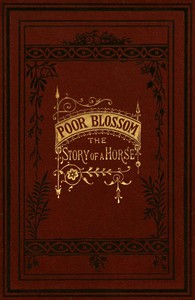
Poor Blossom: The Story of a Horse — Inside the Classic
(0 User reviews)
1036
Project Gutenberg
2020
Not confirmed
Conduct of life -- Juvenile fiction; Children's stories; Children -- Conduct of life -- Juvenile fiction; Animal welfare -- Juvenile fiction; Cruelty -- Juvenile fiction; Horses -- Juvenile fiction; Human-animal relationships -- Juvenile fiction
Readers of public-domain and historical texts
Project Gutenberg digital edition
en
Edition facts
Words
26,092
Reading time
114 min
Text sections
16
For Poor Blossom: The Story of a Horse — Inside the Classic, the stored edition analysis reports 26,092 words, 1 hr 54 min estimated reading time, and 16 detected text sections.
The text analysis averages about 21.7 words per sentence, while the detected sections provide another way to judge how the source is divided.
Project Gutenberg metadata also associates the work with “Conduct of life -- Juvenile fiction,” connecting these edition facts with the source record’s subject description.
Source:
Project Gutenberg record #63418
Edith Carrington's 'Poor Blossom' uses a first-person equine narrator to trace a horse's life through changing owners, from a kind farmer to a carnival cart horse. The narrative structure alternates between stable routines and public spectacles, with recurring motifs of grooming, betting, and the horse's internal reflections on human behavior.
Editorial Edition Score
4.8/5
★★★★★
★★★★★
Calculated from edition completeness, EPUB availability, text structure and catalogue metadata. Not a user rating.
How this score is calculated
- Description quality20 pts
- Title & short description10 pts
- Source metadata20 pts
- Text length15 pts
- Chapters / structure15 pts
- EPUB file integrity20 pts
Total of 100 points, scaled to a 2.5-5.0 range. Editions with an empty description or a missing EPUB file are not scored.
Edition quality
Read the complete public-domain text at its original source.
Read on Project GutenbergFrom its opening sentence—'The first thing that I remember is a green field enclosed by a stiff fence'—Edith Carrington’s Poor Blossom: The Story of a Horse establishes a first-person equine perspective that will carry the reader through a series of owners and settings. The narrative voice is distinctive: Blossom recalls early lessons from his mother, who 'has never laid a whip upon me,' and later reflects on human behavior with a mixture of curiosity and resignation. The structure follows a clear episodic pattern, each chapter marking a change in circumstance—from birth and breaking-in to sale, labor, and public exhibition.
Carrington uses the horse’s viewpoint to comment on human conduct, particularly the contrast between kind and cruel treatment. The excerpts show a careful attention to sensory detail: the feel of grooming, the sight of a flowered bonnet, the sound of betting talk. This editorial note examines how the work’s structure, recurring images, and movement between scenes shape its moral argument.
Episodic Structure and the Chain of Owners
The book is divided into twelve chapters, each titled to signal a transition: 'My Place of Birth,' 'Broken,' 'My New Master,' 'I Am Sold.—Mr. Harkaway,' and so on. This structure mirrors the horse’s experience of being passed from hand to hand. The excerpts show that Blossom’s narrative is less a continuous arc than a series of discrete episodes, each introducing a new human figure—farmer Bayne, the furniture dealer, Benjamin Bunter—and a new set of conditions. The chapter 'The Great Carnival' stands out as a set piece, describing a day at the races in detail. This episodic pattern allows Carrington to contrast different forms of ownership and treatment without needing a unified plot. The horse’s memory is selective: he recalls his mother’s lesson vividly but admits 'I cannot call to mind the earliest days of my existence.' This selective recall reinforces the sense of a life experienced in fragments.
Recurring Images: Grooming, Betting, and the Racecourse
Two images recur across the excerpts: grooming and betting. In 'The Great Carnival,' Benjamin Bunter gives Blossom 'an extra grooming, combing my coat and plaiting my mane with wonderful care' before the races. This careful preparation contrasts with the rough handling implied elsewhere. Betting appears as a male activity: Mr. King whispers about a 'tip' for Melrose, and the men discuss odds. The racecourse itself is presented as a 'great carnival'—a place of noise, crowds, and potential danger. Blossom’s reaction is mixed: he is excited by the prospect of 'green fields and a few hours’ fresh air,' but also anxious. The image of the flowered bonnet worn by Mrs. Bunter—'a walking object of envy'—adds a note of comic social observation. These recurring details ground the moral lessons in concrete, visual moments.
Movement Between Private and Public Spaces
The narrative moves repeatedly between the stable—a private, intimate space—and public arenas like the market, the street, and the racecourse. The stable is where Blossom receives care and where he overhears human conversations; it is also where he is left alone to 'think and wonder.' The public spaces expose him to crowds, noise, and the risk of mistreatment. In 'The Great Carnival,' the journey from 'the worst part of the bricks and mortar' to 'neat suburban villas' and finally to the racecourse traces a spatial arc from confinement to release. This movement is not merely geographical: it corresponds to shifts in Blossom’s emotional state, from curiosity to excitement to unease. Carrington uses these transitions to highlight the contrast between the horse’s inner life and the external demands placed on him.
Voice and the Limits of Equine Understanding
Blossom’s narration is limited by his animal perspective. He can describe what he sees and hears, but he cannot fully grasp human motives. When he kicks at Mr. Bayne 'purely from playfulness,' his mother scolds him: 'Some men are so stupid that they do not know play from vice.' This moment establishes a gap between equine intention and human interpretation. Later, Blossom wonders about 'the connection between horse and man, and the really important influence they have upon each other'—a reflection that is philosophical but still grounded in his limited experience. The narrative never pretends to omniscience; Blossom cannot explain why men bet or why Mrs. Bunter loves bright colors. This restraint gives the moral lessons a quiet force: the reader must infer the critique from the horse’s observations rather than from authorial commentary.
Readers approaching Poor Blossom should attend to the way Carrington uses the horse’s voice to filter human behavior. The episodic structure rewards attention to each new owner as a distinct case study in animal treatment. The recurring images—grooming, betting, the racecourse—are not decorative but functional, each carrying a moral charge. Because the excerpts are incomplete, it is unclear how the final chapters resolve Blossom’s fate, but the pattern of the earlier chapters suggests a cumulative argument about responsibility and care.
Reading Poor Blossom, with its quiet horse watching humans come and go, I kept drifting back to the gentler rhythms of Summer Days — Themes and Context. Both feel like long, warm afternoons where nothing much happens except small kindnesses and patient waiting. Blossom’s stable dust and that book’s meadow air somehow share the same unhurried breath.
There are no reviews for this eBook.
There are no comments for this eBook.
Reader reflection
Your personal reading reflection
Build a private reading journal entry for this title.
Your progress
0
/
10
2
How much did you enjoy the reading experience?
3
Would you pass this book on to a friend?
4
How much effort did this book require?
5
How distinctive were its ideas or approach?
6
Could you apply anything you learned?
7
How closely did the book connect with your experience?
8
Is this a title worth rereading?
9
Which lesson or insight stayed with you?
10