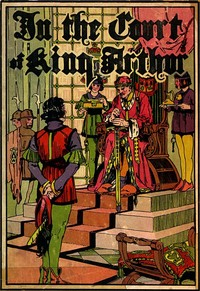
Stories of the Days of King Arthur — A Reader’s Guide

(4 User reviews)   1142
Hanson, Charles Henry, Doré, Gustave, 1832-1883 [Illustrator] Project Gutenberg 2013
Children's literature; Children's stories; Kings and rulers -- Juvenile fiction; Chivalry -- Juvenile fiction; Knights and knighthood -- Juvenile fiction; Arthurian romances -- Juvenile literature; Arthur, King -- Juvenile fiction Readers of public-domain and historical texts
Project Gutenberg digital edition en

Edition facts

Words: 81,602
Reading time: 355 min
Text sections: 8
Charles Henry Hanson's 1880s compilation retells Arthurian legends for young readers, drawing on Malory, the Mabinogion, and Early English Text Society sources. The excerpt from 'Sir Beaumains' Quest' shows a damsel's harsh rebukes met with patient endurance, a pattern of testing and revelation. Hanson preserves archaic dialogue while aiming for clarity, creating a distinctive tone between medieval romance and Victorian instruction.
Share
Editorial Edition Score 4.8/5

Calculated from edition completeness, EPUB availability, text structure and catalogue metadata. Not a user rating.

Edition quality

Read the Text

SOME hundred years after the authority of the Roman emperors had finally ceased in Britain, a king reigned there whose name was Constans. Wise in peace, and skilful and brave in war, this monarch had obliged all the lesser chiefs and kings of the island to acknowledge his supremacy, and had occupied the throne for many years to his own glory and to the benefit of his subjects, when he was attacked by an illness so severe that he himself at once perceived death to be at hand. He had three sons. Constantius, the eldest, had from childhood shown a liking for the cloister, and had for some years been the inmate of a monastery. As, however, the king’s other sons, whose names were Aurelius Ambrosius and Uther Pendragon, were yet only children, Constans named Constantius the monk his successor; and in his dying hour he entreated the sorrowing nobles who gathered round his bed to render to his son the same loyal and faithful service as they had given to himself. With this request the barons, of whom the king’s steward Vortigern was the foremost both in rank and in ability, promised to comply; and thus Constans, after a prosperous reign, died peacefully and happily.

After the funeral of the deceased monarch, Constantius was brought from his monastery and duly crowned King of the Britons. But his disposition, his abilities, and his previous method of life, all unfitted him for the performance of duties which could only be properly discharged by a great statesman and warrior. Of this fact the steward Vortigern was very well aware. He was an ambitious and unscrupulous man, elated by the distinction he had won in King Constants wars with the Danes and the Saxons, and he considered himself, in virtue of his experience as a general and in matters of government, the only competent successor to his late master. It was not long before an opportunity arose for the furtherance of his evil designs. A Danish sea-king named Hengist, who had frequently harassed the country during the late reign, but had always been driven off by the redoubtable Constans, no sooner heard of the death of his old antagonist, and the accession of the pacific Constantius, than he assembled an army of a hundred thousand men, and invaded Britain. Constantius, quite unfit to make headway against such an enemy, entreated Vortigern to conduct the campaign on his behalf. But the treacherous minister, pretending that he was incapacitated by age and illness, retired to his castle, and left the unfortunate king to his own devices. Constantius assembled his forces, and led them against the invaders; but he was no match for a veteran warrior like Hengist, and in the first battle he was completely defeated.

The subordinate British princes, and most of the nobles of the land, had responded to Constantius’s summons, and fought under his banner; but they were greatly enraged at his defeat, which, with some justice, they attributed to his incapacity as a general. The forces of the pagan Hengist now spread like locusts over the country, burning and destroying in every direction; and the Britons, as Vortigern had calculated, saw no hope of getting rid of them except under the leadership of King Constants old lieutenant. They therefore sent a deputation to Vortigern, urging him to take the command of the army, in order to save the country from ruin. The steward, however, refused to engage in such an enterprise merely for the sake of winning honour and authority for the monkish king. “If Constantius were out of the way,” he said, “I would gladly do my best for you and the country; but I will not face all the perils of war to benefit a king who cannot defend his own throne.”

In this dilemma the princes and nobles of Britain forgot the promises they had made to the dying Constans. When they received the answer of Vortigern, a number of them proceeded at once in search of the unfortunate king, and murdered him in his own hall. The two princes, Aurelius and Uther Pendragon, were too young to reign; and even those barons who still remained faithful to the family of Constans saw no alternative, in view of the havoc that was being wrought by the Saxon invaders, except the election of Vortigern to the vacant throne. He was accordingly proclaimed king; and his pretended illness at once gave place to the activity he had been wont to show in earlier days. His first endeavour, after his coronation, was to get possession of the persons of the two princes; but in this design he was foiled by the sagacity of some of their friends, who had hastened, as soon as the murder of Constantius was made public, to convey them over sea to the country which was then called Little Britain, and is now known as Brittany.

If he had not had his hands full at home, Vortigern would have pursued the princes even to their place of refuge; for he was well aware that his tenure of the throne must always be uncertain while they were alive. But he was also conscious that while the victorious Hengist and his Saxons remained in the country, the dignity to which he had been raised was but an empty one. He proceeded without delay to reorganize the army which had been shattered by the defeat of the ill-fated Constantius. He then led it against the invaders, and, displaying all the military skill which he had learned in his campaigns under King Constans, gained victory after victory, and soon reduced Hengist to such straits that he was glad to retire from the kingdom, giving a solemn pledge that he would never again invade it.

Vortigern had thus given substantial proof of the prudence of the choice which had placed him on the throne, and had established a claim to the gratitude of his subjects. But the Britons were soon to learn that something more than military skill is needed to make a good king, and that a man who will only save his country to gratify his own selfish ambition will not hesitate to bring it to ruin from the same motive. At a great festival held by Vortigern to celebrate the victories he had won, the barons who had assassinated Constantius presented themselves, and demanded some reward for the deed which had given the crown to Vortigern. The latter, however, was of opinion that to comply with their request would be to set a premium upon treason; whereas, now that he had attained the object of his desire, it would be wise in him to discourage it. So he repudiated all participation in the murder of Constantius; and to show his abhorrence of the deed, he caused the nobles who had avowed themselves the perpetrators to be put to death with great cruelty. It happened, however, that the criminals--who, if they deserved their fate, certainly ought not to have suffered at the hands of the man who had instigated and profited by their crime--were men of rank and great family influence. Their many relatives and friends at once rose in revolt to avenge their death; and the insurrection very soon became so widespread that Vortigern was on the point of losing the crown for which he had so dexterously intrigued and fought. In his extremity he resorted to the expedient of appealing for help to his old antagonist Hengist, who gladly acceded to the request, and once more came over to Britain at the head of a formidable army. With this assistance Vortigern succeeded in vanquishing the rebels. But he could no longer count on the loyalty of the Britons; so, to make himself secure, he married the daughter of Hengist, and maintained his authority by means of a Saxon army.

The cruelty of his rule, and the favour he showed to his pagan friends and supporters, earned for Vortigern such general and intense hatred among the Britons, that he determined to erect an impregnable fortress which might furnish him with a safe refuge against conspirators and foes. Accordingly, having chosen what seemed to him to be a suitable site on Salisbury Plain, he gathered together many thousands of workmen and ordered them forthwith to begin the erection of his castle. As the tyrant was in the habit of punishing disobedience or dilatoriness with remorseless severity, while he was also lavish in the rewards he gave for zealous service, the masons set to work with a will, and at the close of the first day had made such progress that the ground had been excavated, the foundation laid, and a wall of immense thickness had risen to the height of some feet. But what was the astonishment and awe of the workmen, when on the following morning they assembled at the scene of their labours, to find that the wall had been levelled with the ground, and all that remained of it was nothing more than shapeless piles of stone and mortar! Quite unable to comprehend this extraordinary phenomenon, the builders made the best of the business by once more setting to work with such energy that at nightfall the wall had again risen breast-high. But all their efforts had been expended to no purpose, for the next day it was found that the wall had once more been overthrown. In vain did they examine the site to discover the cause of the mystery. Nothing that could account for it was to be found; so the masons proceeded to inform the king of the inexplicable difficulty that had arisen in the carrying out of his design.

Vortigern hurried to the spot, and investigated the circumstances for himself, but departed no wiser than he had come. The mystery, however, gave him great anxiety, for he could not help connecting it with the treachery by which he had obtained the throne, and the many crimes he had since perpetrated. He therefore summoned his astrologers, and informed them that they must either discover the reason why his castle-wall fell down as soon as it was built up, or be put to death. Incited by this unpleasant alternative, the wise men closely studied the aspect of the heavens, and then told the king that some few years before a boy had been bom in England without an earthly father. If this boy could be found, put to death, and the foundations of the castle smeared with his blood, there would be no further difficulty about its subsequent progress.

Vortigern at once sent emissaries to all parts of the country to find the wonderful boy; but to make sure that the astrologers should not escape his vengeance if the messengers were unsuccessful in their search, he threw them all into prison.

Astrology must, however, have been better understood in those days than it is now, for the wise men had interpreted the planetary revelations with perfect accuracy. The boy for whom the servants of Vortigern were searching did in fact exist, and was none other than the afterwards famous wizard and prophet Merlin, whose mother was a British maiden, while his father was the Arch-fiend, who had hoped through his agency to carry out his evil purposes against mankind. This design had, however, been thwarted by a pious hermit named Blaize, who had taken the boy’s mother under his protection, and had baptized the infant at the moment of his birth, so that the supernatural gifts which he inherited from his demon-father were enlisted on the side of good, instead of being employed in the service of the evil one. Endowed from his birth with the power of foretelling the future, and with the knowledge of all mysteries, Merlin had been thus far content to lead the life of other children, well knowing that the time was at hand when he must play a more important part. He now made himself known to one of Vortigern’s messengers, whom he astonished by informing him of the object of his search. He added that though the astrologers had rightly interpreted the portent of the heavens, his death was not necessary for the erection of Vortigern’s castle; for on this point the wise men had been misled by the devices of Satan, who, since Merlin was now out of his power, was anxious for his destruction. The boy gave the king’s emissary to understand that when brought into Vortigern’s presence he would explain the whole mystery. The royal officer was naturally well pleased to have achieved the object of his mission; and any doubts he might still have entertained about the reality of Merlin’s pretensions to supernatural powers were dispelled by the extraordinary proofs which the child furnished during their journey to Winchester, where Vortigern then held his court. The party were making their way through the busy streets of a town, when Merlin broke into loud laughter. When asked the reason, he pointed out a young man who was bargaining for a pair of shoes, and explained that what had aroused his mirth was the extreme eagerness to secure substantial foot-gear shown by one who would not live to wear the shoes he had bought. As the young man was to all appearance in robust health, Merlin’s companions received this statement with incredulity; but before they had gone many paces further, they heard an uproar in the street behind them, and on inquiry they found that it was due to the fact that the man Merlin had shown to them had suddenly-dropped down dead. This, and other evidences of the prescience of the young seer, convinced Vortigern’s messenger, who hastened to conduct the wonderful boy into the presence of the king.

Vortigern received Merlin with a pomp which in no wise disturbed the philosophical serenity of the child, and in due course conducted him to the place selected as the site of the castle, where he described the extraordinary failure of the attempts that had thus far been made to build it, and inquired the reason.

“Sir King,” answered Merlin, “the reason is this. Below the place where your workmen have sought to lay the foundations of the wall there are two large and deep pools of water. At the bottom of these lie two huge stones, which cover the lairs of two gigantic serpents, the like of which none of your subjects have ever before set eyes on. One of these serpents is milk-white in hue, the other red as blood. They sleep all through the day; but every night they engage in a furious combat, which is without result, because they have not sufficient space wherein to move. The walls built by your masons were overthrown because the very earth was shaken by the struggles of the serpents. But if you cause the water to be drained away, and the stones to be raised, the serpents will be able to settle their dispute, and there will then be no hindrance to the building of the castle.”

Overjoyed at this information, Vortigern at once gave the necessary orders. His army of workmen was speedily engaged in digging, and presently the two pools of water described by Merlin were disclosed. The water having been removed, the stones were laid bare; and when, with infinite difficulty, they had been uplifted, there lay the two serpents, side by side. Both were of enormous size, and covered with shining scales, while fire flashed from their mouths. They were not only distinguished by the difference of colour of which the young wizard had spoken, but the white serpent had two heads. As soon as the light of day fell upon them, they awoke from the torpor in which they had been sunk, uncoiled their monstrous folds, and, to the terror of the vast multitude assembled--amongst whom Merlin was the only unconcerned spectator--they began a furious conflict, which lasted till night. The fire which they vomited forth against each other flashed through the air like lightning, and their huge jaws dripped with their black blood. At first the red serpent seemed to gain the advantage; but as the day wore on the white one waxed in strength, and at last he beat his antagonist to the ground, and then descended upon him with such fury as to crush him into dust. The white serpent then himself disappeared, and was never again seen by mortal man.

The literal fulfilment of Merlin’s prediction naturally inspired Vortigern with the utmost confidence in the wisdom of the prophet, more especially as the erection of the castle thenceforth proceeded without let or hindrance. He was at once installed as the chief counsellor of the king; but this high promotion, which he himself accepted with the taciturn indifference which was his ordinary demeanour, raised him many enemies, and one of these represented to Vortigern that, as Merlin knew everything, he would certainly be able to explain the significance of the terrific, fight between the two serpents, which must doubtless have some deep hidden meaning. The king, whose conscience was always stinging him, eagerly grasped at the idea, and Merlin was forthwith sent for and questioned on the subject. He remained persistently silent, however, until Vortigern threatened him with instant death if he did not answer.

“Know, O King,” said the seer, “that what you threaten is as far beyond your power as it was to discover the reason of the overthrow of your castle wall. Save by my own will, no man of woman bom can injure me. Since, however, you are resolved to know the meaning of the combat between the two serpents, I will reveal it. The red dragon which you saw overthrown and destroyed represented yourself; the white one symbolized the two princes Aurelius and Uther Pendragon, the sons of King Constans, who are the rightful rulers of this realm. They are coming from Little Britain with a mighty armament; they will utterly defeat you in battle; and when, with your family and the Saxon Hengist, you take refuge in the strong castle you have built, you will perish there by fire, even as the red serpent perished.”

At this appalling forecast of his fate, Vortigern was overcome by despair. But bethinking him of Merlin’s great craft and wisdom, he turned fiercely upon him and demanded counsel as to how he should evade the approaching ruin.

“That which is to be must be,” answered the wizard. “I have no counsel to give you.”

Full of wrath, Vortigern drew his sword; but when he would have smitten Merlin with it, the latter had disappeared, and all the king’s efforts to find him were unavailing. He had indeed, by the exercise of his magic art, transported himself to the distant hermitage of his first friend, the holy Blaize, to whom he committed the task of writing his famous Book of Prophecies, foretelling the future history of Britain; a work of which, unhappily, only a few sentences remain, and these expressed in such obscure and figurative language that no man can decipher their meaning.

The ruin which Merlin had foretold speedily overtook the wicked Vortigern. He received news of the landing of Aurelius and Uther at the head of a large army. He mustered his forces, summoned Hengist to his assistance, and hastened to meet his enemies. But the Britons would not fight against the sons of their old king. Deserted by all but his Saxon allies, Vortigern sustained a ruinous defeat. He took refuge with Hengist in his stronghold on Salisbury Plain. The princes forthwith besieged it; but finding that they could make no impression on its mighty walls, they caused wildfire to be cast over the battlements, and in the conflagration that followed, the usurper and all his kin, with his heathen ally, were utterly consumed. The remnant of the Saxon invaders were permitted to leave the country, on giving pledges that they would never return; and Aurelius and Uther, who agreed to share the honours and cares of rule, were recognized by all the smaller potentates, the barons, and the commons, as the kings of Britain.

They were not, however, permitted to remain long in peaceable possession. Their reign had scarcely begun when Merlin, who, like a loyal Briton, had come forward to give the benefit of his wisdom and his counsel to the new kings, warned them that a numerous army of pagans from Denmark had landed at Bristol. He added the painful news that though the Britons would be successful in their encounter with the invaders, one of the royal brothers was destined to perish. All fell out as he had predicted: the heathen were so utterly overthrown that scarcely one of them escaped alive from the field; but Aurelius died nobly in the moment of victory, and Uther Pendragon remained the sole and unopposed monarch of Britain.

Charles Henry Hanson's Stories of the Days of King Arthur presents itself as a compilation, not an original work, yet its preface reveals a deliberate editorial hand. Hanson claims to offer the most complete epitome of Arthurian legends for young readers then available, drawing on sources beyond Malory—including Ellis's Early English Metrical Romances, the Early English Text Society's edition of Sir Gawaine and the Green Knight, and Lady Charlotte Guest's Mabinogion. This range of source material shapes the collection's texture, blending Malory's prose with older metrical romances and Welsh traditions.

The excerpt from 'Sir Beaumains' Quest' illustrates a recurring structural pattern: a knight's worth is tested through a damsel's verbal abuse. Beaumains endures her scorn, responding that 'a knight is worth little that cannot endure a woman's tongue.' The damsel's eventual apology and Beaumains' forgiveness mirror a motif of patience rewarded, common in these tales.

A Compiler's Craft: Sources and Selection

Hanson's preface openly acknowledges his debts: to Malory for the core narrative, to Ellis for the story of Merlin, to the Early English Text Society for Gawaine and the Green Knight, and to Lady Charlotte Guest for Geraint and Enid and Ewaine and the Lady of the Fountain. This transparency is unusual for a Victorian children's book. Hanson states his aim was to choose stories 'most likely to captivate the imagination or excite the attention of the boy-readers of this generation.' The result is a curated selection that omits episodes deemed unsuitable, though the preface does not specify which. The compiler also sought to cast the tales into 'a connected narrative and regular sequence of events,' imposing order on a sprawling legendarium. Readers familiar with Malory will notice that Hanson condenses and reorders, while those coming fresh to the legends will find a streamlined introduction.

Dialogue as a Measure of Character

In the Beaumains excerpt, dialogue carries the weight of character development. The damsel Lynette repeatedly rebukes the knight, calling him a kitchen boy and predicting his defeat. Beaumains answers 'fairly and softly,' turning her insults into fuel for his battles: 'the more you said the more you angered me, and I wreaked my wrath on those with whom I had to do.' This exchange reveals a psychological dynamic where verbal abuse paradoxically strengthens the hero. The damsel's later apology—'forgive me all that I have missaid and misdone against you'—and Beaumains' ready forgiveness ('With all my heart') complete a pattern of testing, endurance, and reconciliation. Hanson preserves the archaic speech ('Certes,' 'thou,' 'doth') but keeps it clear enough for young readers, balancing authenticity with accessibility.

The Landscape of Adventure: Pavilions, Meadows, and Sieges

The excerpt situates its action in a carefully described landscape: 'a fair city' with 'a great meadow that was newly mown, whereon were many pavilions.' This setting—a meadow used for jousting and tourneying in fair weather—is typical of Arthurian romance, where outdoor spaces host both combat and courtly display. The damsel warns Beaumains of Sir Persaunt of Ind, who 'had ever about him five hundred knights and gentlemen,' and of the Red Knight of the Red Lands, 'the most perilous knight that I know, and a man that is without mercy.' The geography is moralized: the Red Knight lays siege to a lady's castle, an act of 'great wrong' against 'one of the fairest in the world.' Hanson uses such details to create a world where physical locations encode ethical stakes, and where a knight's journey through meadows and toward castles becomes a progress through moral trials.

Hanson's collection rewards attention to its layered sources and its framing of chivalric virtue. Readers may find it useful to compare the Beaumains story here with Malory's version in Le Morte Darthur, noting what Hanson condenses or omits. The preface's mention of the Poet Laureate's poems hints at another intertext: Alfred, Lord Tennyson's Idylls of the King, which Hanson's book was designed to complement. Observing how Hanson adapts medieval material for a Victorian audience—softening some episodes while retaining archaic speech—offers insight into the 19th-century reception of Arthurian legend.

Opening that old Arthurian retelling, I lingered on the damsel’s sharp words and Sir Beaumains’ quiet patience—a testing that felt less like cruelty than a slow unveiling of worth. It reminded me of another collection’s gentle unraveling of character through trial, The Peace Egg and Other tales — A Closer Reading, where each tale seemed to hold its own quiet reckoning, much like those weathered pages.

Carter Clark
2 weeks ago

Mila Lewis
2 weeks ago

Henry Martinez
4 weeks ago

David Carter
2 weeks ago

5
5 out of 5 (4 User reviews )

Add a Review

Your Rating *
  • ...
    Brett Rich - 3 weeks ago
    A disappointing rendition of the Arthurian legends. The stories are simplified to the point where they lose their epic grandeur and complexity. The prose is bland, and the characters are flat. There are far better adaptations available that capture the mythos and emotion. This version might serve as a basic summary, but it fails to engage the imagination. Not recommended for anyone already familiar with these tales.

  • ...
    Alejandro Reilly - 1 week ago
    A fantastic introduction to the legends of King Arthur and his knights! The stories are retold with a lively narrative that captures the magic and chivalry of Camelot. From the sword in the stone to the quest for the Holy Grail, each tale is rich with adventure and noble ideals. The language is accessible yet poetic, making it a joy for both young readers and adults. A timeless classic that inspires courage and honor.

  • ...
    Heather Allen - 1 week ago
    This retelling of King Arthur's tales is solid and enjoyable, with a clear, engaging style. The book covers the major sagas and characters well. However, the pacing can be uneven, and some stories feel condensed, losing some depth. Also, the female characters are somewhat sidelined. It's a good introductory book, but those seeking a more comprehensive treatment might want to look elsewhere.


Reader reflection

What did you think of this book?

Answer a few questions and save a private reflection on this device.

Your progress 0 / 10
1

What is your current status with this title?

2

How did the book work for you overall?

3

Is this a title you would suggest to others?

4

How much effort did this book require?

Related eBooks