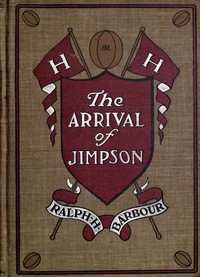
The Arrival of Jimpson, and Other Stories for Boys about Boys — Text and Context

(12 User reviews)   1374
Barbour, Ralph Henry, 1870-1944 Project Gutenberg 2014
Conduct of life -- Juvenile fiction; Children's stories; Boys -- Conduct of life -- Juvenile fiction; Sports -- Juvenile fiction; Friendship -- Juvenile fiction; Students -- Juvenile fiction Readers of public-domain and historical texts
Project Gutenberg digital edition en

Edition facts

Words: 51,123
Reading time: 223 min
Text sections: 11
Eleven stories of schoolboy life, athletics, and friendship, set in early 1900s New England. Barbour's narratives move between dormitory debates, baseball fields, and campus bonfires, using recurring images of rain, mud, and team colors to frame boys' struggles with honor, hazing, and parental expectations.
Share
Editorial Edition Score 4.8/5

Calculated from edition completeness, EPUB availability, text structure and catalogue metadata. Not a user rating.

Edition quality

Read the Text

t Marty knew all about. 71 “Duty!” frothed Morris. 130 Tom moved the net toward the prey. 198 Ned trotted over the plate into the arms of “Big Jim” Milford. 232

THE ARRIVAL OF JIMPSON

Copyright, 1898, by THE CENTURY CO. All rights reserved.

The rain fell in a steady, remorseless drizzle upon the rain-coats and umbrellas of the throng that blocked the sidewalks and overflowed on to the car-tracks; but the fires of patriotism were unquenchable, and a thousand voices arose to the leaden sky in a fierce clamor of intense enthusiasm. It had rained all night. The streets ran water, and the spouts emptied their tides between the feet of the cheerers. The lumbering cars, their crimson sides glistening, clanged their way carefully through the crowds, and lent a dash of color to the scene. The back of Grays loomed cheerless and bleak through the drizzle, and beyond, the college yard lay deserted. In store windows the placards were hidden behind the blurred and misty panes, and farther up the avenue, the tattered red flag above Foster’s hung limp and dripping.

Under the leafless elm, the barge, filled to overflowing with departing heroes, stood ready for its start to Boston. On the steps, bareheaded and umbrellaless, stood Benham, ’95, who, with outstretched and waving arms, was tempting the throng into ever greater vocal excesses.

“Now, then, fellows! Three times three for Meredith.”

“’Rah, ’rah, ’rah! ’rah, ’rah, ’rah! ’rah, ’rah, ’rah! Meredith!” A thousand throats raised the cry; umbrellas clashed wildly in mid-air; the crowd surged to and fro; horses curveted nervously; and the rain poured down impartially upon the reverend senior and the clamorous freshman.

“Fellows, you’re not _half_ cheering!” cried the relentless Benham. “Now, three long Harvards, three times three and three long Harvards for the team.”

“Har-vard, Har-vard, Har-vard! ’Rah, ’rah, ’rah! ’rah, ’rah, ’rah! ’rah, ’rah, ’rah! Har-vard, Har-vard, Har-vard! Team!”

Inside the coach there was a babel of voices. Members of the eleven leaned out and conversed jerkily with friends on the sidewalk. Valises and suit-cases were piled high in the aisle and held in the owners’ laps. The manager was checking off his list.

“Hey? Oh, yes; I’m here.” The manager folded the list. Then a penciled line on the margin caught his eye.

“Who’s Jameson? Jameson here?”

“Should be Jimpson,” corrected the man next to him; and a low voice called from the far end of the barge:

“Here, sir.” It sounded so much like the response of a schoolboy to the teacher that the hearers laughed with the mirth begot of tight-stretched nerves. A youth wearing a faded brown ulster, who was between Gates, the big center, and the corner of the coach, grew painfully red in the face, and went into retirement behind the big man’s shoulder.

“Who is this fellow Jimpson?” queried a man in a yellow mackintosh.

“Jimpson? He’s a freshie. Trying for right half-back all fall. I suppose Brattle took him along, now that Ward’s given up, to substitute Sills. They say he’s an A 1 runner, and plucky. He’s played some on the second eleven. Taunton told me, the other day, that he played great ball at Exeter, last year.”

The strident strains of the Washington Post burst out on the air, urging the cheerers to even greater efforts. They were cheering indiscriminately now. Trainer, rubbers, and coaches had received their shares of the ovation. But Benham, ’95, with his coat soaked through, was still unsatisfied, and sought for further tests. Two professors, half hidden under umbrellas, had emerged from the yard, and were standing at a little distance, watching the scene.

“Three times three for Professor Dablee!” The cheers that followed were mixed with laughter, and the two professors moved off, but not until the identity of the second had been revealed, and the air had filled with the refrain of “’Rah, ’rah, ’rah! Pollock!”

“They look as though they ought to win; don’t you think so?” asked one of them.

The other professor frowned.

“Yes, they look like that; every eleven does. You’d think, to see them before a game, that nothing short of a pile-driver or dynamite could drive them an inch. And a few days later they return, heartbroken and defeated.”

Across the square floated a husky bellow:

“Now, then, fellows! Once more! All together! Three times three for Harvard!”

The band played wildly, frenziedly, out of time and tune; the crowd strained its tired throats for one last farewell slogan; the men in the barge waved their hands; the horses jumped forward; a belated riser in Holyoke threw open a front window, and drowsily yelled, “_Shut up_”; and the Harvard eleven sped on its way up the avenue, and soon became a blur in the gray vista.

“Say, Bob, you forgot to cheer Jimpson.”

The wearied youth faced his accuser, struck an attitude indicative of intense despair, and then joyfully seized the opportunity.

“Fellows! Fellows! Hold on! Three times three for Jim--Jim--who’d you say?”

“Jimpson,” prompted the friend.

“Three times three for Jimpson! Now, then, all together!”

“Say--who _is_ Jimpson?” shouted a dozen voices at once.

“Don’t know. Don’t care. Three times three for Jimpson!”

And so that youth, had he but known it, received a cheer, after all. But he didn’t know it--at least, not until long afterward, when cheers meant so much less to him.

NEW HAVEN, CONN., November 19.

DEAR MOTHER: I can imagine your surprise upon receiving a letter from this place, when your dutiful son is supposed to be “grinding” in No. 30 College House, Cambridge. And the truth is that the dutiful son is surprised himself. Here am I, with some thirty-five other chaps, making ready for the big football game with Yale to-morrow. Here is how it happened:

Yesterday morning, Brattle--he’s our captain--came to my room, routed me out of bed, and told me to report to the coaches for morning practise. You know, I’ve been trying for substitute right half-back. Ward, the regular, sprained his knee in the Dartmouth game, and a few days ago it went lame again. So now Sills has Ward’s place, and I’m to substitute Sills. And if he gets laid out--and maybe I ought to hope he won’t--I go in and play. What do you think of that? Of course Sills may last the entire game; but they say he has a weak back, only he won’t own up to it, and may have to give up after the first half. Gates told me this on the train. Gates is the big center, and weighs 196. He is very kind, and we chummed all the way from Boston. I didn’t know any of the fellows, except a few by sight--just enough to nod to, you know.

We left Cambridge in a driving rain, and a big crowd stood out in it all, and cheered the eleven, and the captain, and the college, and everything they could think of. Every fellow on the first and second elevens, and every “sub” was cheered--all except Mr. Jimpson. They didn’t know of his existence! But I didn’t feel bad--not very, anyhow. I hope the rest of the fellows didn’t notice the omission, however. But I made up my mind that if I get half a show, I’ll make ’em cheer Jimpson, too. Just let me get on the field. I feel to-night as though I could go through the whole Yale team. Perhaps if I get out there, facing a big Yale man, I’ll not feel so strong.

You know, you’ve always thought I was big. Well, to-day I overheard a fellow asking one of the men, “Who is that little chap with the red cheeks?” I’m a midget beside most of the other fellows. If I play to-morrow, I’ll be the lightest man on the team, with the exception of Turner, our quarter-back, who weighs 158. I beat him by three pounds.

Such a hubbub as there is in this town to-night! Everybody seems crazy with excitement. Of course I haven’t the slightest idea who is going to win, but to look at our fellows, you’d think they would have things their own way. I haven’t seen any of the Yale players. We practised on their field for an hour or so this afternoon, but they didn’t show up. There was a big crowd of Yale students looking on. Of course every fellow of us did his very worst; but the spectators didn’t say anything--just looked wise.

Most of the fellows are terribly nervous to-night. They go around as though they were looking for something, and would cry if they didn’t find it soon. And the trainer is the worst of all. Brattle, the captain, is fine, though. He isn’t any more nervous than an alligator, and has been sitting _still all the evening_, talking with a lot of the old graduates about the game. Once he came in the writing-room, where I’m sitting, and asked what I was doing. When I told him, he smiled, and said to tell you that if anything happened he’d look after my _remains_ himself! Maybe he thought I was nervous. But if I am, I’m not the only one. Gates is writing to his mother, too, at the other table.

Give my love to Will and Bess. Tell Will to send my old skates to me. I shall want them. There is fine skating on Fresh Pond, which, by the way, is a lake.

We’re ordered off to bed. I guess some of us won’t sleep very well. I’m rather excited myself, but I guess I’m tired enough to sleep. I’ll write again when I get back to college. With bushels of love to all,

Yours affectionately,

Jimpson sat on the ground, and watched with breathless interest two charging, tattered, writhing lines of men. Jimpson felt a good deal like an outcast, and looked like a North American Indian. Only legs and face were visible; the rest of Jimpson was enveloped in a big gray blanket with barbaric red borders. Some two dozen counterparts of Jimpson sat or lay near by, stretching along the side-line in front of the Harvard section of the grand stand. Behind them a thousand enthusiastic mortals were shouting pæans to the goddess of victory, and, unless that lady was deaf, she must have heard the pæans, however little she approved of them. The most popular one was sung to a well-known tune:

“As we’re strolling through Fifth Avenue With an independent air, The ladies turn and stare, The chappies shout, ‘Ah, there!’ And the population cries aloud, ‘Now, aren’t they just the swellest crowd, The men that broke Old Eli at New Haven!’”

And a mighty response swept across the field from where a bank of blue rose from the green of the field to the lighter blue of the sky. It was a martial air, with a prophecy of victory:

“Shout aloud the battle-cry Of Yale, Yale, Yale! Wave her standard far and high For Yale, Yale, Yale! See the foe retreat before us, Sons of Eli, shout the chorus, Yale, Yale, Yale, Yale, Yale!”

Harvard and Yale were doing battle once more, and twenty thousand people were looking on. The score-board announced: Harvard, 4; Yale, 0. Yale’s ball. 15 minutes to play.

The story of twenty minutes of the first half is soon told. It had been Yale’s kick-off. Haag had sent the ball down the field to Harvard’s 20-yard line, and Van Brandt had gathered it in his long arms, and, with Meredith ahead, had landed it back in the middle of the field. But the fourth down gave it to their opponents after a loss of two yards, and the pigskin went down again to Harvard’s territory, coming to a stop at the white line that marked thirty-five yards. Here Harvard’s new half-back kick had been tried, and the ball went high in air, and the field went after it; and when the Yale full-back got his hands on it, he was content with a bare five yards, and it was Yale’s ball on her 40-yard line. Then happened a piece of ill luck for the wearers of the blue. On the second down, Kurtz fumbled the pass, the ball rolled toward Yale’s goal, and Brattle broke through the opposing left tackle and fell on it.

And while a thunderous roar of joy floated across the field from the followers of the Crimson, the teams lined up on Yale’s thirty yards. Twice Meredith tried to go through between center and left guard, and a bare yard was the reward. Then Van Brandt had run back as for a kick; the ball was snapped, passed to Sills, Harvard’s right half-back, and, with it safely under his arm, he had skirted the Yale left, and fallen and wriggled and squirmed across the goal-line for the first touch-down.

Then ensued five minutes of bedlam, and after the victorious seats had settled into excited complacency, Van Brandt had tried for goal. But success was too much to hope for, and the two teams trotted back to the middle of the field, with the score 4 to 0. Then had the sons of Eli shown of what they were made, and in the next ten minutes the ball had progressed with fatal steadiness from the center of the field to the region of the Crimson’s twenty yards. And now it was Yale’s ball on the second down, and the silence was so intense that the signal was heard as plainly by the watchers at the far end of the field as by the twenty-two stern-faced warriors who faced each other almost under the shadow of the goal-posts.

“_Twelve, six, twelve, fifty-two!_”

And the backs, led by the guards, hurled their weight against Harvard’s right tackle; and when the ball was found, Baker held it within a few inches of the 10-yard line.

The cheers of Yale had now grown continuous; section after section passed the slogan along. The stand across the field looked to Jimpson like a field of waving blue gentians. On the Harvard seats the uproar was less intense, and seemed a trifle forced; and the men near by were breathing heavily, and restively creeping down the line.

Again the lines were formed. Jimpson could see the tall form of the gallant Gates settle down into a hunchback, toad-like position to receive the coming onslaught. Billings, the right tackle, was evidently expecting another experience like the last. He looked nervous, and Gates turned his head and spoke to him under cover of the first numbers of the signal.

The guards were back of the line again, and their elbows almost brushed as they stood between the half-backs. Silence reigned. The referee skipped nimbly out of the way.

“_Seven, seventeen, eighty-one, thirty!_”

Again the weakening tackle was thrust aside, and although the Crimson line held better, the ball was three yards nearer home when the whistle blew, and Billings, somewhat dazed, had to call for a short delay.

“First down again,” muttered a brawny sub at Jimpson’s elbow. “Why doesn’t he take Billings out?”

Again the signal came. Again a jumbled mass of arms and legs for a moment hid the result. Then the men on the stand overlooking the goal-line arose _en masse_, and a mighty cheer traveled up the field, growing in volume until Jimpson could not hear his own groans nor the loud groans of a big sub. Back of the line, and almost equidistant of the posts, lay the Yale full-back; and the ball was held tightly to earth between outstretched hands. The prostrate players were slowly gaining their feet; but Billings and Sills lay where they had fallen. Then Brattle stepped toward the side line, holding up his hand. With a leap Jimpson was on his feet. But the big chap beside him had already pulled off his sweater, and now, tossing it into Jimpson’s face, he sped gleefully toward the captain.

Jimpson sat down again in deep disappointment; and a moment later, Billings, supported on either side, limped from the gridiron, amid the cheers of the Harvard supporters. Sills was on his feet again, and the trainer was talking to him. Jimpson could see the plucky fellow shaking his head. Then, after a moment of indecision, the trainer left him, the whistle sounded, the Crimson team lined up back of the line, and Kurtz was poising the ball for a try at goal. The result was scarcely in doubt, and the ball sailed cleanly between the posts, a good two feet above the cross-bar; and the score-board said, “Harvard, 4; Yale, 6”; and there were three minutes more of the half.

Back went the ball to the 55-yard line, and loud arose the cheers of the triumphant friends of Yale. Gates kicked off, and Warner sent the ball back again, with a gain of ten yards. Sills caught it and ran, but was downed well inside Harvard territory, and the half ended with the ball in Yale’s hands. Jimpson seized his blanket, and trotted after the eleven to the quarters. He found Gates stripping for a rub-down.

“Well, my lad,” panted the latter, “could you discern from where you were just what kind of a cyclone struck us?” But Jimpson was too much interested for such levity.

“Do you think I’ll get in this half, Gates?”

“Can’t say. Take a look at Sills, and judge for yourself.”

That gentleman was having his lame back rubbed by a trainer, but he appeared to Jimpson good for at least another quarter of an hour.

It seemed but a moment after they had reached the rooms that the word of “Time’s up, fellows,” was passed, and renewed cheering from without indorsed the fact. But a moment or two still remained, and that moment belonged to Brattle. He stood on a bench and addressed the hearers very quietly:

“We’re going to kick, this half, fellows. I want every man to get down the field on the instant, without stopping to hold. I don’t think they can keep us from scoring at least once more; but every man has got to _work_. When the time comes to put the ball over the line, I expect it to go over with a rush. Let every man play the best game he knows, but _play together_. Remember that lack of teamwork has often defeated us. And now, fellows, three times three for Harvard!”

And what a yell that was! Jimpson went purple in the face, and the head coach cheered his spectacles off. And then out they all went on a trot, big Gates doing a coltish handspring in mid-field, to the great delight of the Crimson’s wearers. The college band played; thirty thousand people said something all together; and then the great quadrangle was silent, the whistle piped merrily, and the ball soared into air again.

Jimpson took up his position on the side-line once more, and watched with envious heart the lucky players. For the great, overwhelming desire of Jimpson’s soul was to be out there on the torn turf, doing great deeds, and being trampled under foot. He watched the redoubtable Sills as a cat watches a mouse. Every falter of that player brought fresh hope to Jimpson. He would have liked to rise and make an impassioned speech in the interests of humanity, protesting against allowing a man in Sills’s condition to remain in the game. Jimpson’s heart revolted at the cruelty of it.

Some such idea as this he had expressed to Gates, that morning; and the big center had giggled in deep amusement; in fact, he had refused to recognize the disinterested character of Jimpson’s protest.

“Don’t you think,” Jimpson had pleaded, “that I might ask Brattle to give me a show in the second half?”

Ralph Henry Barbour's collection opens not with a boy but with weather: "The rain fell in a steady, remorseless drizzle" onto a crowd awaiting a departing baseball team. That wet, gray scene—glistening car sides, limp flags, blurred windows—sets a pattern. Across these eleven stories, Barbour repeatedly uses weather and physical setting to frame moments of tension or transition. A father-son argument in a Harvard dormitory is staged against a June lawn "intensely green and attractively cool"; a bonfire blazes against a dark campus; a mascot's triumph unfolds on a muddy field. The elements are never mere backdrop. They press on the characters, shaping their moods and marking the stakes of each contest.

Movement Between Indoor and Outdoor Spaces

The stories shuttle between enclosed rooms and open fields, and Barbour often uses that shift to mark a character's change in status or resolve. In the title story, Jimpson first appears as an outsider on a train platform, then moves through a boardinghouse parlor, a schoolroom, and finally a baseball diamond. Each setting alters his reception. The father-son scene in "The Father of a Hero" stays inside a Harvard dormitory, the window framing a Yard full of lounging athletes—a visual contrast between the father's lecture and the son's world. Later stories, like "Barclay's Bonfire," center on an outdoor gathering that becomes a test of loyalty. Barbour rarely lets a scene stay indoors for long; the pull toward the field, the game, the crowd is constant.

Recurring Images of Uniforms and Team Colors

Barbour pays close attention to what boys wear and what those clothes signify. In the opening story, the crowd's umbrellas and rain-coats blend into a mass, but the "crimson sides" of the cars and the "tattered red flag" above Foster's mark allegiance. Later, a boy's straw hat with a "fresh new band" signals belonging. The hero of "The Father of a Hero" is identified by his role as first-baseman and captain, his identity inseparable from his uniform. These details are not incidental; they tell readers who belongs and who is still proving himself. A boy without the right cap or the proper flannel trousers is immediately suspect. Barbour uses these visual cues to establish hierarchy and to show how quickly a boy can move from insider to outcast.

The Structure of the Collection: From Arrival to Début

The eleven stories are arranged to trace a kind of arc, though each is self-contained. The first, "The Arrival of Jimpson," introduces a newcomer; the last, "Mittens," follows a boy making his first appearance in a game. In between, stories cluster around school rituals: hazing ("The Hazing of Satterlee 2d"), a bonfire ("Barclay's Bonfire"), a feast ("Parmelee's 'Spread'"), and a mascot's debut ("Marty Brown—Mascot"). The collection does not follow a single protagonist, but the sequence suggests a progression from arrival to acceptance to performance. Barbour also varies the length and pace: some stories are tight, single-scene sketches; others unfold over several days. This variety keeps the collection from feeling repetitive, even when the themes of loyalty and sportsmanship recur.

Voice and Dialogue as Markers of Character

Barbour gives his boys distinct speech patterns. The father in "The Father of a Hero" speaks in formal, interrupted sentences, punctuated by "sir" and dashes: "I have never," he says, "opposed athletic sports in moderation. On the contrary, I think them—ah—beneficial." His son, the Hero, replies in shorter, more direct phrases. In "The Arrival of Jimpson," the title character's dialogue is sparse at first, then grows more confident as he finds his place. Barbour also uses reported speech and collective voices—the crowd's "fierce clamor," the team's chants—to create a sense of group pressure. Individual voices emerge most clearly in moments of conflict or decision, when a boy must speak up against a friend, a father, or a mob. The dialogue does not merely advance plot; it reveals who has authority and who is still earning it.

Readers will notice that Barbour rarely describes a game in full. He focuses instead on the moments just before—the waiting, the argument, the walk to the field—and the aftermath. The action itself is often compressed into a sentence or two. This technique keeps attention on the boys' relationships and decisions rather than on play-by-play. Approaching the collection as a series of character studies set in athletic surroundings, rather than as sports stories, will reward attention to the small gestures and setting details that Barbour uses to define his world.

Reading about those boys trudging through New England mud, I kept thinking of a quieter season altogether. The rain and team colors felt loud, but their real struggles were inward. It reminded me, oddly, of Summer Days — Themes and Context, where the heat slows everything to a hush. Perhaps both are just about boys finding themselves when no one is cheering.

Wyatt Wright
1 week ago

Avery White
6 days ago

Daniel Wilson
3 weeks ago

Lucas Nguyen
4 days ago

Daniel Wilson
3 weeks ago

5
5 out of 5 (12 User reviews )

Add a Review

Your Rating *
  • ...
    Gary Barrett - 2 weeks ago
    Overall, this collection disappointed me. The stories lack originality and depth, following predictable formulas without much creativity. The characters are shallow, and the lessons feel forced. It reads like a nostalgic attempt to revive old-fashioned tales that no longer resonate. I'd skip it unless you're specifically studying the evolution of children's literature.

  • ...
    Ashley Gutierrez - 1 week ago
    The stories in this collection are enjoyable but vary in quality. Some are lively and fun, while others feel rushed or underdeveloped. The book provides a decent snapshot of early 20th-century boyhood, but modern readers may find the language and cultural references a bit outdated. Still, it's a reasonable choice for those interested in vintage juvenile fiction.

  • ...
    Theresa Shelton - 5 days ago
    This collection of short stories about boys captures the spirit of adventure and mischief with wit and heart. The tales are engaging, with relatable characters and scenarios that resonate across generations. Each story imparts a subtle lesson about honesty, friendship, or resilience, making it not just entertaining but also meaningful. A great read for kids and adults who appreciate classic boyhood narratives.


Reader reflection

What did you think of this book?

Answer a few questions and save a private reflection on this device.

Your progress 0 / 10
1

Which reading stage best describes you?

2

What was your overall reaction to the book?

3

How likely are you to recommend this book?

4

How demanding did the text feel?

Related eBooks