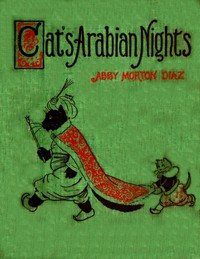
The cats' Arabian nights, or, King Grimalkum — Edition Insights
Edition facts
Calculated from edition completeness, EPUB availability, text structure and catalogue metadata. Not a user rating.
Read the Text
“One day our mother had been watching a mouse at the bottom of the crooked stairs while we played at the top. I hopped too near the small ends and peeped down and my brothers and sisters hopped at me, and down we all went, heels over head. Our mother was angry, for she lost the mouse. We went without our dinner and had other punishment which I need not mention.
“Now the noise we made in falling down and in being punished was heard by some girls playing on the barn floor and they scrambled up a ladder to find out what was the matter. When one of the girls who climbed up the ladder saw me she said, ‘Oh! oh! A black kitten! Do give it to me! She will make three! Then I shall have three black ones and three white ones!’
“‘Yes! do take her!’ said the other girl. ‘If you don’t take her she will be drowned.’
“The next day I was put in a box with holes in the cover and carried a long, long way to a strange place. This made me sorrowful, but still I was glad not to be drowned, and after the first day the five other kittens began to be friendly, and the two black ones were glad I came, for there were then as many black ones as white ones. I was named Black Velvet to match White Velvet. The others were Black Floss and White Floss and Black Satin and White Satin.
“White Satin used to run away and go home to her mother and her sisters. She had a gray mother and two gray sisters. Sometimes we went with her. She liked to play with her sisters and show them her ribbon. Our mistress wished us not to go and tried to keep us in the house. I did not like this, I wanted to scamper across the garden, or down to the river, or across a field to an old barn. I peeped all about and found good places to get out by. Then I used to coax White Velvet, and White Floss, and White Satin, and Black Floss, and Black Satin to go. I always went first and they followed.
“There were two gray kittens living in the barn, and the first day we went there these two ran and jumped into a wheelbarrow and looked down upon us. Pretty soon they began to stretch out their necks, and shake their tails. Then they crept down, then they crept towards us, and began to glare and spit, and sputter, and their tails grew so big we thought we had better go home.
“We liked to go to the barn on account of the chances to catch mice. The gray kittens flew at us every time we went, and at last one of them hit White Velvet in the eye and made it bleed. Our mistress kept us in the house after that, but we had fun racing over the beds and playing in the curtains. We played in the curtains so much that our claws had to be cut at the points. We were almost as well treated as children. Our milk was warmed, we had plenty of squash, and fish, and a good deal of chicken meat. Catnip was brought for us. We had each a basket to sleep in, and the baskets were trimmed with ribbons and had cushions. We had ribbons on our necks; the catnip was good.
“But I did not like staying in the house all the time and every chance there was I jumped out at an open window or door, and White Velvet, White Floss, White Satin, Black Floss and Black Satin all jumped and went wherever I went. But after the Great Whirlwind, I was kept in the house. I will now speak of the Great Whirlwind.
“It was a cold day and it seemed as if a door never would be left open, but one was left open at last, and out I went, and out went White Velvet, White Floss, White Satin, Black Floss and Black Satin after me. We raced across the fields to the barn. The gray kittens were not at home and we watched mouse-holes, and chased mice till a man came and drove us out and shut the door tight.
“The wind blew; the sky was dark; the sun did not shine. We felt rain drops. This set us scampering. When we were in the field we saw a great dog coming and we ran to a tree and scampered up. I stopped to spit at the dog and was the last one up. The sky grew blacker, the wind blew harder and harder. The dog lay down on the ground and howled. Not one of us durst come down. The rain came hard upon us. The tree branches whirled round and round. It was a great wind. It was a whirlwind. It blew off all the leaves that had been left on and then it blew us off. For it was a great wind. Yes, a whirlwind. A dreadful whirlwind. I hope, dear Lady Yellow-paw, that neither you nor any one at this famous party will ever know the feeling of being blown off a tree in a whirlwind. I hope you nor any one at this famous party will know the feeling of being in a tree in a whirlwind with claws that have been pared down at the points. None of our bones were broken. How thankful we all ought to be that we are cats and not children, for we have cushions on our feet, so that we can be blown down without having any bones broken.
“None of our bones were broken but we were drenched with the wet rain. We were almost dead with the fright and the wet rain and we crawled all the way home.
“Our mistress was looking for us. She said, ‘Oh you naughties, come in quick!’ We crawled in and she wiped us with a dry cloth and laid us in a row in front of the stove, and gave us a warm supper and then some catnip.
“After this she kept me in the house. Said she, ‘Black Velvet, you put mischief into the others’ heads and I will keep you in. Black Satin, Black Floss, White Velvet, White Floss and White Satin you may go. Black Velvet shall stay with me.’
“It was hard to see Black Floss, Black Satin, White Velvet, White Floss and White Satin skipping in the yard, over fences, up and down clothes-poles, and be myself shut up indoors. But how little we know what is best for us! One day those others did of themselves go to a corn-house, and there they tasted bad meat which had been put there to kill rats, and they all died! Every one, Black Floss, Black Satin, White Velvet, White Floss, White Satin, every one died. Oh how my mistress did cry! And I too. Yes, I was sad and lonely. I went crying round from room to room, calling for my lost playmates. I looked in all their baskets.
“My mistress seemed to love me more than ever. ‘I have only you, now, Black Velvet,’ she would say. Then she would hug me and hug me. She let me do what I pleased. I had thick cream. When she was sewing I jumped on her shoulder and played in her hair, and I went to sleep in her hat, if I wanted to, and in her work-basket. When she went out to walk she used to take me with her and wrap me up in her apron, and talk to me. But when I grew to be a cat she made me a blanket of my own. It was a good one. It was my own blanket. She loved me a great deal.
“I said at the beginning of my story that it is a wonderful story. You will say that this is true when you hear what happened to me next.
“One day the river grew very big and spread up to the houses, yes, up over the windows of the houses, and broke the houses in pieces. I was sleeping in a rocking chair and the water wet me and waked me from sleep and I sprang up on top the rocking chair back, and the water swashed and there was a great noise and the rocking chair went sailing off and many other things went, and the chair began to go down deeper and then I jumped off on to a bucket. Something hit that a knock and I had only time to catch hold of a box; a small one. There was just room to get all my paws on and I had to stick my back up high. I expected every moment to be drowned. I little thought I should live to tell the story. But a piece of board was knocked against me. I sprang upon that. Then came a chair. I sprang upon that. Then came something else; some thing wonderful, but I said at the beginning that this is a wonderful story. This next thing was a baby’s crib with the baby in it! The curtains were open and the baby was looking out. I jumped from the chair to the cradle and lay down on the baby. I was glad enough to get that resting place. I felt safe with the baby. Somebody would come to get the baby. The baby put out its hands and took hold of me.
“I don’t know what became of that poor baby. The crib tipped over. I heard a man speak, and perhaps he went and got the baby. I was lucky enough to jump on to a firkin, and on this I floated down, down, down, down, I don’t know where, but I cried, cried, cried, oh how I cried!
“I bumped against something hard, something very big. I scrambled up. Men were on it, and a woman, and a girl, and boys. They clapped and shouted and laughed. Oh what a noise! Don’t people know that loud noises make our ears ache? Don’t they know that our ears are made to hear very little faint mouse-taps, butterfly-wing noises, and we can’t bear loud noises? No, they don’t know. But I must go on with my story.
“That big hard thing was not a house nor a barn. It moved over the water. You cats that have lived only on ground cannot think how dreadful it is to stay in the midst of water. Not a bit of ground! No grass to eat. Oh I thought I should die for want of a bit of something green! No trees to climb! But there were some very high poles set for me to climb; poles taller than trees, and ropes and everything handy fixed for me to hang on by. I was treated well. The men fed me, the women fed me, the girl fed me, the boys fed me. The cook taught me some tricks which I shall be happy to show to those present at this famous party, if I shall be properly invited. A little girl held me and she put me around her neck for a comforter. I let her do it. The cook hung a bell round my neck. The noise of it pained my ears, and I was glad when the woman took it off. She took it off because I used to get into the place where the girl slept, and wake her up.
“Now when the ship came to the ground the cook put me into a bag and got into a cart. He was going to give me away. Pretty soon I smelled grass. Then I scratched and cried. Oh how I did want a piece of something green and to roll in the grass! Every cat here knows it would be a hard thing to live without something green. I soon got something green, and plenty of it. The cook opened the bag a little, to show me to another man and I took a sudden spring and away I went, and the more he called, ‘Puss! Puss! Puss!’ the faster I ran, and at last I found myself all alone in the fields, in a strange country.
“I rolled over and over, and tore up the grass, and ran up and down trees, and then I lay down behind a bush and watched to see if there were any moles or field mice in that country. Pretty soon I saw two live things sitting together. They looked like rats, but they had white on them. They were sitting in the sun. I was going to spring at them, but I stopped. I was in a strange country. How did I know if the creatures were good to eat? They might be bad as that bad meat which killed poor White Velvet, White Satin, White Floss, Black Satin, and Black Floss; or they might have dreadful teeth, or dreadful claws.
“While I was waiting a minute to think about it, I heard a sound in the grass; a creep, creep, creep, creeping sound in the grass. It was a cat. But she did not spring quick enough. They heard her and skipped out of sight quicker than a wink.
“As the cat sprang past me I could see that she had no tail. ‘Poor thing,’ I said, ‘she has lost it in a trap!’ Pretty soon I saw another cat without any tail. Then some kittens without any tails. I thought that must be a dreadful place for traps. I dared not step in the grass to hunt.
“I got very hungry keeping still without hunting for mice and moles, and at last I went to a house. In the yard of the house a black-and-white cat without a tail stood and looked at me.
“‘What do you want here?’ said she.
“‘I want to go in the house,’ said I.
“Then she began to spit, and she flew at me, and I flew at her. A woman came running out and took me up. ‘Oh you beautiful creature!’ she said. ‘You’ve got a tail! I’m so glad to get a cat with a tail.’ I must tell you, dear Lady Yellow-paw and all present at this famous party that the cats of that strange place did not have any tails. ‘No tails!’ cried Lady Yellow-paw and others. ‘How then do they show when they are glad and when they are mad?’
“I said at the beginning, dear Lady Yellow-paw, that this is a wonderful story. Let me tell you that the cats of that place do not wish to have tails. ‘Not _wish_ to have tails?’ cried Lady Yellow-paw and others at the famous party. No, your ladyship. But let us not be conceited and think our own ways are always the best. To be sure a tail does add to the good looks of a cat, still we all know that a tail _is_ a great care; always likely to get rocked on, or stepped on, or pulled, and is sometimes in the way when you want to sit down. That no-tailed cat made my tail a way of hurting me. All present must have seen that its tip is gone, though all have been so polite as to seem not to notice this. It was the doings of that jealous no-tailed cat. She was jealous because so much notice was taken of me. She could not bear me to come into the house. She clawed, and bit, and spit at me so that my mistress had to let me sleep in the room with herself and her little boy. One night I did what pleased my mistress very much. One night a mouse jumped on her boy’s bed, and waked him up, just as I used to wake up that girl when I had that bell on my neck. I caught this mouse, and found him quite as good as any in our own country. My mistress praised me more than ever, after this, and held me, and stroked me a great deal, but her doing so made that other cat maul me worse than ever, and I should have run away if my mistress herself had not come away. My mistress came to this country and brought me with her. Here I am, out of reach of that jealous cat’s teeth and claws. Here I am well-fed and tended. Here I live an easy life. Yet still I am not happy. Would you know the reason why? My mistress has another cat, a partly white cat. People call her a beautiful cat. So she may be to any one who fancies white paws and white noses. I do not like to see my mistress hold that cat and stroke her. I am obliged to see it. I am obliged to see the boy like that cat; hug that cat; I am even obliged to see her allowed to jump up and eat milk from the same bowl with him, something _I_ have never been allowed to do!
“All this is hard to bear. I do not like to think about it, and to keep myself from thinking about it I employ myself in teaching the way of opening doors. Every cat should know how to open doors. There may be times in a cat’s life when she may save her life by knowing how to open a door. There are times in every cat’s life when she may get food by opening a door.
“Here a number of cats sprang to their feet and began to tell of particular times when they had saved themselves and got food by knowing how to open doors. Among them was the cat that hadn’t common sense. ‘One at a time, my dears,’ said Lady Yellow-paw. ‘Snowball, will you begin?’”
“But I humbly beg your Majesty’s pardon,” said the lovely Pussyanita to the King. “The particular times when all these saved themselves or got food by knowing how to open doors were not in Black Velvet’s story. You asked, oh King, for Black Velvet’s story. That is ended, I am silent.”
“You shall not be silent!” thundered King Grimalkum. “Speak! As king of all the cats, I wish particularly to know the particular times when all those saved themselves and got food by knowing how to open doors. As king of all the cats, I should be well informed on all such matters.”
“To tell you what you ask,” answered the lovely Pussyanita, “would take a longer time than I have to live.”
“Time shall be granted you,” said the king. “Begin without delay to tell what Snowball told.”
------------------------------------------------------------------------
“When my sister Lily and myself were quite young, but not very, the people who lived in the house began to talk of drowning us. Now all present at this famous party will agree with me that if we are to be drowned at all we should be drowned when we are too young to know anything about it. I suppose there is not one here present who would not rather have been drowned when she knew nothing about it, than to be drowned now.
The book opens with a domestic scene: a group of children and adults looking at cat pictures and telling cat stories. A ten-year-old girl asks why there cannot be a Cats' Arabian Nights story book, and the idea is taken up by cousin Lucia, who agrees to compile it with "make believe and nonsense." This framing device establishes the collection's structure: a cat king, Grimalkum, issues a cruel decree, and his subjects tell stories to save themselves, mirroring the Arabian Nights. The narrative then shifts to the cat kingdom, where King Grimalkum, jet black with yellow eyes, begins his reign with an act of cruelty, setting a tone of peril and storytelling as survival.
Frame Tale and Cat Kingdom Hierarchy
The story is structured as a frame tale: a human prologue introduces the book's origin, then the narrative moves to the cat kingdom. King Grimalkum's rule is defined by strict color hierarchy—only black, maltese, and gray cats are permitted, and his first act is a cruel order. This mirrors the Arabian Nights structure, where stories are told to delay death. The cat narrators, like Pinky-White and Tabby Furpurr, recount their lives, often involving cruelty from humans or other animals. The frame returns only briefly, if at all, based on the excerpts; the bulk is the cats' embedded stories.
Recurring Dreams and Visions
Several cat narrators describe dreams that haunt them. In one story, a cat dreams of a sibling she bit, seeing her "sitting over the fireplace, holding her paw to her throat" and later coming close with "mouth and eyes wide open." Another dream involves being carried away in a basket and finding the way back. These dreams serve as emotional punctuation, revealing guilt, fear, or longing. They are not merely decorative; they advance the cats' inner lives and often precede a turning point, such as separation from a loved one. The dreams are vivid, specific, and tied to real events, blending the fantastical with the traumatic.
Movement Between Safety and Danger
The cats' stories are marked by abrupt shifts in setting and fortune. A cat may be safe with a kind boy, then chased by cruel boys, then rescued again. One narrator describes being carried in "whistling cars" to a strange place, then squeezing through a cellar hole to escape. Another cat moves between a boy's house and a "grandma house" depending on whether she is caught stealing cream. These movements are often triggered by human actions—kindness, cruelty, or indifference. The cats are passive in their journeys, carried or chased, but they actively seek comfort, whether from a dog named Nep or a friendly white kitten. The settings shift from domestic interiors to fields, bridges, and trains, creating a patchwork geography of a cat's precarious world.
Cats and Their Human Bonds
Relationships with humans are central and varied. Some humans are cruel: boys who hurt cats, a man who shoots a mother cat "for her beautiful skin." Others are kind: a boy who carries a wounded cat home, lets it accompany him to the bridge, and says "No, Tabby Furpurr. Go back!" The cat's loyalty is intense—"Oh how I did love that boy!"—and the bond is often tested by other animals, like a jealous dog. The cats also form attachments to other animals: a dog named Nep who shares his meat and lets them warm their feet in his hair. These relationships are portrayed with nuance; even a dog who initially barked can become a protector. The human-cat bond is a thread of stability in otherwise chaotic lives.
Readers approaching this collection should attend to the frame structure and the way each cat's voice differs in rhythm and detail. The stories are not uniformly light; they include cruelty, loss, and fear, balanced by moments of warmth and play. The illustrations, by multiple artists, add another layer of interpretation. The book rewards attention to recurring motifs—dreams, journeys, acts of kindness—that tie the anthology together beyond its Arabian Nights conceit.
This frame-tale of grim felines reminded me of evenings when my own cat would settle on the quilt, purring through my reading. There's a quiet kinship between the cats' weighted dreams and the wintry hearth in Snap-Dragons; Old Father Christmas — Edition Insights, where each tale sits like a coal glowing under ash. That book felt like the same warm, watchful silence.
Sofia Moore
2 weeks agoHow did this book work for you?
Your answers remain private and are stored only in this browser.
Wyatt Hill
4 weeks ago