The Tale of Ferdinand Frog — Text and Context

(6 User reviews)   939
Bailey, Arthur Scott, 1877-1949, Smith, Harry L. (Illustrator) [Illustrator] Project Gutenberg 2008
Animals -- Juvenile fiction; Children's stories; Friendship -- Juvenile fiction; Frogs -- Juvenile fiction Readers of public-domain and historical texts
Project Gutenberg digital edition en

Edition facts

Words: 17,199
Reading time: 75 min
Text sections: 3
An editorial note on Arthur Scott Bailey's The Tale of Ferdinand Frog, focusing on the story's episodic structure, recurring images of bows and somersaults, and the movement between pond and woodland scenes.
Share
Editorial Edition Score 4.5/5

Calculated from edition completeness, EPUB availability, text structure and catalogue metadata. Not a user rating.

Edition quality

Read the Text

There was something about Ferdinand Frog that made everybody smile. It may have been his amazingly wide mouth and his queer, bulging eyes, or perhaps it was his sprightly manner--for one never could tell when Mr. Frog would leap into the air, or turn a somersault backward. Indeed, some of his neighbors claimed that he himself didn't know what he was going to do next--he was so _jumpy_.

Anyhow, all the wild folk in Pleasant Valley agreed that Ferdinand Frog was an agreeable person to have around. No matter what happened, he was always cheerful. Nobody ever heard of his losing his temper, though to be sure he was sometimes the means of other peoples losing theirs. But let a body be as angry as he pleased with Mr. Frog, Mr. Frog would continue to smile and smirk.

Of course, such extreme cheerfulness often made angry folk only the more furious, especially when the whole trouble was Ferdinand Frog's own fault. But it made no difference to him what blunder he had made. He was always ready to make another--and smile at the same time.

Really, he was so good-natured that nobody could feel peevish towards him for long. In fact, he was a great favorite--especially among the ladies. Whenever he met one of them--it might be the youngest of the Rabbit sisters, or old Aunt Polly Woodchuck--he never failed to make the lowest of bows, smile the broadest of smiles, and inquire after her health.

That was Ferdinand Frog--known far and wide for his elegant manners. Every young lady declared that he wore exquisite clothes, too; and many of them secretly thought him quite good-looking.

But people as old as Aunt Polly Woodchuck seldom take heed of what a person wears. As for Mr. Frog's looks, since Aunt Polly believed that "handsome is as handsome does," she admitted that Ferdinand Frog was--as she put it--"purty as a picter."

When Ferdinand Frog heard that, he was so delighted that he hurried straight home and put on his best suit. And then he spent most of a whole afternoon smiling at his reflection in the surface of the Beaver pond, where he was living at the time.

So it is easy to see that Ferdinand Frog was a vain and silly fellow. He was even foolish enough to repeat Aunt Polly's remark to everybody he chanced to meet that night, and the following day as well.

There was no one who could help grinning at Ferdinand Frog's news--he looked so comical. And old Mr. Crow, who was noted for his rudeness, even burst out with a hoarse _haw-haw_.

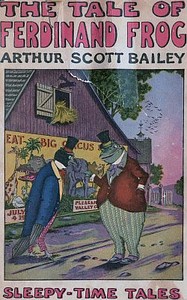
"You're pretty as a picture, eh?" he chuckled. "I suppose Aunt Polly means that you're as pretty as one of the pictures that the circus men have pasted on Farmer Green's barn. . . . I believe----" he added, as he stared at Ferdinand Frog----"I believe I know which one Aunt Polly means."

"Is that so?" cried Mr. Frog, swelling himself up--through pride--until it seemed that he must burst. "Oh, which picture is it?"

"It's the one in the upper left-hand corner," old Mr. Crow informed him solemnly. "And if you haven't yet seen it, you should take a good look at it soon."

"I will!" Ferdinand Frog declared. "I'll visit Farmer Green's place this very night!"

And he opened his mouth and smiled so widely that old Mr. Crow couldn't help shuddering--though he knew well enough that Ferdinand Frog could never swallow anyone as big as he was.

THE DANGERS OF TRAVEL

It was a long way to Farmer Green's from the Beaver pond where Ferdinand Frog made his home. But he felt that he simply _must_ see that picture which Mr. Crow said looked like him. So he started out just before sunset.

One thing, at least, about his journey pleased him: he could make the trip by water--and he certainly did hate travelling on land.

Luckily the stream that trickled its way below the Beaver dam led straight to Swift River. And everybody who knew anything was aware that Swift River ran right under the bridge not far from the farmhouse.

So Mr. Frog leaped spryly into the brook and struck out downstream.

He was a famous swimmer, having been used to the water from the time he was a tadpole. And now he swam so fast, with the help of the current, that he reached the river by the time the moon was up.

As he looked up at the sky Ferdinand Frog was both glad and sorry that there was a moon that night. The moon would be a good thing, provided he reached the end of his journey, for it would give him a fine clear view of the picture on the barn, which he so much wanted to see. On the other hand, he would have preferred a dark night for a swim in Swift River. There were fish there--pickerel--which would rather swallow him than not. And he knew that they were sure to be feeding by the light of the moon.

If Mr. Frog hadn't always looked on the bright side of life no doubt he would have waited a week or two, until there was no moon at all. But he remarked to himself with a grin, as he hurried along, that he had never yet seen the pickerel that was quick enough to catch him, and furthermore, he never expected to.

But those words were hardly out of Ferdinand Frog's mouth when he turned and made for the bank as fast as he could go. He had caught sight of a dark, long-nosed fish lying among some weeds. And he decided suddenly that he would finish his journey by land.

"It would be a shame----" he told himself, as he flopped up the steep bank----"it would be a shame for so handsome a person as I am to be eaten by a fish."

"But you wouldn't object to a bird, would you?" said a voice right in Ferdinand Frog's ear--or so it seemed to him.

He made no answer--not even stopping to bow, or say good evening--but turned a somersault backward and hid himself under the overhanging bank.

It was Solomon Owl who had spoken to him. There was no mistaking the loud, mocking laughter that followed Mr. Frog's hasty retreat.

"Solomon Owl is a great joker," Mr. Frog murmured with a smile. "He was only teasing me. . . . Still, he might be a bit hungry. So I'll stay here out of harm's way for a while, for it would be a shame for so handsome a person as I am to be eaten by an old, rascally bird like Solomon Owl."

One can judge, just by that remark, that Ferdinand Frog was not quite so polite as his neighbors supposed--_when there was no one to hear what he said_.

Mr. Frog waited until it was broad daylight before he left his hiding place beneath the bank of the river. He knew that by that time Solomon Owl must have gone home to his hemlock tree to get his rest. So Ferdinand Frog felt quite safe again.

Having made up his mind that he would finish his journey to Farmer Green's place by land, he started briskly across the cornfield, travelling in a straight line between two rows of young corn.

He had not gone far before a hoarse voice called to him. But this time he was not alarmed.

It was only old Mr. Crow, who seemed greatly pleased to see him.

"Hullo, young fellow!" said Mr. Crow. "If you're on your way to the barn to look at that picture, I'll fly over there myself, because I'd like to see it again."

"Aren't you afraid of meeting Farmer Green?" Ferdinand Frog asked him.

"Afraid?" Mr. Crow snorted. "Certainly not! We're the best of friends. He set up this straw man here, just to keep me company. . . . Besides," he went on, "at this time o' day Farmer Green is inside the barn, milking the cows. And we'll be outside it, looking at the circus pictures."

"We can call to him, if you want to say good morning to him," Ferdinand Frog suggested cheerfully.

"Oh, no!" his companion said quickly. "I wouldn't want to do that--he's so busy."

Ferdinand Frog smiled. And for some reason old Mr. Crow seemed displeased.

"What's the joke?" he inquired in a surly tone. "Something seems to amuse you. Why are you grinning?"

"It's just a habit I have," Ferdinand Frog explained.

"I'd try to break myself of that habit, if I were you," Mr. Crow advised him. "Some day it will get you into trouble, for you're likely to grin when you oughtn't to. There's a wrong time and a right time for everything, you know."

"Just as there is for planting corn," Mr. Frog chimed in.

"Exactly!" Mr. Crow returned.

"And for eating it!" Mr. Frog added.

But old Mr. Crow only said hastily that he would be at the barn by the time Ferdinand reached it. And without another word he flapped himself away across the field.

"He's a queer one," said Ferdinand Frog to himself. "It seems as if a person couldn't please him, no matter how much a person tried." Then he untied his necktie, and tied it again, because he thought one end of the bow was longer than the other; and that was something he couldn't endure.

Then he resumed his jumping. And after exactly one hundred and thirty-two jumps he reached a corner of Farmer Green's great barn, where he found old Mr. Crow waiting for him.

"Still smiling, I see," the old gentleman observed gruffly. "Maybe you'll laugh out of the other corner of your mouth after you've seen the pretty picture that you look like."

"I hope so! Where is it?" Ferdinand Frog asked him eagerly. "Show me the pretty one!"

"Come with me!" said old Mr. Crow. And he led the way around the barn, stopping before the side that faced the road.

"There!" he cried. "It's in the upper left-hand corner, just as I told you." And he chuckled as loud as he dared--with Farmer Green inside the building, milking the cows.

As Ferdinand Frog gazed upward a shadow of disappointment came over his face. And for once he did not smile.

"Do I look like that?" he faltered.

"You certainly do," old Mr. Crow assured him. "See those eyes--don't they bulge just like yours? And look at that mouth! It's fully as wide as yours--and maybe a trifle wider!"

"The face does look a bit like mine, I'll admit," Ferdinand Frog muttered. "But no one could ever mistake one of us for the other. . . . What's the name of this creature?"

"It's called the _hippopotamus_," old Mr. Crow replied. "I heard Johnnie Green say so. And he ought to know, if anyone does."

MR. CROW LOSES SOMETHING

The picture of the hippopotamus on Farmer Green's barn did not please Ferdinand Frog. But in a few moments he began to smile again.

"You've made a mistake," he told old Mr. Crow with a snicker. "When Aunt Polly Woodchuck said I was as pretty as a picture she never could have had this one in mind."

"Why not?" Mr. Crow inquired. "The eyes and the mouth----"

"Yes! Yes--I know!" Ferdinand interrupted. "But this creature has a tail! And tails are terribly out of fashion. I haven't worn one since I was a tadpole."

That was enough for old Mr. Crow. _He_ had a tail----or tail feathers, at least. And he at once flew into a terrible rage.

"You've insulted me!" he shouted.

Ferdinand Frog knew then that he had blundered. So he hastened to mend matters.

"There, there!" he said in a soothing tone. "Having a tail is not so bad, after all; for you can always cut it off, if you want to be in style." And he was surprised to find that his remark only made Mr. Crow angrier than ever.

"Cut off my tail, indeed!" the old gentleman snorted. "I'd be a pretty sight, if I did. Why, I wouldn't part with a single tail-feather, on any account." He continued to scold Ferdinand Frog at the top of his lungs, telling him that he was a silly fellow, and that nobody--unless it was a few foolish young creatures--thought he was the least bit handsome.

Now, old Mr. Crow was in such a temper that he forgot that Farmer Green was inside the barn. And he made so much noise that Farmer Green heard him and peeped around the corner of the barn to see what was going on.

A moment later the old shot-gun went off with a terrific roar. Ferdinand Frog saw Mr. Crow spring up and go tearing off towards the woods. And a long, black tail-feather floated slowly down out of the air and settled on the ground near the place where Mr. Crow had been standing.

After shaking his fist in Mr. Crow's direction, Farmer Green disappeared.

"That's a pity," Mr. Frog thought. "Mr. Crow has parted with one of his tail-feathers. And I must find him as soon as I can and tell him how sorry I am."

Then Mr. Frog turned to look at the other pictures, which covered the whole side of the big barn. He beheld many strange creatures--some with necks of enormous length, some with humps on their backs, and all of them of amazing colors.

But whether they were ringed, streaked or striped, not one of them was--in Mr. Frog's opinion--one-half as beautiful as the hippopotamus.

"Even he----" Mr. Frog decided----"even he couldn't be called half as handsome as I am. For once old Mr. Crow certainly was mistaken."

And he began to laugh. And while he was laughing, Farmer Green came out of the barn with a pail of milk in each hand.

Then Ferdinand Frog had a happy thought. Why not ask Farmer Green to shoot off the tail of the hippopotamus? The loss of that ugly tail would improve the creature's looks, and make him appear still more like Mr. Frog himself.

At least, that was Mr. Frog's own opinion.

And he called to Farmer Green and suggested to him that he step out behind the barn and take a shot at the tail of the hippopotamus.

"Try your luck!" Mr. Frog coaxed. "It's plain to see that you need practice, or you'd have made Mr. Crow part with all his tail-feathers, instead of only one." And he laughed harder than ever.

But Farmer Green paid little heed to Ferdinand Frog's wheedling, although he did smile and say:

"I declare, I believe that bull frog's jeering at me because I missed the old crow!"

MR. FROG'S SECRET SORROW

Ferdinand Frog always looked so cheerful that no one ever suspected that he had a secret sorrow. But it is true, nevertheless, that something troubled him, though he took great pains not to let a single one of his neighbors know that anything grieved him.

His trouble was simply this: he had never been invited to attend the singing-parties which the Frog family held almost every evening in Cedar Swamp.

Now, Ferdinand Frog loved to sing at night.

Indeed, he liked nothing better than to go to the lake not far from the Beaver dam and practice his songs among the lily pads near the shore. He had a deep, powerful bass voice, which one could hear a mile or more across the water on a still evening.

Often he dressed himself with the greatest care and went to the lake alone, where he stayed half the night and sang so loudly that a good many of the wild folk who lived in the neighborhood thought him a great nuisance. Not caring for music, they objected to being forced to listen to Ferdinand Frog's favorite songs.

"Why don't you go over to Cedar Swamp, if you want to make a noise?" one of the Beaver family who was known as Tired Tim asked Mr. Frog one evening. "You have come here for nine nights running; and your racket has upset me so that I haven't done a stroke of work in all this time."

Mr. Frog had puffed himself up and had just opened his mouth to begin a new song. But upon being spoken to so rudely he closed his mouth quickly and swallowed several times. For just a second or two he was speechless, he was so surprised. And then presently he began to giggle.

"I believe you," he said. "I believe that you haven't done a stroke of work for ninety nights." He knew--as did everybody else--that Tired Tim was the laziest person for miles around.

"I said nine--not ninety," Tired Tim corrected him.

"Oh! My mistake!" Mr. Frog replied.

"You haven't answered my question," Tired Tim reminded him with a wide yawn. "I asked you why you didn't attend the singing-parties over in Cedar Swamp. You could croak your head off there and no one would stop you."

But Mr. Frog shook his head. And at the same time, he sighed.

"No!" he said. "I'd rather sing here on the border of the lake. The trouble is, _I sing too well_ for those fellows over in Cedar Swamp."

"Why don't you join them and teach them how to sing, if you know so much about it?" Tired Tim persisted.

"Oh, I've no time for that," Ferdinand Frog answered.

And then it was his companion's turn to snicker.

"You appear to have plenty of time to waste here," he observed. "It's my opinion that there's just one reason why you don't go to the Cedar Swamp singing parties."

"What's that?" Mr. Frog inquired with a slight trace of uneasiness.

"They haven't invited you."

"How did you guess that?" Ferdinand Frog asked him.

He wished, the next moment, that he had not put that question to Tired Tim. For he saw at once that he had given his sad secret away.

TIRED TIM DOES A FAVOR

In spite of all Ferdinand Frog's teasing, Tired Tim Beaver refused to explain how he happened to know Mr. Frog's secret.

To tell the truth, he had _guessed_ the reason why Mr. Frog did not attend the Cedar Swamp singing-parties. But he hoped that Ferdinand Frog would think that some of the musical Frog family had been talking to him. And he even hinted to Mr. Frog that maybe it would be possible to get him an invitation to the singing-parties.

"Do you think you could do that?" Ferdinand Frog asked him with, great eagerness.

"I _might_ be able to; but it wouldn't be an easy matter," Tired Tim replied. "And I'd expect you to do something for me, if I went to so much trouble on your account."

"I'll do _anything_ for you, in return for an invitation to the Cedar Swamp singing-parties," Ferdinand Frog declared.

"Very well!" Tired Tim told him. "I'll go right over to the swamp now. And when I tell 'em a few things, I know they'll want you to join 'em."

Ferdinand Frog felt so gay that he stood on his head and waved his feet in the air.

"Let's meet here to-morrow night," he suggested.

But Tired Tim objected to that plan.

"You would be hanging about this place--and singing--for four-and-twenty hours," he grumbled. "It will be a great deal better if we meet on the edge of the swamp."

"Just as you wish!" Ferdinand Frog exclaimed. "And since you're going to Cedar Swamp, I'll hop along with you, to keep you company."

"You forget----" said Tired Tim Beaver----"you forget that you haven't been invited yet."

"Have you?" Mr. Frog inquired.

"Certainly!" said Tired Tim. And grinning over his shoulder, he swam away.

Mr. Frog watched his friend from the shore.

"He can't fool me," he muttered. "Tired Tim _invited himself_. And I've been stupid not to do likewise."

On the following night Ferdinand Frog went to the edge of Cedar Swamp, where he waited somewhat impatiently on a log until Tired Tim Beaver joined him.

"Well!" Mr. Frog cried. "I'm glad to see you and I hope you've brought my invitation."

But Tired Tim wouldn't say yes or no.

"If I succeed in getting you into the Cedar Swamp singing-parties will you promise me that you won't sing any more around the lake, or near our pond, either?" he demanded.

Ferdinand Frog gave his solemn promise.

"Very well, then!" Tired Tim said. "Go along over to the swamp. They're expecting you."

When he heard the good news Ferdinand Frog was so delighted that he leaped into the air and kicked his heels together.

And then forgetting his solemn promise, he began to bellow at the top of his voice:

Ferdinand Frog's first appearance in Arthur Scott Bailey's story is marked by a bow and a smile—gestures that recur throughout the narrative as signatures of his character. The opening chapter, "Pretty as a Picture," establishes a pattern: Mr. Frog's cheerful demeanor and unpredictable leaps define him before any plot unfolds. Bailey's prose moves briskly between scenes, often jumping from the pond to the woodland without transition, mirroring the frog's own jumpiness. The story's structure is episodic, each chapter a self-contained incident that showcases Ferdinand's good nature or his knack for causing trouble.

A Tailor's Shop and a Trick

The chapter "Everyone Is Happy" reveals a key structural feature: Bailey builds scenes around a single, absurd premise. Here, Ferdinand Frog sets himself up as an "unfashionable tailor," a claim he defends with a sign. The humor derives from the literal-mindedness of the Beaver customers, who pay him with a tape measure—sixty inches—instead of money. The scene moves from the shop interior to the pond bank, where Mr. Frog's final somersault and splash conclude the episode. This pattern—a problem, a verbal duel, and a physical escape—recurs across the book.

Bailey's dialogue often carries the action. The Beavers' objections and Ferdinand's grinning retorts drive the scene, while the narrator's interjections ("There was really no need of that last warning") add a wry tone. The chapter ends with Mr. Frog laughing underwater, unseen, a motif that emphasizes his private amusement at others' expense.

The Unseen Threat and the Frozen Pose

In "Stop That!" Bailey shifts the setting to a quiet morning among reeds. The arrival of a huge bird—initially mistaken for a stick—introduces danger through a visual misdirection. Mr. Frog's response is characteristic: he shows no fear, but the narrative notes his awareness of the bird's "great, long bill." The scene hinges on stillness and sudden movement, contrasting with Ferdinand's usual leaps. The bird's repeated command "Stop that!" creates a rhythmic tension, while Mr. Frog's feigned ignorance prolongs the standoff.

This chapter exemplifies Bailey's use of the natural environment as both setting and obstacle. The pond, reeds, and muddy bottom are not just backdrops but active elements—the bird's leg looks like a stick, the water hides Ferdinand's laughter. The movement between above-water and underwater perspectives gives the story a layered geography.

Recurring Gestures: Bows, Smiles, and Somersaults

Throughout the excerpts, Ferdinand Frog's physical repertoire is remarkably consistent. He bows low, smiles broadly, and leaps into the air—often turning a back somersault. These actions are described with slight variation each time, creating a rhythm that readers come to expect. In the opening chapter, his "sprightly manner" and unpredictable jumps are noted; later, he "leaped suddenly into the air and alighted directly in front of a Beaver." The somersault becomes a punctuation mark for scenes, as when he "turned a back somersault, and then he rolled over and over until he landed with a great splash."

Bailey also repeats the motif of clothing and appearance. Mr. Frog's "elegant manners" and his role as a tailor tie into a broader concern with how characters present themselves. The Beavers' new suits, the sign declaring "unfashionable tailor," and the tape-measure payment all circle back to the idea of fashion as a social game. These recurring elements give the episodic structure a thematic coherence.

Movement Between Pond and Woodland

The story's geography is simple but effective: the pond, the bank, and the surrounding woodland. Scenes shift between these locations with little connective tissue, mirroring the jumpy nature of the protagonist. In "Pretty as a Picture," the setting is general—"Pleasant Valley"—but specific scenes anchor themselves: the tailor shop appears in "Everyone Is Happy," the reeds in "Stop That!" The pond is both a home and a refuge; Ferdinand dives into it to escape or to laugh unseen.

Bailey uses the pond's vertical dimension: above water for social encounters, below for private moments. The muddy bottom where Mr. Frog laughs is inaccessible to the Beavers, creating a spatial hierarchy of knowledge. This movement between visibility and concealment, sound and silence, structures the reader's experience. The narrative voice remains omniscient but often withholds information, letting readers discover details alongside the characters.

Readers attentive to Bailey's craft will notice how each chapter reuses a small set of props—tape measures, signs, bows—to generate new comic situations. The story rewards attention to physical comedy and verbal repetition. For a full appreciation, consider how the illustrations by Harry L. Smith might have complemented these scenes, though they are not reproduced here. The Tale of Ferdinand Frog is best read as a series of quick, self-contained vignettes, each a variation on a theme of cheerful mischief.

The rain tapped against the window while I reread Ferdinand’s bows and somersaults, noting how each small gesture altered the pond’s mood. Later, drying my hands, I found myself drifting toward another quiet shelf, picking up In Wild Rose Time — Reading Companion. The pages felt like a slower echo of that same afternoon—not a continuation, but a warm, familiar pause.

Benjamin Allen
3 weeks ago

Anthony Harris
3 weeks ago

Victoria Williams
1 week ago

Leo Nelson
2 weeks ago

Leo Hernandez
3 weeks ago

5
5 out of 5 (6 User reviews )

Add a Review

Your Rating *
There are no comments for this eBook.

Reader reflection

Take a moment to reflect on this book

Create a short personal record of your experience with this book.

Your progress 0 / 10
1

Have you finished this book?

2

Did this book hold your interest?

3

Would you encourage someone else to read it?

4

How easy was the book to follow?

Related eBooks