1

The Tale of Ferdinand Frog — Text and Context
(0 User reviews)
1002
Project Gutenberg
2008
Not confirmed
Animals -- Juvenile fiction; Children's stories; Friendship -- Juvenile fiction; Frogs -- Juvenile fiction
Readers of public-domain and historical texts
Project Gutenberg digital edition
en
Edition facts
Words
17,199
Reading time
75 min
Text sections
3
The source record for The Tale of Ferdinand Frog — Text and Context measures this digital text at 17,199 words, 1 hr 15 min estimated reading time, and 3 detected text sections.
The text analysis averages about 12.9 words per sentence, while the detected sections provide another way to judge how the source is divided.
Project Gutenberg metadata also associates the work with “Animals -- Juvenile fiction,” connecting these edition facts with the source record’s subject description.
Source:
Project Gutenberg record #24590
An editorial note on Arthur Scott Bailey's The Tale of Ferdinand Frog, focusing on the story's episodic structure, recurring images of bows and somersaults, and the movement between pond and woodland scenes.
Read the complete public-domain text at its original source.
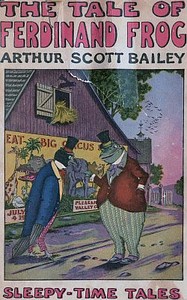
Read on Project GutenbergFerdinand Frog's first appearance in Arthur Scott Bailey's story is marked by a bow and a smile—gestures that recur throughout the narrative as signatures of his character. The opening chapter, "Pretty as a Picture," establishes a pattern: Mr. Frog's cheerful demeanor and unpredictable leaps define him before any plot unfolds. Bailey's prose moves briskly between scenes, often jumping from the pond to the woodland without transition, mirroring the frog's own jumpiness. The story's structure is episodic, each chapter a self-contained incident that showcases Ferdinand's good nature or his knack for causing trouble.
A Tailor's Shop and a Trick
The chapter "Everyone Is Happy" reveals a key structural feature: Bailey builds scenes around a single, absurd premise. Here, Ferdinand Frog sets himself up as an "unfashionable tailor," a claim he defends with a sign. The humor derives from the literal-mindedness of the Beaver customers, who pay him with a tape measure—sixty inches—instead of money. The scene moves from the shop interior to the pond bank, where Mr. Frog's final somersault and splash conclude the episode. This pattern—a problem, a verbal duel, and a physical escape—recurs across the book.
Bailey's dialogue often carries the action. The Beavers' objections and Ferdinand's grinning retorts drive the scene, while the narrator's interjections ("There was really no need of that last warning") add a wry tone. The chapter ends with Mr. Frog laughing underwater, unseen, a motif that emphasizes his private amusement at others' expense.
The Unseen Threat and the Frozen Pose
In "Stop That!" Bailey shifts the setting to a quiet morning among reeds. The arrival of a huge bird—initially mistaken for a stick—introduces danger through a visual misdirection. Mr. Frog's response is characteristic: he shows no fear, but the narrative notes his awareness of the bird's "great, long bill." The scene hinges on stillness and sudden movement, contrasting with Ferdinand's usual leaps. The bird's repeated command "Stop that!" creates a rhythmic tension, while Mr. Frog's feigned ignorance prolongs the standoff.
This chapter exemplifies Bailey's use of the natural environment as both setting and obstacle. The pond, reeds, and muddy bottom are not just backdrops but active elements—the bird's leg looks like a stick, the water hides Ferdinand's laughter. The movement between above-water and underwater perspectives gives the story a layered geography.
Recurring Gestures: Bows, Smiles, and Somersaults
Throughout the excerpts, Ferdinand Frog's physical repertoire is remarkably consistent. He bows low, smiles broadly, and leaps into the air—often turning a back somersault. These actions are described with slight variation each time, creating a rhythm that readers come to expect. In the opening chapter, his "sprightly manner" and unpredictable jumps are noted; later, he "leaped suddenly into the air and alighted directly in front of a Beaver." The somersault becomes a punctuation mark for scenes, as when he "turned a back somersault, and then he rolled over and over until he landed with a great splash."
Bailey also repeats the motif of clothing and appearance. Mr. Frog's "elegant manners" and his role as a tailor tie into a broader concern with how characters present themselves. The Beavers' new suits, the sign declaring "unfashionable tailor," and the tape-measure payment all circle back to the idea of fashion as a social game. These recurring elements give the episodic structure a thematic coherence.
Movement Between Pond and Woodland
The story's geography is simple but effective: the pond, the bank, and the surrounding woodland. Scenes shift between these locations with little connective tissue, mirroring the jumpy nature of the protagonist. In "Pretty as a Picture," the setting is general—"Pleasant Valley"—but specific scenes anchor themselves: the tailor shop appears in "Everyone Is Happy," the reeds in "Stop That!" The pond is both a home and a refuge; Ferdinand dives into it to escape or to laugh unseen.
Bailey uses the pond's vertical dimension: above water for social encounters, below for private moments. The muddy bottom where Mr. Frog laughs is inaccessible to the Beavers, creating a spatial hierarchy of knowledge. This movement between visibility and concealment, sound and silence, structures the reader's experience. The narrative voice remains omniscient but often withholds information, letting readers discover details alongside the characters.
Readers attentive to Bailey's craft will notice how each chapter reuses a small set of props—tape measures, signs, bows—to generate new comic situations. The story rewards attention to physical comedy and verbal repetition. For a full appreciation, consider how the illustrations by Harry L. Smith might have complemented these scenes, though they are not reproduced here. The Tale of Ferdinand Frog is best read as a series of quick, self-contained vignettes, each a variation on a theme of cheerful mischief.
The rain tapped against the window while I reread Ferdinand’s bows and somersaults, noting how each small gesture altered the pond’s mood. Later, drying my hands, I found myself drifting toward another quiet shelf, picking up In Wild Rose Time — Reading Companion. The pages felt like a slower echo of that same afternoon—not a continuation, but a warm, familiar pause.
There are no reviews for this eBook.
There are no comments for this eBook.
Reader reflection
Take a moment to reflect on this book
Create a short personal record of your experience with this book.
Your progress
0
/
10
2
Did this book hold your interest?
3
Would you encourage someone else to read it?
4
How easy was the book to follow?
5
How personally connected did you feel to the book?
6
Did the story or argument move comfortably?
7
Did you gain anything practical from the text?
8
What did you appreciate most?
9
What is the main idea you are taking away?
10