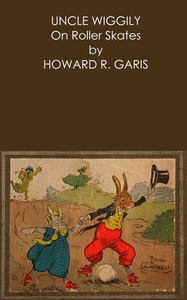
Uncle Wiggily on roller skates — Inside the Classic
Edition facts
Calculated from edition completeness, EPUB availability, text structure and catalogue metadata. Not a user rating.
Read the Text
no use. “Oh, if we only had some one to help!” he sighed. “I’ll help you!” offered a voice. “Who was that?” asked Baby Bunty. “Oh, the Alligator!” cried Uncle Wiggily.
9. All of a sudden, as soon as he knew the Alligator was there, Uncle Wiggily’s legs seemed to pull together. “I’m all right now, Bunty!” he cried. “Come on, I’ll skate as I haven’t skated since I was a boy rabbit!” And Mr. Longears did just that. He and Baby Bunty glided so fast that, run as he did, the Skillery Scallery Alligator could not get them. “Ha! Ha!” laughed the bunny, “who says I can’t skate!”
And if the gold fish doesn’t try to flip out of its bowl and go to sleep in the canary bird’s cage, the next pictures and story will tell how
THE FOX AND WOLF, BOTH BAD CHAPS THEY, TRIED HARD UNCLE WIGGILY TO CATCH ONE DAY. BUT SNOW BALLS AT THEM FLEW SO FAST, THEY BOTH DID RUN AWAY AT LAST.
1. Once upon a time Uncle Wiggily was out walking wearing his tall silk hat, for he had been to a reception given by Mrs. Twistytail, the pig lady. Then, all of a sudden, when Uncle Wiggily was nearly at his hollow stump bungalow, the Fox threw a snowball, knocking off the hat. “Ha! Ha!” laughed the Wolf. “That’s funny!” Uncle Wiggily could see nothing very funny about it. “Guess I’ll run,” he said.
2. Uncle Wiggily guessed what sort of a trick the Fox and Wolf were trying to play on him. “They thought I’d stop and pick up my hat,” said the bunny to himself, “and then they could catch me and nibble my ears. But I’d rather lose my hat than my ears!” So away he ran without his hat. Out jumped the Fox and Wolf. One of them picked up the hat and chased after Uncle Wiggily with it, crying: “Wait!”
3. Uncle Wiggily ran so fast without his hat that soon he left the Fox and Wolf behind. “Well, our trick didn’t work,” said the Fox. “No,” agreed the Wolf, “but I know another trick we can play.” The Fox wanted to know what it was. “We’ll do this,” growled the Wolf. “We’ll sneak up and leave Uncle Wiggily’s hat near his bungalow. Then we’ll hide, and when he comes out to get it, we’ll grab him!”
4. Uncle Wiggily ran on as fast as he could, without his hat, until he reached his hollow stump bungalow. Near it he saw some of the animal boys having a snowball fight. “Oh, this gives me an idea for playing a trick on the Fox and Wolf,” said the bunny. Just then up rushed Floppy Twistytail, the piggie boy. He had heard what the Fox and Wolf said about coming to the bungalow and Floppy told all.
5. “You say the Fox and Wolf are coming to put my hat on the ground near my bungalow, and will grab me when I go to get it; is that it, Floppy?” asked the bunny. “That’s it,” said the piggie boy. “Ah, now for a snowball fight!” cried Uncle Wiggily to the animal boys. “Make all the hard balls you can,” he told them. “Hide around the corner of my bungalow, and we’ll wait for the Fox and Wolf to come.”
6. Along came the Fox and Wolf, not knowing what was going to happen to them. Around the corner of the bungalow Uncle Wiggily and the animal boys watched. “We’ll leave the hat on the snow,” said the Fox to the Wolf. “I guess Uncle Wiggily is in there now. Then we’ll hide behind the stump and wait for him to come out to get his hat.” The Wolf said that would be a good plan, so that’s what they did.
7. “Now, boys, be on the watch!” whispered Uncle Wiggily to the animal chaps with their hard snowballs. “I’m going out now to get my hat. When the Fox and Wolf rush at me--well, you know what to do!” The animal boys chuckled with glee. “Yes, we know what to do, all right, Uncle Wiggily!” His pink nose twinkling at what was going to happen, Uncle Wiggily stepped bravely toward his hat.
8. All of a sudden, just as Uncle Wiggily reached down and picked up his hat--all of a sudden, out rushed the Fox and Wolf from behind the stump. “Now we’ll get him!” howled the Wolf. “Let them have the snowballs, fellows!” cried the piggie boy. And they threw the hard chunks of snow and ice in the faces of the Fox and Wolf. “Oh wow! What is this?” barked the Fox as he felt a snowball hit him on his ear.
9. “Give it to them, boys! Give it to them!” cried Uncle Wiggily. The bunny rabbit put his hat down over his ears so it wouldn’t fall off and then he, too, joined in the snowball fight. “I thought you said we could easily get Uncle Wiggily!” howled the Wolf to the Fox. “Well, I thought we could!” cried the Fox. “Oh, wow, but what a mistake we made. Never again will I throw at Uncle Wiggily’s hat!”
And if the hammer doesn’t try to play croquet with a snowball and catch cold in its head, the next pictures and story will tell how
UNCLE WIGGILY TOOK THE SCARECROW, JUST TO PLAY A LITTLE TRICK. THE BAD OLD WOLF WAS BLOWN UP, LIKE A LONG SKYROCKET STICK. HA! HA!
1. One day, when Uncle Wiggily was hopping around, looking for an adventure, he reached a cornfield where, all summer, had stood an old Scarecrow. “Hum!” said the bunny to himself, as he saw the old stuffed, ragged man. “The farmer has no further use for this Scarecrow. His corn is cut and the crows have flown south. I’ll take the Scarecrow home and play a little trick on Nurse Jane with it. Ha! Ha!”
2. Uncle Wiggily laughed to himself as he thought of the trick he would play on Nurse Jane with the Scarecrow. “I guess I’ll put it away and save it for Hallowe’en and play the trick then,” said the bunny to himself. He became tired of hauling the stuffed and ragged man, and stood the Scarecrow up near a log, while he sat down on the other side of the log. Then the Fuzzy Fox saw the Scarecrow and wanted it.
3. All of a sudden, as Uncle Wiggily was thinking of hopping on again, up ran the Fox. “Ho! Ho!” barked the Fox, as he saw the Scarecrow, “these old clothes are just what I want for the winter!” Then the Fox started to run away with Uncle Wiggily’s Scarecrow that the bunny wanted for Hallowe’en. “Here! Come back!” cried the bunny, jumping up on the log. But the Old Fox only ran the faster.
4. “Well, if the Fox took one Scarecrow away from me I must find another,” said Uncle Wiggily, with a twinkle of his pink nose. He hopped along a little farther, and in a fence corner he saw a second ragged and stuffed man. “He has a tall silk hat on--like I wear!” said the bunny. “Some might take him for me. And what’s this--powder and matches! A hunter must have left them here. Now for a trick!”
5. “I’ll play a joke on the Fox or Wolf if they try to take this Scarecrow away from me,” said Uncle Wiggily with a laugh. Then the bunny poured some powder from the hunter’s flask inside the second Scarecrow. “I’ll put in a Fourth of July fuse, such as firecrackers have,” said Uncle Wiggily. “I’ll hide and watch, and when the Fox or Wolf runs away with this Scarecrow--Zoopie! What will happen?”
6. After Uncle Wiggily had put powder inside the Scarecrow, making the stuffed man into a sort of torpedo bomb, the bunny carried the image near a big rock. “I’ll lie down around the corner of the rock and make believe I’m asleep,” thought the rabbit. “But I’ll have one eye open and as soon as any bad animal takes my Scarecrow I’ll strike a match, light the powder fuse and then--Whoop! Up they’ll go!”
7. From afar the Woozie Wolf had seen Uncle Wiggily’s second Scarecrow, but the Wolf didn’t know about the powder. “Oh ho!” snickered the Wolf, creeping closer to the Scarecrow, “the Fuzzy Fox thought he was smart, taking away a Scarecrow to get the old clothes to keep him warm this winter. Well, he isn’t the only one! I’ll carry this stuffed man off to my den and take his clothes for myself!”
8. All of a sudden, almost before Uncle Wiggily knew what was happening, the Wolf made a jump and grabbed the Scarecrow. “You’re mine!” he howled. But the bunny gentleman quickly struck a match and lighted the powder fuse. It began to smoke and sizzle. Away ran the Wolf with the Scarecrow! “Oh ho!” laughed Uncle Wiggily, “He won’t run so fast in a few minutes! Oh, listen for the noise!”
9. All of a sudden there was a loud banging noise. “There it goes!” cried the bunny gentleman. “There goes the powder!” And the Scarecrow the Wolf was carrying away was blown up. Uncle Wiggily was far enough off not to be hurt. But that Wolf--“Oh, Skuzzie-zuzzie!” he howled, as he felt himself coming down like a skyrocket stick, after having sailed up, “Oh, zoopie! Lightning must have struck me!”
1. Original spellings were standardised only when a dominant version was found. 2. Enclosed italics font in _underscores_.
The book opens with Uncle Wiggily meeting Baby Bunty on skates. He is doubtful—his pink nose twinkles—but he cannot disappoint her, so he buys a pair and begins. The narration immediately establishes a pattern: the rabbit gentleman’s internal hesitation versus his willingness to please. His stammered “Ye-ye-yes” and “it isn’t so-so-so easy” signal the physical comedy that will recur. The story then shifts abruptly to a chase, as the Skillery Skallery Alligator gives pursuit. This movement between a domestic, polite opening and sudden danger is a structural hallmark of the three tales.
Repeated Chases and Escapes
Each of the three stories follows a similar arc: Uncle Wiggily encounters a threat—the alligator, then the fox and wolf—and must flee. The chase is the central action, but the escapes are never violent. Instead, the bunny relies on luck, cleverness, or the intervention of friends. For example, when the fox and wolf snowball him, the conflict is resolved not through confrontation but through a trick. This repetition of chase-and-escape gives the book a predictable rhythm that suits young readers. The alligator’s name, “Skillery Skallery,” hints at the playful language Garis uses throughout, where alliteration and nonsense words lighten the menace.
Movement Between Indoor and Outdoor Settings
The scenes shift quickly from domestic interiors to open fields or snowy paths. Uncle Wiggily’s home is a safe starting point, but the action soon moves outdoors, where dangers lurk. The roller skating begins on a path, the snowballing occurs in a winter landscape, and the trick on the wolf likely involves a familiar outdoor spot. This movement between safety and exposure reinforces the tension. The illustrations by Lang Campbell, though not reproduced here, would have emphasized these changes in setting. The text itself uses brief, scene-setting phrases to cue the reader: “Once upon a time” gives way to specific locations like “the bunn…” (cut off in the excerpt).
Physical Comedy and the Bunny’s Body
Uncle Wiggily’s body is a source of humor. His twinkling nose, stammering speech, and awkward skating are described in a way that invites laughter. The narration dwells on his physical reactions: he “stammered” and found skating “not so easy.” This emphasis on the bunny’s body—his long ears, his uncertain movements—makes the comedy tangible. The alligator’s chase is also physical, but the bunny’s clumsiness is the focus. Garis uses repetition of sounds (“so-so-so”) to mimic the character’s stutter, a technique that adds aural humor. The stories likely include further physical gags, such as falls or near-misses, based on the pattern established in the opening.
The Role of Baby Bunty and Other Animal Characters
Baby Bunty appears only in the first story, but she sets the plot in motion. She is a “cute little rabbit girl” who skates boldly, contrasting with Uncle Wiggily’s hesitation. Her role is to encourage the older rabbit, but she disappears once the chase begins. The fox and wolf are the antagonists in the later stories, but their menace is cartoonish rather than frightening. They snowball the bunny, a prank that is more annoying than dangerous. The animal characters are types—the helpful child, the sly predators—but Garis gives them distinct voices through dialogue tags and action. The alligator’s name, “Skillery Skallery,” suggests a whimsical threat rather than a realistic one.
Readers will notice that the three stories share a common structure: a polite opening, a sudden chase, and a clever resolution. The humor depends on Uncle Wiggily’s physical awkwardness and the playful language of the narrator. Pay attention to how Garis uses repetition and alliteration to build rhythm. The book is best enjoyed as a series of short, self-contained adventures rather than a continuous narrative.
I remember wobbling on rented skates at the rink, exactly like Uncle Wiggily’s hesitant ankles, that mix of thrill and foolishness. The snowballed fox felt less like a villain, more like a clumsy neighbor. That same gentle awkwardness surfaced reading Mary Erskine — Key Ideas to Explore, where kindness arrives sideways, through quiet missteps. Strange how these old stories keep company with newer ones, both whispering that obliging hearts stumble toward home.
Matthew Roberts
4 weeks agoOlivia Hill
3 weeks agoSofia Smith
1 week agoHow did this book work for you?
Your answers remain private and are stored only in this browser.
Michael Green
2 weeks ago