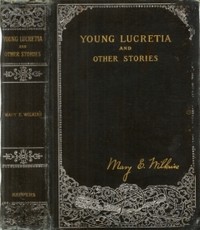
Young Lucretia and Other Stories — A Reader’s Guide

(3 User reviews)   835
Freeman, Mary Eleanor Wilkins, 1852-1930 Project Gutenberg 2006
Conduct of life -- Juvenile fiction; Children's stories; Children -- Conduct of life -- Juvenile fiction; New England -- Social life and customs -- Juvenile fiction Readers of public-domain and historical texts
Project Gutenberg digital edition en

Edition facts

Words: 54,052
Reading time: 236 min
Text sections: 6
In these thirteen stories, Mary E. Wilkins Freeman portrays New England children navigating small-town life, where adult conversations overheard, handmade gifts, and small acts of disobedience carry real weight. The title story follows young Lucretia, whose aunts' sternness contrasts with an elderly neighbor's impulse to sew her a rag doll.
Share

Read the Text

She had to poke one of the girls two or three times before she could get her question answered.

"What did you say, Lucretia Raymond?" she asked.

"That the Christmas-tree out there?"

"Course 'tis. Say, Lucretia, can't you come this evening and help trim? the boys are a-going to set up the tree, and we're going to trim. Say, can't you come?"

Then the other girls joined in: "Can't you come, Lucretia?--say, can't you?"

Lucretia looked at them all, with her honest smile. "I don't believe I can," said she.

"Won't they let you?--won't your aunts let you?"

"Don't believe they will."

Alma Ford stood back on her heels and threw back her chin. "Well, I don't care," said she. "I think your aunts are _awful mean_--so there!"

Lucretia's face got pinker, and the laugh died out of it. She opened her lips, but before she had a chance to speak, Lois Green, who was one of the older girls, and an authority in the school, added her testimony. "They are two mean, stingy old maids," she proclaimed; "that's what they are."

"They're not neither," said Lucretia, unexpectedly. "You sha'n't say such things about my aunts, Lois Green."

"Oh, you can stick up for 'em if you want to," returned Lois, with cool aggravation. "If you want to be such a little gump, you can, an' nobody'll pity you. You know you won't get a single thing on this Christmas-tree."

"I will, too," cried Lucretia, who was fiery, with all her sweetness.

"You see if I don't, Lois Green."

All through the day it seemed to her, the more she thought of it, that she must go with the others to trim the school-house, and she must have something on the Christmas-tree. A keen sense of shame for her aunts and herself was over her; she felt as if she must keep up the family credit.

"I wish I could go to trim this evening," she said to Alma, as they were going home after school.

"Don't you believe they'll let you?"

"I don't believe they'll 'prove of it," Lucretia answered, with dignity.

"Say, Lucretia, do you s'pose it would make any difference if my mother should go up to your house an' ask your aunts?"

Lucretia gave her a startled look: a vision of her aunt's indignation at such interference shot before her eyes. "Oh, I don't believe it would do a mite of good," said she, fervently. "But I tell you what 'tis, Alma, you might come home with me while I ask."

"I will," said Alma, eagerly. "Just wait a minute till I ask mother if I can."

But it was all useless. Alma's pretty, pleading little face as a supplement to Lucretia's, and her timorous, "Please let Lucretia go," had no effect whatever.

"I don't approve of children being out nights," said Aunt Lucretia, and Aunt Maria supported her. "There's no use talking," said she; "you can't go, Lucretia. Not another word. Take your things off, and sit down and sew your square of patchwork before supper. Almy, you'd better run right home; I guess your mother'll be wanting you to help her." And Alma went.

"What made you bring that Ford girl in here to ask me?" Aunt Lucretia, who had seen straight through her namesake's artifice, asked of young Lucretia.

"I don't know," stammered Lucretia, over her patchwork.

"You'll never go anywhere any quicker for taking such means as that," said Aunt Lucretia.

"It would serve you right if we didn't let you go to the Christmas-tree," declared Aunt Maria, severely, and young Lucretia quaked. She had had the promise of going to the Christmas-tree for a long time. It would be awful if she should lose that. She sewed very diligently on her patchwork. A square a day was her stent, and she had held up before her the rapture and glory of a whole quilt made all by herself before she was ten years old.

Half an hour after tea she had the square all done. "I've got it done," said she, and she carried it over to her aunt Lucretia that it might be inspected.

Aunt Lucretia put on her spectacles and looked closely at it. "You've sewed it very well," she said, finally, in a tone of severe commendation.

"You can sew well enough if you put your mind to it."

"That's what I've always told her," chimed in Aunt Maria. "There's no sense in her slighting her work so, and taking the kind of stitches she does sometimes. Now, Lucretia, it's time for you to go to bed."

Lucretia went lingeringly across the wide old sitting-room, then across the old wide dining-room, into the kitchen. It was quite a time before she got her candle lighted and came back, and then she stood about hesitatingly.

"What are you waiting for?" Aunt Lucretia asked, sharply. "Take care; you're tipping your candle over; you'll get the grease on the carpet."

"Why don't you mind what you're doing?" said Aunt Maria.

Young Lucretia had scant encouragement to open upon the subject in her mind, but she did. "They're going to have lots of presents on the Christmas-tree," she remarked, tipping her candle again.

"Are you going to hold that candle straight or not?" cried Aunt Lucretia. "Who is going to have lots of presents?"

"All the other girls."

When the aunts got very much in earnest about anything they spoke with such vehement unison that it had the effect of a duet; it was difficult to tell which was uppermost. "Well, the other girls can have lots of presents; if their folks want to get presents for 'em they can," said they. "There's one thing about it, you won't get anything, and you needn't expect anything. I never approved of this giving presents Christmas, anyway. It's an awful tax an' a foolish piece of business."

Young Lucretia's lips quivered so she could hardly speak. "They'll think it's--so--funny if--I don't have--anything," she said.

"Let 'em think it's funny if they want to. You take your candle an' go to bed, an' don't say any more about it. Mind you hold that candle straight."

Young Lucretia tried to hold the candle straight as she went up-stairs, but it was hard work, her eyes were so misty with tears. Her little face was all puckered up with her silent crying as she trudged wearily up the stairs. It was a long time before she got to sleep that night. She cried first, then she meditated. Young Lucretia was too small and innocent to be artful, but she had a keen imagination, and was fertile of resources in emergencies. In the midst of her grief and disappointment she devolved a plan for keeping up the family honor, hers and her aunts', before the eyes of the school.

The next day everything favored the plan. School did not keep; in the afternoon both the aunts went to the sewing society. They had been gone about an hour when young Lucretia trudged down the road with her arms full of parcels. She stole so quietly and softly into the school-house, where they were arranging the tree, that no one thought about it. She laid the parcels on a settee with some others, and stole out and flew home.

The festivities at the school-house began at seven o'clock. There were to be some exercises, some recitations and singing, then the distribution of the presents. Directly after tea young Lucretia went up to her own little chamber to get ready. She came down in a surprisingly short time all dressed.

"Are you all ready?" said Aunt Lucretia.

"Yes, ma'am," replied young Lucretia. She had her hand on the door-latch.

"I don't believe you are half dressed," said Aunt Maria. "Did you get your bow on straight?"

"I think she'd better take her things off, an' let us be sure," said Aunt Lucretia. "I'm not goin' to have her down there with her clothes on any which way, an' everybody making remarks. Take your sacque off, Lucretia."

"Oh, I got the bow on straight; it's real straight, it is, _honest_," pleaded young Lucretia, piteously. She clutched the plaid shawl tightly together, but it was of no use--off the things had to come. And young Lucretia had put on the prim whaleboned basque of her best dress wrong side before; she had buttoned it in the back. There she stood, very much askew and uncomfortable about the shoulder seams and sleeves, and hung her head before her aunts.

"Lucretia Raymond, what _do_ you mean, putting your dress on this way?"

"All--the other--girls--wear--theirs buttoned in--the back."

"All the other girls! Well, you're not going to have yours buttoned in the back, and wear holes through that nice ladies' cloth coat every time you lean back against a chair. I should think you were crazy. I've a good mind not to let you go out at all. Stand round here!"

Young Lucretia's basque was sharply unbuttoned, she was jerked out of it, and it was turned around and fastened as it was meant to be. When she was finally started, with her aunts' parting admonition echoing after her, she felt sad and doubtful, but soon her merry disposition asserted itself.

There was no jollier and more radiant little soul than she all through the opening exercises. She listened to the speaking and the singing with the greatest appreciation and delight. She sat up perfectly straight in her prim and stiff basque; she folded her small red hands before her; her two tight braids inclined stiffly towards her ears, and her face was all aglow with smiles.

When the distribution of presents began her name was among the first called. She arose with alacrity, and went with a gay little prance down the aisle. She took the parcel that the teacher handed to her; she commenced her journey back, when she suddenly encountered the eyes of her aunt Lucretia and her aunt Maria. Then her terror and remorse began. She had never dreamed of such a thing as her aunts coming--indeed, they had not themselves. A neighbor had come in and persuaded them, and they had taken a sudden start against their resolutions and their principles.

Young Lucretia's name was called again and again. Every time she slunk more reluctantly and fearfully down to the tree; she knew that her aunts' eyes were surveying her with more and more amazement.

After the presents were all distributed she sat perfectly still with hers around her. They lay on her desk, and the last one was in her lap. She had not taken off a single wrapping. They were done up neatly in brown paper, and Lucretia's name was written on them.

Lucretia sat there. The other girls were in a hubbub of delight all around her, comparing their presents, but she sat perfectly still and watched her aunts coming. They came slowly; they stopped to speak to the teacher. Aunt Lucretia reached young Lucretia first.

"What have you got there?" she asked. She did not look cross, but a good deal surprised. Young Lucretia just gazed miserably up at her. "Why don't you undo them?" asked Aunt Lucretia. Young Lucretia shook her head helplessly. "Why, what makes you act so, child?" cried Aunt Lucretia, getting alarmed. Then Aunt Maria came up, and there was quite a little group around young Lucretia. She began to cry. "What on earth ails the child?" said Aunt Lucretia. She caught up one of the parcels and opened it; it was a book bound in red and gold. She held it close to her eyes; she turned it this way and that; she examined the fly-leaf. "Why," said she, "it's the old gift-book Aunt Susan gave me when I was eighteen years old! What in the world!"

Aunt Maria had undone another. "This is the _Floral Album_," she said, tremulously; "we always keep it in the north parlor on the table. Here's my name in it. I don't see--"

Aunt Lucretia speechlessly unmuffled a clove apple and a nautilus shell that had graced the parlor shelf; then a little daintily dressed rag doll with cheeks stained pink with cranberry juice appeared. When young Lucretia spied this last she made a little grab at it.

"Oh," she sobbed, "somebody did hang this on for me! They did--they did! It's mine!"

It never seemed to young Lucretia that she walked going home that night; she had a feeling that only her tiptoes occasionally brushed the earth; she went on rapidly, with a tall aunt on either side. Not much was said. Once in a lonely place in the road there was a volley of severe questions from her aunts, and young Lucretia burst out in a desperate wail. "Oh!" she cried, "I was going to put 'em right back again, I was! I've not hurt 'em any. I was real careful. I didn't s'pose you'd know it. Oh, they said you were cross an' stingy, an' wouldn't hang me anything on the tree, an' I didn't want 'em to think you were. I wanted to make 'em think I had things, I did."

"What made you think of such a thing?"

"I shouldn't think you would know. I never heard of such doings in my life!"

After they got home not much was said to young Lucretia; the aunts were still too much bewildered for many words. Lucretia was bidden to light her candle and go to bed, and then came a new grief, which was the last drop in the bucket for her. They confiscated her rag doll, and put it away in the parlor with the clove apple, the nautilus shell, and the gift-book. Then the little girl's heart failed her, remorse for she hardly knew what, terror, and the loss of the sole comfort that had come to her on this pitiful Christmas Eve were too much.

"Oh," she wailed, "my rag baby! my rag baby! I--want my--rag baby. Oh! oh! oh! I want her, I want her."

Scolding had no effect. Young Lucretia sobbed out her complaint all the way up-stairs, and her aunts could distinguish the pitiful little wail of, "my rag baby, I want my rag baby," after she was in her chamber.

The two women looked at each other. They had sat uneasily down by the sitting-room fire.

"I must say that I think you're rather hard on her, Lucretia," said Maria, finally.

"I don't know as I've been any harder on her than you have," returned Lucretia. "I shouldn't have said to take away that rag baby if I'd said just what I thought."

"I think you'd better take it up to her, then, and stop that crying," said Maria.

Lucretia hastened into the north parlor without another word. She carried the rag baby up-stairs to young Lucretia; then she came down to the pantry and got a seed-cake for her. "I thought the child had better have a little bite of something; she didn't eat scarcely a mite of supper," she explained to Maria. She had given young Lucretia's head a hard pat when she bestowed the seed-cake, and bade her eat it and go right to sleep. The little girl hugged her rag baby and ate her cooky in bliss.

The aunts sat a while longer by the sitting-room fire. Just before they left it for the night Lucretia looked hesitatingly at Maria, and said, "I s'pose you have noticed that wax doll down to White's store, 'ain't you?"

"That big wax one with the pink dress?" asked Maria, faintly and consciously.

"Yes. There was a doll's bedstead there, too. I don't know as you noticed."

"Yes, I think I did, now you speak of it. I noticed it the day I went in for the calico. There was a doll baby's carriage there, too."

The aunts looked at each other. "I s'pose it would be dreadful foolish," said Lucretia.

"She'd be 'most too tickled to live," remarked Maria.

"Well, we can't buy 'em to-night anyway," said Lucretia. "I must light the candles an' lock up."

The next day was Christmas. It was about three o'clock in the afternoon when old Mrs. Emmons went up the road to the Raymond house. She had a little parcel. When she came into the sitting-room there was young Lucretia in a corner, so that the room should not get in a mess, with her wealth around her. She looked forth, a radiant little mother of dolls, from the midst of her pretty miniature house-keeping.

"My sakes!" cried old Mrs. Emmons, "isn't that complete? She's got a big wax doll, an' a bedstead, an' a baby-carriage, an' a table an' bureau. I declare! Well, I don't know what I should have thought when I was a little gal. An' I've brought some pieces for you to make some more dresses for the rag baby, if you want to."

Young Lucretia's eyes shone.

"You were real kind to think of it," said Aunt Lucretia; "an' she'll take real comfort making the dresses. I'm real glad you came in, Mis' Emmons. I've been going down to see you for a long time. I want to see Ann, too; I thought I'd see if she hadn't got a pattern of a dress that buttons up in the back for Lucretia."

Young Lucretia's eyes shone more than ever, and she smiled out of her corner like a little star.

HOW FIDELIA WENT TO THE STORE

"I don't know what we're goin' to do," said Aunt Maria Crooker. She sat in a large arm-chair, and held in her lap a bowl of sugar and butter that she was creaming. Aunt Maria filled up the chair from arm to arm, for she was very portly; she had a large, rosy, handsome face, and she creamed with such energy that she panted for breath.

"Well, I don't know, either," rejoined her sister, Mrs. Lennox. "I can't go to the store with my lame foot, that's certain."

"Well, I know _I_ can't," said Aunt Maria, with additional emphasis. "I haven't walked two mile for ten year, an' I don't believe I could get to that store and back to save my life."

"I don't believe you could, either. I don't know what is goin' to be done. We can't make the cake without raisins, anyhow. It's the queerest thing how father happened to forget them. Now here he is gone over to East Dighton after the new cow, and Cynthy gone to Keene to buy her bonnet, an' me with a scalt foot, an' you not able to walk, an' not one raisin in the house to put into that weddin'-cake."

Mrs. Lennox stated the case in full, with a despairing eloquence, and Aunt Maria sighed and wrinkled her forehead.

"If there were only any neighbors you could borrow from," she observed.

"Well, there ain't any neighbors 'twixt here and the store except the Allens and the Simmonses, and the Allens are so tight they never put raisins into their Thanksgivin' pies. Mis' Allen told me they didn't. She said she thought most folks made their pies too rich, an' her folks liked them just as well without raisins. An' as for the Simmonses, I don't believe they see a raisin from one year's end to the other. They're lucky if they can get enough common things to eat for all those children. I don't know what's goin' to be done. Here's the dress-maker comin' to-morrow, an' Cynthy goin' to be married in two weeks, and the cake ought to be made to-day if it's ever goin' to be."

"Yes, it had," assented Aunt Maria. "We've put it off full long enough, anyway. Weddin'-cake ain't near so good unless it stands a little while."

Just then there was a shrill, prolonged squeak. It came from the yard. The doors and windows were open; it was a very warm day.

"What's that?" cried Aunt Maria.

"Oh, it's nothin' but Fidelia's little wagon. She's draggin' it round the yard."

The two women looked at each other; it was as if a simultaneous idea had come suddenly to them.

Aunt Maria gave expression to it first. "Fidelia couldn't go, could she?"

"Maria Crooker, that little thing! She ain't six years old, an' she's never been anywhere alone. Do you s'pose I'm goin' to send her a mile to that store?" Mrs. Lennox's tone was full of vehement indignation, but her eyes still met Aunt Maria's with that doubtful and reflective expression.

The collection opens with old Mrs. Emmons and her daughter Ann watching young Lucretia pass by. Their dialogue—Mrs. Emmons pitying the child, Ann defending the aunts' care—establishes a pattern: adult judgments shape children's worlds. Freeman renders these exchanges in sharp, idiomatic speech, with Ann's "high-pitched and sharply sweet" voice and Mrs. Emmons's tender recollection of rag babies. The story then follows Lucretia to school, where she is warmly dressed but emotionally un-coddled, and the promised Christmas-tree becomes a quiet test of generosity.

The Weight of a Rag Doll

In "Young Lucretia," a rag doll made from blue thibet becomes a symbol of the care the child lacks at home. Mrs. Emmons's impulse to sew it contrasts with Ann's dismissal: "She won't think anything of it." Yet the narrative lingers on the doll's making, implying its significance. Similarly, in "Where Sarah Jane's Doll Went," a homemade doll named Lily Rosalie Violet May is eaten by a bossy calf after a boy steals it. The loss is treated as trivial by adults—"too trivial to fuss over"—but Sarah Jane's grief is palpable. Freeman shows how children invest objects with emotional weight that adults dismiss.

Voice and Silence in Village Life

Freeman's dialogue carries the story. In "Young Lucretia," Ann's voice is "high-pitched and sharply sweet," marking her as the choir soprano and hinting at a brittle nature. Mrs. Emmons speaks in a softer, nostalgic register. When Sarah Jane calls after Joe West, her "quaking" voice goes unanswered; Joe's silence and later his secret purchase of a china-headed doll reveal his remorse without words. The narrative often withholds characters' inner thoughts, letting speech and action imply motive. Joe's peeping from his window and the bossy's silent chewing of the doll are told without commentary, trusting readers to infer.

Small Rebellions and Their Consequences

Disobedience drives several plots. Sarah Jane is warned not to let a boy hold her doll, but she does, and loses it. Her mother declares the loss "served her right." Yet the story does not endorse this harsh logic: it follows Sarah Jane's despair and Joe's secret atonement. In "Young Lucretia," the child's lack of a Christmas-tree gift is not her fault, but the story implies she will receive the rag doll despite adult resistance. Freeman's children are not passive; they call out, follow, and plead. Their rebellions are small—letting a boy hold a doll, walking home alone—but the consequences are real, and the resolutions often come through unspoken adult kindness.

Freeman's stories reward attention to the spaces between words: the pause after a sharp remark, the glance out a window, the object left on a doorstep. Readers will find that the children's perspectives, though filtered through third-person narration, are never mocked. The New England setting—geraniums in windows, clover fields, apple trees—is rendered with precision, but the emotional landscape is what lingers.

I kept thinking about that Freeman collection long after finishing it—how a single rag doll could feel heavier than any lesson. It reminded me of that quiet stretch in Elsie on the Hudson — Reading Companion, where small gestures soften what feels rigid. Some books just settle into you like that, gently, without asking for anything back.

Madison Johnson
3 weeks ago

Lucas Davis
2 weeks ago

Noah Clark
2 weeks ago

4
4 out of 5 (3 User reviews )

Add a Review

Your Rating *
  • ...
    William Weeks - 3 weeks ago
    {'reviewType': 'neutral', 'content': "This collection offers a glimpse into the past with its gentle stories about everyday life. The writing is clear and evocative, but some of the pacing is slow and the plots are less exciting than modern short stories. Still, it's a good choice for those who appreciate historical fiction and character-driven storytelling."}

  • ...
    Wesley Williams - 2 weeks ago
    {'reviewType': 'positive', 'content': 'Young Lucretia and Other Stories is a delightful collection that transports the reader to a bygone era. The title story is a poignant and relatable tale of youthful strength and integrity, while the other stories are equally charming. Mary E. Wilkins Freeman has a unique talent for creating memorable characters and evoking a sense of place. This is classic American literature at its finest.'}

  • ...
    Jennifer Rebecca Ross - 2 weeks ago
    {'reviewType': 'negative', 'content': "I was hoping for more from this collection, but the stories felt dated and lacking in the depth and complexity of Freeman's earlier work. The characters, though well-drawn, are often passive, and the plots are mundane. The title story was the only one that held my attention. For a more engaging read, I'd recommend her other works instead."}


Reader reflection

Before you leave, reflect on the book

Use these questions to collect your thoughts before moving on.

Your progress 0 / 10
1

What is your current status with this title?

2

Was reading this book enjoyable?

3

Would you pass this book on to a friend?

4

Did the language feel accessible?

Related eBooks