About 21 minutes
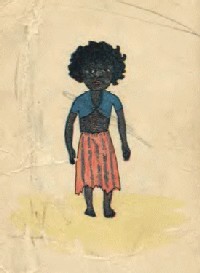
The Story of Little Black Mingo — Story, Setting & Ideas
Childrens Adventures
4,758 recorded words. 2 minutes difference from this book's estimate.
View Gutenberg source #11162

For Little Black Sambo — Story, Setting & Ideas, the stored edition analysis reports 4,215 words, 19 min estimated reading time, and 1 detected text section.
The text analysis averages about 22.5 words per sentence, while the detected sections provide another way to judge how the source is divided.
Project Gutenberg metadata also associates the work with “Children's stories,” connecting these edition facts with the source record’s subject description.
Explore this collection
These alternatives are selected using recorded categories and estimated reading time.
About 21 minutes
Childrens Adventures
4,758 recorded words. 2 minutes difference from this book's estimate.
View Gutenberg source #11162About 25 minutes
Childrens Adventures
5,553 recorded words. 6 minutes difference from this book's estimate.
View Gutenberg source #12116About 26 minutes
Childrens Adventures
5,760 recorded words. 7 minutes difference from this book's estimate.
View Gutenberg source #70017Search stored excerpts and compare books → Choose by your preferences →
Choices use stored catalog measurements. Estimates vary with reading speed. A shared category is a catalog label, not a claim that two books have the same argument or literary quality.
Search reads excerpt text stored with this catalog and links to its associated Gutenberg record. The connection is stored in the site database; this tool does not recheck that every excerpt is word-for-word identical to that external record. Excerpt search does not cover every chapter and does not verify historical publication dates.
Catalog snapshot checked: 2026-09-25. Coverage: 96 public books, 96 available source excerpts.
Read the complete public-domain text at its original source.
Read on Project GutenbergFrom the opening sentence, 'Little Black Sambo' establishes a pattern of repetition that drives its narrative engine. Each encounter with a tiger follows the same template: a threat, a plea, a trade, and a boast. Yet within this rigid structure, Bannerman introduces subtle variations that alter the rhythm and escalate the stakes. The tigers' demands shift from clothing to accessories, and Sambo's responses grow more inventive—suggesting shoes worn on ears or an umbrella tied to a tail. These incremental changes prevent the repetition from becoming monotonous, instead building a cumulative comic effect.
The story's backbone is a series of nearly identical episodes. Each tiger appears, declares its intention to eat Sambo, and is appeased by an item of clothing. The dialogue is formulaic: 'Little Black Sambo, I'm going to eat you up!' followed by 'Oh! Please, Mr. Tiger, don't eat me up, and I'll give you my...' This pattern is established so firmly that any deviation—such as the tiger questioning the usefulness of shoes—stands out sharply. The repetition also mirrors oral storytelling traditions, where predictable structures aid memorization and audience participation. Bannerman leans into this, using the same phrasing for the tigers' boasts ('Now I'm the grandest Tiger in the Jungle') to reinforce the cyclical nature of the encounters.
The narrative voice is deceptively simple, relying on short declarative sentences and minimal description. Yet within this spare style, Bannerman creates distinct vocal qualities. Sambo's pleas are polite and desperate, always beginning with 'Oh! Please.' The tigers' responses vary: some accept immediately, while others challenge the offer. The tiger who rejects the shoes asks, 'What use would your shoes be to me? I've got four feet and you've got only two.' This logical objection introduces a brief shift in tone—from pure threat to a quasi-negotiation. Sambo's clever retort ('You could wear them on your ears') injects humor and shows his resourcefulness. The dialogue thus oscillates between menace and wit, keeping the reader engaged.
Although the encounters follow a similar pattern, the pacing accelerates as the story progresses. The first two trades are straightforward: coat for life, trousers for life. The third and fourth trades require more back-and-forth, as the tigers question the items' utility. This lengthens the exchanges and adds dramatic tension. The final tiger's demand for the umbrella introduces a new element—the need to 'tie a knot on your tail'—which is the most elaborate solution yet. The cumulative loss of Sambo's finery also creates a sense of mounting stakes: each item is described with increasing specificity ('beautiful little Purple Shoes with Crimson Soles and Crimson Linings'), emphasizing what is sacrificed. The rhythm of the prose mirrors this escalation, with longer sentences and more dialogue tags in later encounters.
Readers may find it useful to track how Bannerman manipulates the repetitive structure to build anticipation. Notice that the tigers' boasts grow slightly more confident with each acquisition, while Sambo's responses become more inventive. The story's brevity—under 20 minutes to read—belies its careful construction. Pay attention to the moments where the pattern breaks, as these are where the narrative's humor and tension reside.
I kept thinking about how the rhythm in that old Sambo analysis—the bargaining back and forth, the way each repetition shifts just slightly—stayed with me like a song I couldn't shake. Funny enough, the same quiet pull happened with Christmas Stories Containing John Wildgoose the Poacher, the Smuggler, and Good-nature, or Parish Matters — Reading Notes. There’s something gentle in watching a voice circle a story, finding humor in the same spots, and I felt that echo without quite knowing why.
Save your reaction, strongest insight, and memorable passage.