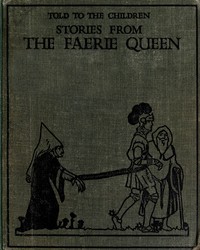
Stories from the Faerie Queen, Told to the Children — Edition Insights
Edition facts
Calculated from edition completeness, EPUB availability, text structure and catalogue metadata. Not a user rating.
Read the Text
Una was one of the most beautiful princesses that ever were seen, and she was as good as she was beautiful.
She and her father and mother loved each other very dearly, and they were very happy together, until a dreadful thing happened in their kingdom and took all their happiness away.
A hideous dragon came from another country, and killed men and women and little children. With its fiery breath it turned the trees and grass and flowers into black ashes, and it slew everybody that it came across.
It would have killed Una's father and mother too, but they and some of their servants shut themselves up in a tower made of brass. The dragon tried very hard to get in and eat them up, but it could not break into a tower so strong.
For seven years the king and queen hid in their tower, while the dragon lay outside.
Many brave knights came and fought with the horrible monster and tried to save the king and queen. But the dragon was stronger than all the knights, and killed every one of them.
At last Una made up her mind to ride to Fairyland and ask the Queen of the Fairies to send one of her knights to kill the dragon.
Una took no soldiers nor servants with her, but a dwarf carried for her the food and clothes she needed, and she rode on a little white ass.
Her dress was of white, but she covered it and her beautiful, shining, golden hair up with a black cloak to show that she felt sad. Her lovely face was very sorrowful, for she was so unhappy at the cruel things the dragon had done, and the danger her dear father and mother were in.
Una safely got to the court of the Faerie Queen, and a young knight, fearless and faithful and true, offered to come back with her to kill the dragon.
His name was George, but on the breast of his silver armour, and on his silver shield, a red cross was painted. So people called him the Red Cross Knight.
The sun shone bright, and the birds sang sweetly, as Una and her knight rode away through the woods that lay between her father's kingdom and the lands of the Faerie Queen.
The knight's great war-horse pranced and champed at its bit, and Una's little donkey put down its dainty feet gently on the grass and wondered at the great big horse and his jingling harness as they went along side by side.
Before they had gone very far a storm came on. The sky grew dark and rain fell heavily, and they would have been drenched had they not found shelter in a thick wood. There were wide paths in this wood, and tall trees whose leafy branches grew so close that no rain could come through.
It was such a beautiful wood, and they were so happy talking together and listening to the birds' sweet song, that they rode along without noticing where they went.
So when the rain stopped and they wished to get back to the open road, they could not find the way. On and on they went, until they came to the mouth of a great dark cave.
The knight sprang from his horse, and giving his spear to the dwarf to hold, went forward to see what might be hidden in the darkness.
'Do not be so rash!' cried Una; 'I know that this is a terribly dangerous place, and that a dreadful monster stays in that black den!'
The frightened dwarf also begged him to come away, but the knight said, 'I should be ashamed to come back. If one is good, one need have no fear of the darkness.'
So into the darkness he went, and in the faint light that came from his shining armour he saw a hideous monster. It had a great ugly head and a long speckled tail like a serpent's, and it rushed at the knight, roaring furiously. He struck at it with his sword, but it wound its horrible tail around him, until he was nearly crushed to death.
Una called to him not to fear, but to strike the monster bravely. And he, smiting it with all his might, cut off its head.
Then Una and he rode joyfully onwards, and, as evening fell, they found a way out of the wood. On the road they met an old man who looked kind and good. He asked them to stay all night in his cottage in a little valley near at hand, and they gladly went.
This old man was a wicked magician, and all he wanted was to do them harm.
When they had lain down to rest, he began to work his magic on them. So well did he do it, that he made the Red Cross Knight believe that Una was very false and wicked, and that the best thing he could do was to go away from her. Very early in the morning the knight made the dwarf saddle his horse, and they went off together and left Una asleep in the house of the wicked magician.
When she awoke and found them gone, Una could only weep bitterly at what seemed to her their cruelty.
She rode after them as quickly as she could, but her little donkey could only go slowly, and in his anger and sorrow the knight had made his horse gallop so fast that she had no chance of overtaking them.
Day after day, up hill and down dale, in woods and on lonely moors, she sought her knight. And her heart was very sad, because he whom she loved had left her so ungently.
One day when she was very tired she lay down to rest under the trees in a thick wood. She took off her black cloak, and her beautiful golden hair fell loosely round her face. Her face was so fair and so full of goodness that it seemed to make sunshine in the shady place.
Suddenly there rushed at her from out of the wood a furious lion. He was hunting for something to kill and eat, and when he saw Una he ran at her greedily, with hungry gaping jaws.
But when it had looked at her lovely face, instead of tearing her in pieces it gently licked her little white hands and feet. And Una's sad heart was so grateful to the noble beast that her tears dropped on him as he did it.
The lion would not leave her. He kept watch while she slept, and when she was awake he followed her like a faithful dog.
Together they wandered on, but never met any one that Una could ask if he had seen the Red Cross Knight.
At last, one evening, they saw a young woman walking up a steep mountain path, and carrying a pot of water on her back. Una called to her, but when the woman looked round and saw a lovely lady and a lion, she got such a fright that she threw down the pot and ran for her life. Her old mother was blind, and they lived in a hut on the mountain, and when she got there she rushed in and shut the door.
Una and the lion followed her, and the lion, with one blow from his strong paw, drove the door in.
The two women were hiding in a dark corner, half-dead from fear. Una tried to comfort them, and asked them if she and her lion might shelter there for the night. When darkness came she lay down, very tired, to sleep, while her lion lay and watched at her feet.
In the middle of the night a knock came to the door. It was a wicked robber, who used to bring the things he stole and give them to those two bad women. The women were so afraid of the lion that they dared not come out of their hiding-place. So the thief, in a rage, burst the door open, and when he did this, the lion rushed at him and tore him in pieces.
Next morning Una rose early and went away with the lion.
When she had gone, the women came out, and when they saw the robber's dead body, they were filled with rage at Una and her lion. They ran after her, calling her bad names, but they could not overtake her.
As they were going home they met the wicked magician. They told him about Una, and he rode quickly after her. By his magic he made himself armour the same as that of the Red Cross Knight, and when Una saw him she thought it was her own true knight come back to her at last. He spoke to her as if he was really her knight, and her heart was filled with gladness.
But she was not the only one who thought that the wicked magician was the Red Cross Knight. Sansloy, a rough and wicked man, whose brother had been killed in a fight with the Knight of the Red Cross, came riding along and met them. When he saw the red cross on the magician's breast he rode at him furiously.
The old magician had to fight, whether he wanted to or not, and Sansloy fought so fiercely that he wounded him and cast him bleeding on the ground. Then Sansloy dragged off his helmet and was going to kill him, when he found, instead of the Red Cross Knight's handsome young face, the wicked old face and grey hair of the magician.
Sansloy was afraid of the magician, so he drew back and did not hurt him more. But when he saw how beautiful Una was, he roughly dragged her off her ass, and made up his mind to take her away with him and make her his wife.
When the lion saw the knight roughly take hold of Una, he made a fierce rush at him, and would have torn him in pieces; but Sansloy beat the lion back with his shield, and when the lion would have torn the shield from him, he drove his sword deep into the lion's faithful heart. With a great roar the noble beast fell dead, and Sansloy threw Una before him on his horse and galloped away with her. She wept and sobbed and begged him to let her go, but Sansloy would not listen. And it seemed as if Una had no friend left, or, at least, no friend that could help her. For the little white donkey trotted after her, afraid of nothing except to be left alone without his mistress.
The darkness fell, and the stars that came out looked down like weeping eyes on Una's sorrow and helplessness.
Sansloy stopped his horse at last and lifted Una down. When she shrank from him in fear, he was so rough that she screamed for help until the woods rang and echoed her screams.
Now in the woods there lived wild people, some of whom were more like beasts than men and women. They were dancing merrily in the starlight when they heard Una's cries, and they stopped their dance and ran to see what was wrong.
When Sansloy saw them, with their rough long hair and hairy legs and arms and strange wild faces, he was so frightened that he jumped on his horse and galloped away.
But the wild people of the woods were more gentle than the cowardly knight. When they saw Una, so beautiful and so frightened and so sad, they smiled at her to show her that they meant to be kind. Then they knelt before her to show her that they would obey her, and gently kissed her feet.
So Una was no longer afraid, and when the wild people saw that she trusted them, they were so glad that they jumped and danced and sang for joy. They broke off green branches and strewed them before her as she walked, and they crowned her with leaves to show that she was their queen. And so they led her home to their chief, and he and the beautiful nymphs of the wood all welcomed her with gladness.
For a long time Una lived with them and was their queen, but at last a brave knight came that way. His father had been a wild man of the woods, but his mother was a gentle lady. He was brave and bold as his father had been. When he was a little boy and lived with the wild people, he used to steal the baby lions from their mothers just for fun, and drive panthers, and antelopes, and wild boars, and tigers and wolves with bits and bridles, as if they were playing at horses. But he was gentle like his mother, although he was so fearless. And when Una told him the story of the Red Cross Knight and the lion, and of all her adventures, his heart was filled with pity. He vowed to help her to escape, and to try to find the Red Cross Knight. So one day he and she ran away, and by night had got far out of reach of the wild men of the woods.
When the wicked magician knew of Una's escape, he dressed himself up like a pilgrim and came to meet her and the brave knight of the forest.
'Have you seen, or have you heard anything about my true knight, who bears a red cross on his breast?' asked Una of the old man.
'Ah yes,' said the magician, 'I have seen him both living and dead. To-day I saw a terrible fight between him and another knight, and the other knight killed him.'
When Una heard this cruel lie she fell down in a faint. The brave young knight lifted her up and gently tried to comfort her.
'Where is this man who has slain the Red Cross Knight, and taken from us all our joy?' he asked of the false pilgrim.
'He is near here now,' said the magician. 'I left him at a fountain, washing his wounds.'
Off hurried the knight, so fast that Una could not keep up with him, and sure enough, at a fountain they found a knight sitting. It was the wicked Sansloy who had killed Una's lion and carried her away.
The brave knight rushed up to him with his drawn sword.
'You have slain the Red Cross Knight,' he said; 'come and fight and be punished for your evil deed.'
'I never slew the Red Cross Knight,' said Sansloy, in a great rage. 'Your enemies have sent you to me to be killed.'
Then, like two wild beasts, they fought, only resting sometimes for a moment that they might rush at each other again with the more strength and fury.
Blood poured from their wounds, the earth was trampled by their feet, and the sound of their fierce blows rang through the air.
Una was so terrified at the dreadful sight that she ran away and left them fighting furiously.
Before she had gone far she saw a little figure running through the woods towards her. It was her own dwarf, and his woful face told her that some evil thing had happened to the Red Cross Knight.
The knight had had many adventures since he left her in the magician's hut, and at last a giant had caught him, and kept him a prisoner in a dreary dungeon. The dwarf had run away, lest the giant should kill him.
Una loved the Red Cross Knight so much that her heart almost broke when she heard the dwarf's story. But she made up her mind to find her knight and free him. So on she went, up hill and down dale, beaten by driving rain and buffeted by bitter winds.
At last, by good chance, she met a knight and his squire. This knight was the good Prince Arthur, of all the knights of the Faerie Queen the bravest and the best. To him she told her sorrowful tale.
'Be of good cheer and take comfort,' said the good prince. 'I will never leave you until I have freed the Red Cross Knight.'
And the prince kept his promise.
The story of St. George and the Dragon will tell you how Una and her knight met together again and were married, and forgot their past sorrows in their great happiness.
ST. GEORGE AND THE DRAGON
Long, long ago, before the things that happened were written down in history books, a spiteful fairy came into the castle of an English king. She saw a beautiful baby-boy, the king's little son, lying asleep, and, out of mischief, she ran away with him and left her own ugly little fairy baby there instead.
But when she had stolen the baby, she could not be troubled to take care of him. So she laid him down in the furrow of a ploughed field.
Soon a ploughman, with his horses, came that way. He was a kind man, and he lifted the baby up off the cold brown earth and carried him home to his cottage. He called him Georgos, and brought him up as if he were his own boy.
When Georgos was a big boy he did not care to be a ploughman. He wished to be a knight and fight for people who were not as strong as he was. So he went to the court of the Faerie Queen, and she took him for one of her knights. She called him George, and gave him armour all shining with silver and with a red cross on his shield and on his breast.
You have heard the story of Una, so you know that it was George of the Red Cross who left the fairy court to fight for her and to be her knight.
There was no sadder knight to be found in all Fairyland than George of the Red Cross, after the wicked magician had made him think that Una was false and bad. With a heavy heart he rode away from the magician's cottage in the grey dawn, with the dwarf sadly following him.
As he went through the woods he met a knight riding with a beautiful lady in red robes that sparkled with jewels. The lady's horse was all decked out with gold, and from its bridle hung golden bells.
Although she was so beautiful, she was really a wicked witch, who was never so happy as when she was making men fight and kill each other.
When she saw George coming, she said to the knight with whom she rode, 'Here comes a knight! you must fight with him.'
So the knight rode furiously at George, and George met him as fiercely, and both their spears splintered as they crashed against each other. Then, with their swords they cut and thrust and hacked. The knight cut through a piece of George's helmet by the fury of one blow, but George gave him such a stroke in return, that his sword went through the steel helmet right into the knight's head, and he fell dead.
When the witch saw him fall, she galloped away, screaming with fear. George rode after her and begged her not to be afraid, but the witch pretended to cry bitterly. She told him she did not cry for sorrow that the knight was dead, but only because she was frightened. She said that the knight who lay there had wished to marry her, but that she did not love him, and liked George much better.
The witch looked so beautiful, with her red robes and splendid jewels, and pretended so well to be simple and good, that George believed all that she said.
'Do not be afraid,' he said, 'I will take care of you, and be your friend.'
So he did not think of Una any more, but rode away happily with the witch, who said her name was Fidessa.
In the middle of the day, when the sun had grown very hot, they rested in the shade of two great trees.
The spreading branches of the trees were overgrown with grey moss, and their green leaves were never still, but whispered and trembled as if the wind was blowing on them. George thought he would make a garland of these fresh leaves to put on Fidessa's dark hair. He plucked a little branch, and, as he broke it, red drops of blood trickled down from the place where it was broken.
Jeanie Lang's retelling of Edmund Spenser's The Faerie Queene for children opens with a directness that signals her editorial method: she condenses Spenser's elaborate stanzas into plain sentences while keeping the core of each adventure. In 'Una and the Lion,' the dragon's 'fiery breath' turns 'trees and grass and flowers into black ashes'—a sensory detail that replaces Spenser's dense allegory with immediate peril. Lang's diction leans toward the concrete: knights 'treat' ladies, shepherds 'sulk and scowl,' and a witch's magic is simply 'wicked.' The result is a version that prioritizes plot momentum and clear moral contrasts over the original's layered symbolism.
Diction and Moral Clarity
Lang consistently replaces Spenser's archaic, polysyllabic vocabulary with simpler terms that signal good or evil without ambiguity. Una is 'beautiful' and 'good'; the dragon is 'hideous' and kills 'men and women and little children.' The witch in 'Florimell and the Witch' is simply 'wicked,' and her magic is described as 'spiteful tricks.' This binary language suits the intended audience but also flattens Spenser's nuanced allegory. For instance, the Redcrosse Knight's spiritual struggles become a straightforward fight against a dragon. Lang's word choices—'dreadful,' 'happy,' 'gentle'—create a world where virtue is instantly recognizable and vice is unmistakable.
Dialogue as Character Marker
Lang uses dialogue sparingly but effectively to define character. The old shepherd Melibœus speaks in a courteous, measured tone: 'I have only a little cottage, turfed outside to keep out the wind and wet, but it is better to be there than to roam all night in the lonely woods, and I bid you welcome, Sir Knight.' His hospitality contrasts with Corydon's jealous muteness. When Calidore offers gold, Melibœus refuses: 'I do not want your gold, but, if you will, stay with us and be our guest.' This exchange establishes the shepherd's wisdom without exposition. In contrast, the witch's dialogue (not shown in excerpts) is presumably minimal, as Lang relies on action to convey malice.
Description and the Pastoral Setting
Lang's descriptive passages are most vivid in pastoral scenes. In 'Pastorella,' she builds a tableau: 'In the middle of the ring of girls sat Pastorella,' wearing a 'crown of spring flowers that the shepherdesses had bound together with gay silken ribbons.' The repetition of 'looked'—'he looked, and he looked, and he looked again'—mimics Calidore's fixation. Lang also adds sensory details absent from Spenser's original, such as 'the evening dew began to fall, and the sunset slowly died away.' These touches ground the romance in a tangible world. However, she omits Spenser's elaborate descriptions of armor and heraldry, focusing instead on natural imagery that a child can visualize.
Structure and Selection of Episodes
Lang selects eight episodes from Spenser's six books, each with a clear narrative arc. She begins with Una and the Lion, establishing the pattern of a virtuous protagonist overcoming a monstrous threat. The stories are self-contained, with minimal cross-references. Lang's introductions and transitions are functional: 'Now, one of the shepherds, whose name was Corydon...' This linear structure sacrifices Spenser's interwoven allegories for accessibility. Notably, she omits the more philosophical or violent episodes, such as the House of Pride or the Bower of Bliss. The chosen tales emphasize chivalric courtesy, as when Calidore places the victor's crown on Corydon's head, reinforcing the moral lesson of generosity.
Lang's adaptation invites young readers to encounter Spenser's characters as archetypes of virtue and vice, stripped of allegorical complexity. The prose moves briskly, with dialogue and action carrying the moral weight. Readers familiar with the original will notice the simplifications; newcomers will find a clear entry point into the world of knights, dragons, and enchanted mirrors. The illustrations by Rose Le Quesne, one per story, complement the text's visual clarity.
I finished Stories from the Faerie Queen and felt that strange quiet after closing a book, like waking from a vivid dream. It made me think of that other old story, where a boy’s stubbornness slowly softens into something kinder. Both leave you with a gentle ache for courage, the sort that lingers long after the page. Oscar; Or, The Boy Who Had His Own Way — Inside the Classic has that same patient warmth.
Daniel Thomas
2 weeks agoMatthew Young
2 weeks agoSofia Nelson
4 weeks agoVictoria Smith
3 weeks ago-
Brittany Jones - 3 weeks ago
A well-written adaptation that captures the spirit of Spenser's work. Some parts are simplified, which is expected for a children's version, but the stories remain enjoyable. A minor nitpick: the language could be slightly more modern, but overall, it's a solid book for introducing classic literature. -
Dennis Garcia - 3 weeks ago
An excellent introduction to Spenser's classic poem. The retelling is engaging and keeps the essence of the original while making it accessible to children. The tales of knights and dragons are vivid and exciting, and the illustrations (if present) add to the charm. Perfect for young readers who love fantasy. -
Chelsea Pierce - 1 week ago
As a fan of Spenser's original, I was disappointed. This retelling strips away much of the poetic beauty and nuance, and the simplified language feels flat. It might be okay for kids who want a quick introduction, but it doesn't do justice to the source material. There are better adaptations available.
Your personal reading reflection
Build a private reading journal entry for this title.
Noah Robinson
4 weeks ago