1

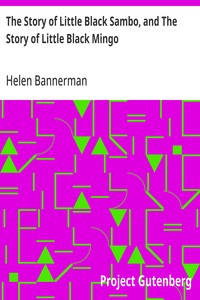
The Story of Little Black Sambo, and The Story of Little Black Mingo — Story, Setting & Ideas
(0 User reviews)
2918
Project Gutenberg
1998
Not confirmed
Children's stories; Boys -- Juvenile fiction; Girls -- Juvenile fiction; India -- Juvenile fiction; Tiger -- Juvenile fiction; Pride and vanity -- Juvenile fiction; Mongooses -- Juvenile fiction; Crocodiles -- Juvenile fiction
Readers of public-domain and historical texts
Project Gutenberg digital edition
en
Edition facts
Words
6,116
Reading time
27 min
Text sections
1
The source record for The Story of Little Black Sambo, and The Story of Little Black Mingo — Story, Setting & Ideas measures this digital text at 6,116 words, 27 min estimated reading time, and 1 detected text section.
The text analysis averages about 22.5 words per sentence, while the detected sections provide another way to judge how the source is divided.
Project Gutenberg metadata also associates the work with “Children's stories,” connecting these edition facts with the source record’s subject description.
Source:
Project Gutenberg record #1330
Two linked tales from 1899, each following a child who outwits a predator through negotiation and luck. The catalog subjects (India, tigers, crocodiles) match the setting, but the stories' repetitive structure and focus on clothing and food are more prominent than the moral framing suggests.
Editorial Edition Score
4.3/5
★★★★★
★★★★★
Calculated from edition completeness, EPUB availability, text structure and catalogue metadata. Not a user rating.
How this score is calculated
- Description quality20 pts
- Title & short description10 pts
- Source metadata20 pts
- Text length15 pts
- Chapters / structure15 pts
- EPUB file integrity20 pts
Total of 100 points, scaled to a 2.5-5.0 range. Editions with an empty description or a missing EPUB file are not scored.
Edition quality
Read the complete public-domain text at its original source.
Read on Project GutenbergThe two stories in this volume share a symmetrical structure: a child alone in a jungle-like setting encounters a series of predators, bargains away possessions or food to avoid being eaten, and eventually recovers everything through a combination of animal behavior and human intervention. In The Story of Little Black Sambo, the boy meets four tigers in succession, each time surrendering an article of clothing—red coat, blue trousers, purple shoes, green umbrella—until the tigers fight over the finery and turn into butter. In The Story of Little Black Mingo, the girl is taken by a mugger (crocodile) to an island, where she befriends a mongoose and later escapes when her captor is blown up by a kerosene explosion.
Repetition as Narrative Engine
Both tales rely on a pattern of repeated encounters with slight variation. Sambo meets four tigers, each time using the same plea—“Oh! Please Mr. Tiger, don’t eat me up, and I’ll give you my beautiful little…”—and each tiger departs claiming “Now I’m the grandest Tiger in the Jungle.” The formula is identical across the first three tigers; only the fourth tiger’s demand for the umbrella breaks the sequence. Mingo’s story also repeats: the mugger catches her, she is taken to an island, and she repeatedly feeds the mongoose. The repetition is not merely stylistic; it creates a rhythm that allows the child protagonist to retain agency through negotiation, even when physically overpowered.
Material Objects and Their Fate
The catalog subjects list Pride and vanity, but the excerpts show that clothing and food are the primary currencies of the plot. Sambo’s garments are described with precise colors and details: “beautiful little Red Coat,” “beautiful little Blue Trousers,” “lovely little Pair of Purple Shoes with Crimson Soles and Crimson Linings,” and a “Green Umbrella.” The tigers covet these items not for survival but for status—each declares itself the grandest after acquiring one. In Mingo’s story, the mugger demands “a whole lot of little fishes” and later eats Black Noggy along with a kerosene tin and matches. The explosion that kills the mugger is caused by the very objects he swallowed, turning his appetite against him.
Setting and Its Limits
The preface states the stories were invented by “an English lady in India, where black children abound and tigers are everyday affairs.” The catalog subject India is thus confirmed, but the excerpts offer no specific Indian cultural markers beyond the bazaar and the names (Mumbo, Jumbo, Sambo, Mingo, Noggy, Bumbo). The jungle is generic—tigers, a mugger, a mongoose—and the resolution in Sambo’s story involves the tigers turning into butter, a fantastical element unrelated to any real ecosystem. The setting functions as a stage for the repetitive plot rather than a culturally specific backdrop. Readers should note that the stories’ portrayal of India is filtered through the author’s expatriate perspective and should not be taken as ethnographic description.
These stories reward attention to their patterned language and the way objects—clothing, food, a kerosene tin—drive the action. The endings are abrupt and violent (butter transformation, explosion), yet the tone remains matter-of-fact. Readers may compare the two tales to see how the same narrative template adapts to different predators and different forms of rescue. The preface’s claim that the stories were made for the author’s own children suggests a domestic, improvisational origin that the repetitive structure still reflects.
Those old stories—the child outsmarting tigers through quick thinking and a bit of luck—stayed with me longer than I expected, mostly because of how gently they unfold. It reminded me of another quiet collection, Tales from Tennyson — Story, Setting & Ideas, where the weight sits softly, too. I keep thinking about how both leave room for wonder without pushing a lesson.
There are no reviews for this eBook.
There are no comments for this eBook.
Reader reflection
Record your reading impressions
A brief reflection can help important ideas stay with you longer.
Your progress
0
/
10
2
How much did you enjoy the reading experience?
3
Is this a title you would suggest to others?
4
How much effort did this book require?
5
How clearly were the main ideas presented?
6
What was the strongest part of the book?
7
How did the pace of the book feel?
8
Did it raise ideas you would like to talk about?
9
What changed or sharpened your thinking?
10