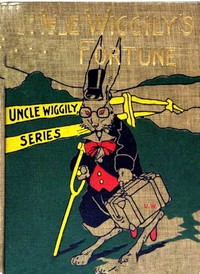
Uncle Wiggily's Fortune — Inside the Classic

(7 User reviews)   1356
Garis, Howard Roger, 1873-1962, Wisa, Louis, 1873-1953 [Illustrator] Project Gutenberg 2017
Animals -- Juvenile fiction; Children's stories; Birds -- Juvenile fiction; Seashore -- Juvenile fiction; Rabbits -- Juvenile fiction; Foxes -- Juvenile fiction; Insects -- Juvenile fiction; Uncle Wiggily (Fictitious character) -- Juvenile fiction; Seashore animals -- Juvenile fiction Readers of public-domain and historical texts
Project Gutenberg digital edition en

Edition facts

Words: 46,153
Reading time: 201 min
Text sections: 32
In this 1913 children's adventure, Uncle Wiggily Longears, an old gentleman rabbit, searches for fortune with a crutch made from a cornstalk. The narrative voice shifts between playful storytelling and sudden peril, as when an alligator traps him in a hole. A bizarre, mud-covered creature intervenes, showcasing Garis's use of absurd rescues.
Share
Editorial Edition Score 4.8/5

Calculated from edition completeness, EPUB availability, text structure and catalogue metadata. Not a user rating.

Edition quality

Read the Text

Wiggily was very kind.

He used to sleep in a hollow stump, near the nest of the tailor bird, and one night it rained so hard that he had to go to bed and pull the dried leaves up over him to keep warm. All night it rained, and in the morning Uncle Wiggily got up, and he was hoping it had cleared off, so he could travel on and seek his fortune, and get rich.

Out of bed hopped Uncle Wiggily. In one corner of the stump was his valise in which he carried his lunch and clean clothes and the like of that.

The day before, a bad wolf had chased Uncle Wiggily, catching him and tearing his coat, so that now the rabbit gentleman was quite stiff and sore. Still he managed to move about.

"Oh, dear me!" he exclaimed as he looked out of a hole in the stump, and saw the big rain drops still pattering down, "this is a very poor day for me to find my fortune. Still, I can't stay in on account of the weather, so I will get my breakfast and travel on."

He had some carrot and lettuce sandwiches in his valise and he ate these and then looked out to see if the rain had stopped, but it had not, I am sorry to say.

"Well," Uncle Wiggily said. "I don't like to get wet, but there is no help for it. I'll start out." Then he happened to think of something. "I know what I'll do!" he exclaimed. "I'll get the largest toadstool I can find, and use it for an umbrella."

Out he ran and soon he had picked a big toadstool that made as fine an umbrella as one could wish. Then, strapping his satchel to his back, where it would be out of the way, the old gentleman rabbit hopped off, holding the toadstool umbrella over his head, and limping along on his barber-pole crutch. And as he went over the meadows and through the woods he sang this little song, and sometimes when one sings it just at the right time, why it stops raining almost at once. But it has to be sung at the proper time. Anyhow this is the song:

"Splish-splash! Drip-dash! How the raindrops fall! When the weather gets too wet, It isn't nice at all.

"Mr. Rain, oh, please go 'way! For my feet are wet. And you're splashing on my nose. What? You can't stop yet?

"Won't you please be nice to me-- Make your raindrops dry. I am sure you could do this If you'd only try.

"Dry raindrops are very nice, And if they would fall, We could walk in showers, and Not get wet at all."

Well, as soon as Uncle Wiggily had sung this song, he looked up quickly from under his toadstool umbrella to see if it had stopped raining, but it hadn't, and he got a drop right in his left eye, which made him sneeze so hard that his spectacles fell off. And they dropped right into a mud puddle.

"Ha, hum!" exclaimed the old gentleman rabbit, "this is a pretty kettle of fish!" Of course, he didn't mean that there was a kettle of fish in the mud puddle, but that was his manner of talking, because he was so surprised. "A very pretty kettle of fish, indeed!" cried the old gentleman rabbit, "and speaking of fish, I guess I'll have to fish for my spectacles."

So what did he do but use his red-white-and-blue-striped-barber-pole crutch for a fishing pole, and he dipped it down in the mud puddle and in a little while up came his glasses wiggling on the end of the crutch just like an eel.

"That is good luck!" said the rabbit, as he wiped off the mud and water and put on his spectacles, and he was just going to put his toadstool umbrella over his head again when he found out that the rain had stopped and he didn't need it.

Then he left the toadstool hanging on a berry bush by the mud puddle to dry, so that whoever came along next time would have an umbrella all ready for the rain.

"Well, now that the sun is coming out I must be on the watch for my fortune," said the old gentleman rabbit to himself. And he peered first on one side of the road and then on the other, but not a sign of his fortune could he see.

Then, all of a sudden he saw something shining golden yellow in a field close by.

"Ah, that must be a pile of yellow gold!" exclaimed Uncle Wiggily. "Now my fortune is made!" and he hopped over to the field. But alas! and alack-a-day! Instead of being gold the pile of yellow things were carrots.

"Well, it might be worse!" said the rabbit. "At least I can eat carrots. I wonder if whoever they belong to would mind if I took some?"

"I wouldn't mind a bit!" exclaimed a voice. "Take as many as you like, Uncle Wiggily," and up jumped Mr. Groundhog, who owned the carrots. "Take all you can eat and fill your valise," said Mr. Groundhog.

"Thank you very kindly," replied the rabbit, so he ate several carrots and filled his satchel with more, and then he and Mr. Groundhog talked about the weather, and things like that, until it was time for Uncle Wiggily to hop on again after his fortune.

But he didn't find it, and pretty soon it came on toward night, and the old gentleman rabbit looked for a place to stay while it was dark.

"I think this will do," he said, when he came to a small stone cave. "I'll just crawl in here with my carrots and my crutch," and in he crawled as nicely as a basket of shavings.

Pretty soon Uncle Wiggily was fast, fast asleep, and he never thought the least mite about any danger. But danger was close at hand just the same.

Hark! What's that creeping, creeping along under the bushes? Eh? What's that? Why, my goodness me sakes alive and a piece of pie! It's the fuzzy old fox! Yes, as true as I'm telling you, the old red fox had seen Uncle Wiggily go into the cave, and now he was snooping and snipping up to catch him if he could.

"Oh, I'll soon have a fine time!" said the fox in a whisper, smacking his lips. Into the cave he crawled, and in the darkness he happened to knock over Uncle Wiggily's crutch, which was standing in a corner. Quickly the old gentleman rabbit awakened when he heard the noise. Up he jumped and he cried out:

"I'm the fox," was the answer, "and I came to catch you."

But do you s'pose Uncle Wiggily was afraid? Not a bit of it. He ran to his valise and he took out a pawful of carrots with their sharp points, and before that fox could even sneeze the rabbit threw one carrot at him and hit him on the nose, for Uncle Wiggily could see in the dark.

Then he threw another carrot and hit the fox on the ear, and then he threw still another one and he hit him on the two eyes, and that fox was so frightened and surprised that he jumped out of the second-story window of the cave house and sprained his toenail. Then he ran back to his den and didn't bother Uncle Wiggily any more that night, and the rabbit slept in peace and quietness, and dreamed about Santa Claus and ice-cream popcorn balls.

But Uncle Wiggily had another adventure next day. I'll tell you about it in a little while, when, in case some one sends me a mud pie with a cherry on the top, the story will be about Uncle Wiggily and the bird's nest.

------------------------------------------------------------------------

UNCLE WIGGILY AND THE BIRD'S NEST

"Now, I must be very careful to-day," said Uncle Wiggily to himself as he got up after sleeping in the stone cave, as I told you he did in the story before this one. "I must be very careful so that fox won't catch me."

So, very carefully and cautiously, he crept to the window of the stone cave house, and looked down, but the red fox was not there. The sun was brightly shining and the old gentleman rabbit could see the big dent made in the soft ground, where the fox had landed when he jumped out of the window and sprained his toenail.

"My! that certainly was a narrow escape for me," thought Uncle Wiggily. Then he fried some of Mr. Groundhog's carrots for his breakfast and, putting some of them in his valise for his lunch, off he started once more to seek his fortune.

He hadn't gone very far before he came to a place where he heard a funny buzzing sound. It was just like a small saw-mill away off in the woods, where the men saw logs into boards in order that houses may be built.

"Oh, my suz dud and a piece of red paper!" exclaimed Uncle Wiggily. "I must be careful or I might get my nose cut off in that saw-mill." So he was very careful, and, after he had listened a while longer, he wasn't quite so sure that it was a saw-mill that he heard, for he could hear a little voice crying:

"Oh, dear. I'll never get loose! I'm caught fast! Oh, if some one would only help me!"

"Ha! That is some one in trouble!" said the rabbit. "I'm going to see if I can't help them." So he bravely kept on through the woods, and the buzzing sound became louder, until, all at once, the old gentleman rabbit saw a nice, good bumble bee caught in the web of a big, black spider.

The bee was all tangled up in the web, and it was his wings fluttering to and fro and up and down that made the buzzing sound.

"Ha! Can't you get loose?" asked the rabbit.

"Indeed he can't!" cried the big, black spider lady, as she sat all hunched up in a corner of her web, waiting for the bee to get more tangled up and all tired out, so she could bite him. "He'll never get away from me," said the spider lady, sassy-like.

"Oh, ho! We will have to see about that!" exclaimed the rabbit. "I am afraid you are mistaken, Mrs. Spider. I am very sorry to have to spoil your cobweb, but I must help my friend, the bumble bee." And with that Uncle Wiggily took his crutch, and broke the web away from the bee's legs and wings so that he was loose and could fly away.

"I never can thank you enough, Uncle Wiggily," said the bee to the rabbit, "and if ever I can do you, or any of your friends, a favor I will. Don't forget to call on me."

"And if ever I can bite you, I will, Mr. Rabbit," said the spider in her crossest voice, as she set to work to mend her cobweb net so that she might catch some one else. Oh! but she was angry, though perhaps we can't blame her.

Well, Uncle Wiggily didn't worry much about what the spider said, as he knew he was going to travel on for a long distance after his fortune, and he didn't think she would come after him, and she didn't.

On and on hopped the old gentleman rabbit, sometimes going slowly and sometimes fast, and once in a while he would go up a hill, and then, again, he would go down. And so it went on. When it wasn't one thing it was another. But he didn't find his fortune anywhere.

Pretty soon, when it was nearly noon, Uncle Wiggily began to feel hungry, so he looked for a nice place where he might sit down and eat his lunch. He saw a shady tree, and he walked toward that, and, just as he did so, he happened to look up, and there, hanging from a branch, was a sort of brown-colored round object, that looked like a small bag.

"Ha! I think I know what that is!" exclaimed Uncle Wiggily. "That is the nest of a stingery hornet, and if I go too close I'll get stung. I'll just keep away, and go somewhere else to eat my lunch."

Uncle Wiggily started off, but at that moment he heard some voices calling. And this is what they said:

"Oh, dear! How hungry we are! Oh, when will mamma come back! Oh, if we only had something to eat!"

"Hum! I hope those hornets don't see me, and come out to bite me," said the rabbit.

And, would you ever believe it? the next moment those who had been calling must have seen Uncle Wiggily, for a voice exclaimed:

"Oh, good Mr. Rabbit won't you please come here? We can't get out, and our mamma has gone to the store for something to eat, and she hasn't come back; and we're so hungry. Please help us!"

"No indeed, I will not!" said Uncle Wiggily firmly. "I don't want to be unkind," he said, "but I am afraid you will sting me, you little hornets!"

"Why, the idea!" cried all the voices at once. "We are not hornets, we are only little birdies, and this is a bird's nest."

"Why, bless my whiskers!" exclaimed Uncle Wiggily. "I believe I have made a mistake." Then he put on his glasses, and surely enough he saw that the brown object like a bag was a nest, and it was full of little birds who could not yet fly very much, for their wings were not strong enough.

"Now, will you help us?" the birdies asked the rabbit. "Help us, please do; for we won't hurt you!"

"Bless my whiskers! Of course I will!" Uncle Wiggily cried, and he at once opened his valise and gave them all they could eat.

"Now I will go look for your mamma," he said. Off he started, but he had not gone very far before he heard the birdies in the nest crying:

"Help! Help! Help!" Uncle Wiggily looked back, and there was a great, big, ugly snake crawling up the tree to get the little birds.

"Oh, I must stop that!" exclaimed the rabbit, and back he started to hop to the nest. But he was quite a distance off, and he saw that he could not get back in time to drive off the snake. "Oh, what shall I do?" he cried. "If only the bumble bee would come along now and sting that snake the crawly creature would run away!"

And, would you ever believe it if I didn't tell you? At that moment along buzzed the bee and he saw the snake and stung him so that the snake was glad to jump away, and not hurt the little birdies. Then Uncle Wiggily and the little birds thanked the bee, who buzzed off to find some apple blossom honey. And pretty soon the mamma bird came home from the store, and she was very grateful to the rabbit for taking care of her little ones.

The reason she was away so long was because a boy threw a stone at her and made her spill the bread she had for her birdies. So she had to go back to the store for more.

"If you stay with us for a few days we will help you look for your fortune," said the mamma bird, and Uncle Wiggily did stay, and he had an adventure.

I'll tell you about it on the next page, when, in case the popcorn ball doesn't roll off the table and bump the kittie's nose, the story will be about Uncle Wiggily and a big rat.

------------------------------------------------------------------------

UNCLE WIGGILY AND A BIG RAT

When Uncle Wiggily had fed the little birds in the nest, after he and the bumble bee had saved them from the snake, as I told you in another story, the mamma bird said she could not do enough for the old gentleman rabbit.

"I will have my little ones sing a song for you," she went on. "Come now, birdies, sing for Uncle Wiggily."

So this is the song the little birds in the nest sang:

"Uncle Wiggily is good, Uncle Wiggily is kind, And we hope with all our hearts, That his fortune he may find.

"Gold and silver, diamonds, too, Ice-cream cones and candy sticks, And we hope that he can buy, Two red monkeys who do tricks."

"Oh! that is a very nice song, birdies," said the rabbit, as he took off his hat and made a low bow. "But," he went on, "I don't know as I care for red monkeys who do tricks. What in the world would I do with them?"

"Why, you could give them to us and they would amuse us when our mamma was away," said a little bird who had some feathers sticking crossways in her tail.

"Yes, I suppose I could give you the monkeys," went on the old gentleman rabbit, "but I hardly expect to find any in my travels--especially red ones."

"Won't you stay to supper with us?" asked the mamma bird, "and we would also be pleased to have you stay all night. Oh, no!" she suddenly exclaimed. "I don't see how you can stay all night."

"I can if you want me to," said Uncle Wiggily, for he thought perhaps the bird was afraid the snake might come back in the darkness, and the old gentleman rabbit made up his mind that if the crawly creature did sneak up, he would hit it with his crutch.

"Well, of course we'd like to have you stay," said the mamma bird, slowly, "but the truth of the matter is that I have no place for you to sleep. You see, our nest is so small; and besides, I never knew of a rabbit in a nest, except at Easter time."

"Of course," agreed Uncle Wiggily, "I never thought of that. However, it is very kind of you, and I'll travel on until I find a hollow stump, or some place like that where I can sleep."

"Oh, mamma!" exclaimed a little boy birdie, "why can't Uncle Wiggily make a tent, and sleep in it right near our nest? He can pretend that he is camping out."

"The very thing!" cried the rabbit. "I'll do it. But of what can I make a tent?"

"We can give you the sticks and the cloth," said the mamma bird, so she showed Uncle Wiggily where there were some nice long sticks, like fishing poles, and some old sheets from a bed that no one wanted.

"That will make a fine tent!" said Uncle Wiggily, "and I'm sure I will sleep in it very nicely."

So he set to work to make the tent. First he stuck one stick in the ground, and then he stuck another stick in, and then still another, until he had about seven sticks sticking around in a circle. Next the mamma bird pulled them together at the top, just like the Indians' tents in the Wild West show, and then she and all the other little birdies tied them with blades of grass for strings, and helped put the cloth around to cover up the sticks.

Then, if you'll believe me, and I hope you do, there was the tent, pointed on top and round at the bottom, just like those chocolate drops with white cream inside that are so nice and soft.

"Ha! this is a very fine tent indeed!" exclaimed Uncle Wiggily. "Now I'll move my valise and crutch inside, and I'll feel right at home."

"And we'll help you make your bed," said the little birds, and away some of the strongest of them flew around, gathering up in their bills dozens of soft leaves, and soon they had made as fine a bed, almost, as baby's crib.

Then supper was ready. And now, let me see, what did they have for supper? Oh, I know! There was some rose leaf pie, and some violets with sugar on, and some bird seed boiled in molasses, and for Uncle Wiggily there was the loveliest turnip cake, with carrot frosting on top, that you have ever seen. Oh! it was most delicious, and it makes me hungry even to typewrite about it, and I'm sure you would like it if you had some.

"Now it's bedtime for you birdies," said the mamma, and she sang them a little lullaby and soon their eyes were tightly shut.

Howard R. Garis opens Uncle Wiggily's Fortune with a narrator who directly addresses the reader, defining "adventures" as "things happening to you, such as stubbing your toe, or getting lost or things like that." This conversational tone, paired with the rabbit's crutch—gnawed from a cornstalk and painted with raspberry jam—establishes a world where domestic objects and wild threats coexist. The story quickly shifts from cozy description to sudden danger: an alligator corners Uncle Wiggily in a hole he dug while searching for gold. The pace accelerates as a grasshopper flees for help, and a bizarre creature—its tail stuck with burrs, ears decorated with a leaf and Chinese lantern paper—arrives to growl the alligator away. Garis balances the absurdity of the rescue with genuine suspense, leaving the rabbit uncertain whether his savior is friend or foe.

A Narrator Who Winks at the Reader

The storytelling voice in Uncle Wiggily's Fortune is anything but neutral. Garis uses a narrator who interrupts the action with asides, such as when the alligator grins so widely that "it is a wonder the top of his head didn't fly off." The narrator also withholds information for effect: after the muddy creature growls, the text adds, "No, perhaps it's just as well you didn't hear him, or you might have bad dreams." This technique creates a conspiratorial bond with the reader, acknowledging the story's artificiality while heightening tension. The narrator defines terms like "adventures" in a parenthetical aside, treating the audience as novices to the genre. This voice is consistent across the excerpts, using phrases like "sad-like" and "sorrowful-like" to tag emotions with a folksy rhythm. The effect is a reading experience that feels guided rather than merely observed, with the narrator acting as a friendly chaperone through perilous scenes.

Sudden Peril and Absurd Rescues

Garis structures each episode around a rapid escalation from mundane activity to life-threatening danger. In the excerpt, Uncle Wiggily digs for gold on a grasshopper's suggestion; within moments, he is trapped in a hole with an alligator leaning over the edge. The alligator speaks in a "nutmeg-grater voice" and threatens to bite the rabbit "now." The rescue arrives not through the rabbit's own cleverness but through an absurd deus ex machina: a creature so grotesquely decorated—with burrs, mud, a leaf, and Chinese lantern paper—that it frightens the alligator away. The rabbit's internal reaction—"Oh, worse and worse! If the alligator doesn't get me this terrible creature will!"—shows that the rescue does not immediately reassure him. This pattern of sudden peril followed by an improbable, ambiguous savior recurs throughout the book, keeping the reader uncertain whether each new character is helper or threat.

Objects That Bridge Comfort and Chaos

Everyday items in the story carry unusual weight. The crutch, made from a cornstalk and painted with raspberry jam, is both a practical aid and a whimsical artifact. Uncle Wiggily offers it—along with a valise filled with cherry pie—as a bribe to the alligator, treating the crutch as a bargaining chip. The alligator's refusal ("Not for worlds!") underscores that the crutch's value is not universal. Later, the rescuing creature's decorations—a green leaf, red paper, chestnut burrs—are scavenged objects that transform him into a fearsome spectacle. These items are not magical; they are repurposed from the natural and domestic world, suggesting that resourcefulness and appearance can be as effective as strength. Garis uses such details to ground the fantasy in a tactile reality, where a crutch can be gnawed, a pie can be packed, and a leaf can become part of a disguise.

Readers will find that Uncle Wiggily's Fortune rewards attention to its narrative voice, which oscillates between cozy explanation and abrupt crisis. The rabbit's fortune is less a treasure than a series of narrow escapes, each resolved by a character whose motives remain ambiguous. Pay particular attention to how Garis uses the crutch and valise as recurring props; they often reappear in unexpected ways. The book's 32 short chapters make it suitable for reading aloud, with each episode offering a self-contained arc of tension and release.

Years of shelving have shown me how Uncle Wiggily’s Fortune finds its own quiet rescue in unlikely moments, much like the steady, hand-annotated wisdom tucked into Small Means and Great Ends — Reading Notes. Both ask patience of a reader, promising that a stumble—or a muddy stranger—might gently turn toward something like grace.

Michael Moore
2 weeks ago

James Robinson
5 days ago

Sebastian Rivera
3 weeks ago

Wyatt Lopez
5 days ago

Ella Jones
3 weeks ago

4.5
4.5 out of 5 (7 User reviews )

Add a Review

Your Rating *
  • ...
    Karen Denise Gutierrez - 2 weeks ago
    This book offers a series of lighthearted stories featuring Uncle Wiggily, with his usual adventures and mishaps. The writing is playful, and the episodic nature makes it easy for young readers to follow. However, the plots are simple and predictable, and some stories feel repetitive. Still, it's a fine choice for early chapter book readers who enjoy animal tales.

  • ...
    Mark Jenna Brown - 2 weeks ago
    I found 'Uncle Wiggily's Fortune' to be rather dated and formulaic. The stories rely on repetitive patterns and simple morality that may not appeal to modern children. The language is quaint but can feel stilted, and the humor often falls flat. While it has historical value, it's not engaging enough for contemporary young readers without significant parental involvement.

  • ...
    Charles Adams - 4 days ago
    Uncle Wiggily's adventures are as charming as ever in 'Uncle Wiggily's Fortune.' The book is filled with whimsical tales that teach kindness, perseverance, and cleverness. The imaginative scenarios and endearing animal characters capture children's attention from start to finish. It's a heartwarming addition to the series that will delight both new readers and longtime fans of the lovable rabbit.


Reader reflection

What did you think of this book?

Answer a few questions and save a private reflection on this device.

Your progress 0 / 10
1

Where are you in your reading?

2

What was your overall reaction to the book?

3

Would you encourage someone else to read it?

4

Did the language feel accessible?

Related eBooks