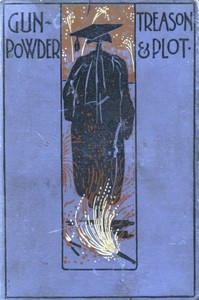
Gunpowder Treason and Plot, and Other Stories for Boys — Story, Setting & Ideas
Edition facts
Calculated from edition completeness, EPUB availability, text structure and catalogue metadata. Not a user rating.
Read the Text
Brocklehurst had retired from the Royal Navy as commander, receiving a step in rank upon his retirement, and he was never in two minds as to the profession that the boys should enter when they were old enough to do so.
"They shall serve the Queen, as I did," he would say, "and one day there shall be two ships in the navy list commanded each by a Brocklehurst."
"Good lads," he would say when pleased with them for any reason; "you shall die admirals, both of you."
Though the boys were alike in many ways, they were dissimilar in this, that Granby early betrayed an obstinacy of disposition which was most marked, and which punishment only seemed to intensify. Noel did not share this peculiarity. Both were kindly and affectionate, and accustomed to stand by one another through thick and thin.
At the age of thirteen, just before their admission to the _Britannia_, the twins had a misunderstanding. It was as foolish and ridiculous a matter as could well be imagined to found a standing quarrel upon; yet a breach was made, and Granby's constitutional obstinacy stood in the way of its healing.
It happened at school--a naval preparatory school of long standing at Cubberly-on-Sea, to which the captain sent his boys because he had been there himself, and would have considered no naval education complete unless founded and continued at this establishment.
Granby was an excellent sprinter, and had been considered at school a "certain card" for the hundred yards race, as well as for the hurdle race and the long jump. Now, the winning of these three events would make Granby "champion" for the year, a position greatly desired by these athletes of thirteen and fourteen years; and when Granby sallied forth on the afternoon of the great day, equipped in his racing garments, he carried an ambitious and an intensely-agitated heart within his buttoned-up greatcoat, being resolved to win that championship or perish in the attempt.
Noel was not great at athletic sports, though an excellent cricketer, and more than pretty good at football. He therefore officiated as referee or judge on this occasion, not having entered for the races. Noel was quite as anxious as Granby that his brother should win the championship medal; and when Granby easily won the long jump, and just contrived to shake off his most dangerous rival, Evans, in the hurdle race, Noel felt certain, with the rest of the school, that the medal was as good as in Granby's pocket.
"He's all right, even if he halves the hundred yards with Bradbury," whispered an excited partisan in Noel's ear. "If Bradbury runs him a dead heat, his half marks for the hundred will still clear him. Bradbury is next up, though. The mile and second in the quarter only leave him twenty-five marks behind Granby, so it's an important race for both. Granby's 375 up to now--200 for the hurdles and 175 for the long jump; and Bradbury's 350--200 for the mile and 100 for second in the quarter. It's a near thing, isn't it?"
"Run and ask Mr. Headon to be judge for this race, will you?" said Noel. "I hardly like officiating when it means so much for my brother."
The boy ran off to request the master named to undertake the duty which Noel, under the circumstances, dreaded; but he was too late. Mr. Headon was at the starting-place, and the race was begun before the messenger reached him.
It was a magnificent race.
Granby got off badly, his foot slipping at the mark and losing him nearly two yards.
Bradbury, seeing that he had an advantage at the start, made stupendous efforts to retain the lead, and did well for the first half of the race. But inch by inch Granby crept up behind him, and when but ten yards were left to run there was scarcely half a yard between them.
Bradbury made his effort, and for an instant it seemed as though those last eighteen inches would not be recovered by his opponent; but Granby made his own effort, and a frantic one, in the last three strides, ending with a leap forward which appeared to a few to land him in front of Bradbury. To the majority they seemed to breast the tape at the same instant; to a second minority it appeared that Bradbury had just won.
Beyond the tape Granby had shot well ahead. Had the race been five yards farther he would certainly have won it. As it was, all eyes were turned upon Noel, in whose hands the decision lay. Partisan shouts arose and rent the air. Some shouted "Brocklehurst!"--a majority, perhaps; others shrieked "Bradbury!"
Noel's face was very pale, but he had a set, determined look about the mouth. He was going to decide as he believed to be right and just--that was clear.
The head-master bustled up, panting, having "scorched" up from the starting-mark.
"Well, Brocklehurst?" he said; "well?"
"Bradbury, sir, by two inches," said poor Noel; and, having dashed the cup of happiness from Granby's and his own lips, he turned and marched away to his study and shut himself up, quite tragically miserable. Perhaps he even shed a tear of mortification. He was only thirteen, be it remembered, and the decision against his brother had been a very hard and somewhat heroic thing.
Granby arrived presently, and entered the study, taking no notice of Noel. He was evidently very angry, for he banged the books about, and scattered a packet of chocolate--Noel's--all over the floor.
Noel was nervous as to how Granby would take his decision. Perhaps he would not understand how _more_ than ordinarily important it had been that he should be absolutely impartial, or even inclined, if anything, to favour the opponent.
"Granby, I'm awfully sorry, old man," he began, "that you didn't win. I'd give a good deal--"
"You're a liar! I _did_ win! Everybody says so but you," said Granby, interrupting him furiously.
"Well, I watched both posts, and I did my best to give a fair decision," said Noel, shocked at his brother's violence.
"You have swindled me in Bradbury's favour," Granby began.
Noel laughed. He was growing angry also.
"What rot you talk!" he said; "as if I wouldn't rather you had won!"
"Then why not tell the truth and say I did, like a man?" cried angry, disappointed Granby.
Noel saw that argument was useless, and left the study; but afterwards, later in the evening, he returned to the charge.
"Come, Granby; we'd better shake hands and make it up," he began, but Granby interrupted him.
"Will you admit you cheated me?" he said.
"Certainly not!" said Noel. "I tell you I--"
"Very well; you have ruined my happiness. I was set upon getting that medal, and you have lost it to me by your unfairness. I shall never shake hands with you again so long as I possess a right hand, and it's no use your speaking to me in future, for I shan't answer!"
"Oh, very well," said Noel, hurt and offended, leaving the room; "I daresay you'll be less idiotic about all this when you've slept over it."
Noel certainly never supposed that Granby's wrath would last, or that he would carry out his avowed intention of "remaining enemies," and of silence. Had he known what he was to learn with deep regret during the next few years of their lives--namely, that Granby would remain obstinately determined to ignore his brother when in his presence--he would somehow have contrived to soften the bitterness of his offence on that first night, or have made almost any sacrifice in order to appease the floodtide of fury and mortification which his unfortunate decision--a wrong one, as many assured him--had called forth. But from this time forward not a word would Granby vouchsafe his brother, even though affectionately addressed or treated with marked kindness. During their sojourn on board the _Britannia_, officers, instructors, and cadets were alike amused first, and afterwards incensed, by the obstinate refusals of Granby to speak to his brother. The older men, officers and instructors, devised many ways of bringing them together, for both were noteworthy among the cadets of their year, whether at work or play; but no ingenuity of theirs was successful in compelling Granby to address even an accidental word to his brother, for his own cleverness was at least equal to theirs, and he invariably contrived to escape the necessity of direct communication with Noel by employing a third party to convey the required message or whatever he might have been asked to do or say.
As for the cadets, Granby soon showed these interfering persons that two things in connection with his quarrel with Noel must be laid to heart by them. The first was, that the said quarrel was no affair of theirs, and that interference or attempted peace-making, by trickery or otherwise, was _dangerous_. Granby was a doughty person among the cadets of his term, or any term, and not one to be lightly provoked.
The other truth they were obliged to learn was this, that though Granby might not wish, for private reasons, to maintain friendly intercourse with his brother, no one else in this world was at liberty to offend or injure Noel in his presence, whether Noel himself were by or not. Once or twice some misguided cadet attempted to curry favour with Granby by abusing Noel, imagining that he would thereby placate the brother who, to all appearances, was upon the worst possible terms with his twin. Such cadets learned very quickly that their last state was worse than the first.
As for Noel, the state of affairs with Granby gave him much sorrow as well as shame. He was as fond of his brother as ever, in spite of his foolish, long-continued obstinacy, and this although he was at times very angry with him, and ashamed of the foolishness which Granby was apparently not himself ashamed to display before others. Was Granby waiting for an apology for the old offence at Cubberly? Well, Noel was not without a spice of stubborn will, though his obstinacy was not to be compared with that of his brother, and he for his part was firmly determined that he would never offer any kind of apology for his decision on that historical occasion, unless Granby should first own up to his great foolishness, and ask for pardon.
Nevertheless, though Granby never replied, and though Noel knew that he would never reply, Noel invariably spoke to his brother just as though he might be expected to carry on the conversation; or, if others were present, he would refer to Granby by name just as frequently, during the course of conversation, as to any other person. And on such occasions Granby would reply as though one of the others had spoken, and not Noel.
It was a queer state of things, and sometimes ludicrously exasperating, as, for instance, one day when, during a cricket match on the beautiful Dartmouth Hill, the brothers being at the wickets together, Granby ran Noel out simply because he would not so much as cry "No!" when Noel called a run and started from his wicket. Granby had been somewhat ashamed of this, and had said in Noel's presence afterwards that he was "beastly sorry he had run some fellow out"--he forgot who it was--but "he ought to have seen there was no run."
Things had not improved a couple of years later, when the twins, both serving now as midshipmen in H.M.S. _Argus_, landed upon the west coast of Africa as members of a small party sent to chastise some umbrellaed potentate of the Gold Coast, who, unwilling to be chastised without a struggle, had the effrontery to oppose a thousand or two of his black legions against the _Argus_ contingent, in the hope of preventing the representatives of Her Majesty from reaching the native village, lying in the pestiferous forests which abound in those parts, which formed his metropolis.
In this attempt he succeeded so well that, long before the British marines and blue-jackets had advanced half-way to his village, they found themselves attacked by so strong a force of natives that the only course open to them was to retire at once towards the sea, in the hope of regaining their boats before King Kom-Kom's hosts should have cut them all to pieces.
That retreat through the jungle was a nightmare experience for all, and when at length the British troops reached their boats and opened fire upon their pursuers with a small piece of ordnance which they had brought with them but could not land (this was long before these days of quick-firing guns and Maxims and such military luxuries of our day), they chased away the niggers, indeed, but became aware, having at length time and leisure to count their losses, that about half the party had fallen, and among those missing were both the Brocklehursts, the only two officers lost, barring the first lieutenant, who had dropped at the first attack, when the party of unsuspecting British had walked straight into the ambush prepared for them.
Several had seen Noel Brocklehurst fall. He had been pierced by a spear in the neck, and had dropped dead apparently, for there were those present who would have risked much to bring him along. No one had actually seen Granby fall, but a sailor declared he had seen him tearing through the jungle, apparently in a fury of passion, after a "nigger--probably the Johnny as killed his brother, sir," said the sailor; "and he looked that angry I wouldn't have given a tuppenny Bath bun for the nigger's life."
"Well, but in that case we can't possibly return to the ship," said the officer left in command. "He may turn up; and if not, I think I shall have to ask for volunteers to form a search party."
Instantly every man present volunteered.
"Thanks, lads," said the officer; "I knew you would; but we'll give him ten minutes."
Before that period had elapsed, Granby suddenly appeared out of the cover, bleeding profusely from a slight wound in the leg and another cut in the face, and carrying his brother Noel, who might be dead, by the look of him, though Granby said, as he put him down,--
"He isn't dead, doctor. Have a look at him, quick, please!"
The doctor did not waste many seconds in acting as desired. He knelt down by Noel's body and carefully inspected his wound. The spear had passed almost through his neck, and Noel had lost much blood, which accounted for his unconscious condition.
"He may pull through," said the doctor presently, "but he's middling bad, Brocklehurst, and it'll take some nursing."
All through the days of suspense and peril Granby watched by his brother's bedside. Noel lay and groaned--alive, indeed, but little more. He knew no one, and did not speak, though he was semiconscious. But presently his youth and his splendid constitution began to assert themselves, and Noel grew better.
Then, finding that his brother was apparently out of danger, and would begin to recognize faces, and to speak and be spoken to, Granby ceased to haunt Noel's bedside.
When the latter was well enough to speak, the first question he asked was whether Granby had survived the attack on the day of the ambush.
"Why, certainly," said the doctor. "He was slightly wounded, but nothing to matter. He has been nursing you till yesterday, and nursing you very well too!"
Noel shut his eyes and was silent. When he reopened them two hours later, "Did you say Granby nursed me?" he asked, and the doctor replied that he had said so.
"Dear old chap!" murmured Noel.
While his brother slept, Granby came in to see how he progressed, and sat and watched the sick man. Once Noel opened his eyes and caught him in the act of departing.
"Granby!" said Noel in his weak voice; but Granby either did not or pretended that he did not hear.
After this he came no more to look after Noel.
But when Noel was able to come into the gunroom, a few days later, he said to Granby in the presence of all the midshipmen,--
"Granby, old man, I want to tell you before every one present how grateful I am for all you did for me when the niggers knocked me over that day. I--"
"You were saying we were likely to renew the attack in a few days, weren't you, Chambers?" said Granby. "It's about time we did something to take down that Kom-Kom fellow's impertinence, besides peppering them from the ship. I don't know why we've waited so long."
It was no use, and Noel, weak still from his illness, and more easily upset than of old, went back to his cabin and shut himself in and--yes, cried--shed tears of disappointment and bitterness; for he thought that if Granby would not "make it up" now, he never would.
So matters went on for another year or two, or it may have been half a dozen. The brothers served for a while apart from one another, in different ships. Both were lieutenants now, Noel having been appointed to the _Thunderer_, Granby to the _Mars_. But now they were together once again, a circumstance which had caused both brothers much secret delight, though the feud still continued--the foolish, lamentable, incomprehensible breach that dated from the race day at Cubberly-on-Sea, now nearly ten years ago.
As a matter of fact, Granby, hearing that Noel had been appointed to the _Irreconcilable_, applied himself for the same ship, using all the influence he could command in order to get the desired appointment. Old Captain Brocklehurst assisted the application by seconding it with a personal request at the Admiralty, where he possessed many old friends; and his endeavours to have the brothers once more serving in the same ship met with success.
Granby had always taken care to apply for leave whenever he knew that Noel had either had his own or would not yet be taking it, for he was unwilling that his parents should become aware of their quarrel. As a matter of fact, so fond did the old captain know the boys to be of each other that he would never have believed it if assured of the existence of such a quarrel. Each brother invariably spoke of his twin most kindly and affectionately while in the presence of the old folks. In Granby this was a sign of grace, the saving clause in his foolish and obstinate perversity.
One day, while cruising in the southern seas, some of the younger officers were amusing themselves, first by feeding a number of sharks which they had attracted to the ship's side by throwing offal and other refuse into the sea, and afterwards by fishing for the brutes, of which there were a dozen or more swimming around and about the vessel, showing, from time to time, their great dorsal fins and their tails, as they rose close to the surface in order to see what was to be had in the way of delicacies of a floating description.
Noel was officer of the watch, while Granby happened to be among the youngsters, enjoying the fun of watching and angling for the great brutes beneath just as much as the younger officers. Noel, walking up and down the deck, being on duty, took but little notice of the group of laughing and chattering youngsters. He strolled up the deck and down again, now taking a look at the sharks for a moment, now pausing to issue some order to one or other of the crew lazily busy over the varied duties that fall to Jack at sea in order to keep him employed and the ship clean and smart.
Suddenly a terrible thing happened.
A youngster, nominally busy upon a yardarm, but actually too interested in watching what went on below in the matter of the shark-feeding, suddenly lost his hold, in the excitement of gazing down, and fell from his perch.
It so happened that Granby was at that moment leaning dangerously over the side of the ship endeavouring to entice a certain shark to take the bait he dangled in front of it, and the youngster, in falling, struck Granby so violently upon the neck that he too lost his hold and fell with the lad into the sea.
A loud, inarticulate cry arose from all who saw the occurrence.
"Man overboard!" shrieked some, and "A boat!" cried others. "Cutter's crew--quick, for Heaven's sake!"
The collection opens with a foundling story set on the Devon coast: two baby boys are discovered floating in a lifebuoy-and-basket raft by fisherman Dan Mudge. The narrative dwells on the construction of the raft and the community’s response—a hat is passed to fund newspaper advertisements. This episode, from Harold Avery’s “When Friends Fall Out,” establishes a pattern of resourceful characters and local color that runs through the volume.
Later stories shift to very different settings. Fred Whishaw’s “The Wolfman” takes place on a Russian estate where wolves are considered sacred, and the lord’s command to shoot a lamb-killing wolf causes moral crisis. R. B. Townshend’s “Lost in the Soudan” (as the contents page spells it) moves to a desert environment. The catalog subjects—schools, adventure—are only partially reflected; only two of the five stories are school tales.
Setting and Voice Across Three Authors
The three authors employ distinct narrative voices. Avery’s Devon story uses a colloquial, almost oral tone: “Old Dan Mudge, fisherman, of Brixham, Devon, saw a curious sight.” Whishaw’s Russian tale adopts a more formal, folkloric register, with phrases like “the barin was placed in position” and references to an ikon and moujiks. Townshend’s desert story, from the brief excerpt, appears to use a more direct, action-oriented style. The settings are geographically diverse—coastal England, rural Russia, the Sudanese desert—but each is rendered with specific local details: the “lifebuoys, held apart by thick wire zigzags” in Devon; the “snowy surface of the land” and “wolf track” in Russia; and the implied heat and sand of the Sudan. This variety means the collection offers more than the school stories the catalog subjects might suggest.
Recurring Motifs: Foundlings, Loyalty, and Moral Choice
Two stories explicitly involve foundlings or orphans. In “When Friends Fall Out,” the twin babies are abandoned at sea and adopted by the community. In “The Wolfman,” the hunter Volkitch was raised by a wolf—his “foster-mother”—creating a bond that conflicts with his master’s orders. Both tales hinge on loyalty: the Brixham villagers pool money to advertise for the babies’ parents; Volkitch refuses to kill a wolf out of filial piety. The lord’s threat to shoot the wolf himself forces a confrontation between human authority and natural kinship. These moral dilemmas are presented without easy resolution—Volkitch’s “wolfish and wicked” look suggests suppressed anger. The school stories, by contrast, likely treat loyalty in the context of team sports or honor codes, as hinted by titles like “In Honour Bound” and “The Cock-House Cup.”
The Catalog’s Emphasis on Schools vs. the Actual Range
The Project Gutenberg catalog assigns the subjects “Schools — England — Juvenile fiction” and “Adventure and adventurers — Juvenile fiction.” However, of the five stories listed in the contents, only two—“In Honour Bound” and “The Cock-House Cup”—are explicitly school stories. The other three are set outside England entirely or in a non-school English setting. “When Friends Fall Out” is a maritime foundling tale; “The Wolfman” is a Russian folk-inflected drama; “Lost in the Soudan” is a desert survival story. The title story, “Gunpowder, Treason, and Plot,” may involve historical or school elements, but its placement in the contents suggests it is not the dominant mode. Readers expecting a collection of English school adventures will find a broader, more varied anthology that draws on adventure tropes from multiple continents and traditions.
The excerpts show that the collection’s unity comes less from setting or theme than from a consistent interest in boys facing tests of character—whether at sea, in a wolf-haunted forest, or on a playing field. The three authors’ different styles reward attention to shifts in tone and detail. Readers may wish to compare how each writer handles the motif of the outsider or the moral dilemma, and to note that the school stories, while present, are not the whole of the book.
I remember shelving Gunpowder Treason and Plot beside the older volume, Stories of Heroic Deeds for Boys and Girls Historical Series - Book II — Text and Context, and noticing how both carry boys through danger—the foundling twins and the young heroes alike—each quiet step toward courage leaving the same warm dust on the shelf. Familiar old friends, those pages.
Theodore Wilson
2 weeks ago-
Rachael Kennedy - 3 weeks ago
This collection of historical adventure stories is a thrilling read for boys who love action and intrigue. The title story about the Gunpowder Plot is particularly gripping, bringing history to life with vivid detail. Each tale is well-paced and full of heroism, making it perfect for young readers seeking excitement and moral lessons. A must-have for any young adventurer's bookshelf! -
Diane David Montoya - 2 weeks ago
While the title suggests exciting tales, this book falls short of modern expectations. The stories are steeped in outdated language and moralizing, making them feel preachy and slow. The historical context is interesting, but the lack of diversity and action might bore contemporary kids. If you're looking for gripping adventure, there are better options. Only recommended for those interested in vintage children's literature. -
William Rachel Harris - 1 week ago
A decent anthology of adventure stories with a strong historical bent. The writing is engaging, and the stories are varied, offering something for different tastes. However, the language is a bit dated, and some stories feel predictable. It's a good choice for history buffs but may not captivate all modern young readers. Still, worth a look for its educational value.
How will you remember this book?
Save your reaction, strongest insight, and memorable passage.
Camila Gonzalez
1 week ago