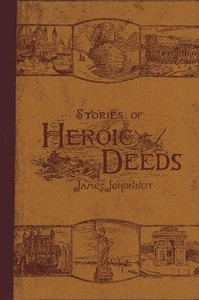

The Jungle Fugitives: A Tale of Life and Adventure in India Including also Many Stories of American Adventure, Enterprise and Daring — Background and Themes
Edition facts
Calculated from edition completeness, EPUB availability, text structure and catalogue metadata. Not a user rating.
Read the Text
IN THE SPRING OF 1857.
All through India, with its fanatical population five times as great as that of England, the rumblings of the coming uprising had been heard for months. The disaffection had been spreading and taking root. The emissaries of the arch-plotters had passed back and forth almost from end to end of the vast empire, with their messages of hatred and appeal. The people were assured that the "Inglese loge" were perfecting their insidious schemes for overthrowing their religion, and the faithful everywhere were called upon to crush the infidels in the dust. The evil seed fell upon the rankest of soil, and grew with a vigor and exuberance that threatened to strangle every other growth.
The plot, as agreed upon, was that a general uprising was to take place throughout India on the last day of May, 1857, but, as is often the case in such far-reaching schemes, the impatience of the mutineers precipitated the tremendous tragedy.
The first serious outbreak took place at Meerut on Sunday, May 10th, just three weeks previous to the time set for the general uprising. That town, with its population of about 40,000 at that time, lies thirty-two miles northeast from Delhi, which was to be the capital of the resurrected Mogul Empire. It was the precipitancy of this first revolt that prevented its fullest success. The intention was to kill every white man, woman and child in the place. Two regiments were clamorous for beginning the massacre, but the Eleventh Native Infantry held back so persistently that the others became enraged and fired a volley among them, killing a number. Thereupon the Eleventh announced themselves ready to take their part in the slaughter that was to free India from the execrated "Inglese loge."
Seeing now for the first time the real peril, the colonel of the Eleventh made an impassioned appeal to the regiment to stand by its colors and to take no part in the useless revolt. While he was speaking, a volley riddled his body, and he tumbled lifeless from his saddle. The Eleventh, however, covered the flight of the other officers, but helped to release a thousand prisoners, suffering punishment for various offenses, and then the hell fire burst forth.
The bungalows of the officers, the mess houses of the troops, and all the buildings between the native lines and Meerut were fired, and the whole became a roaring conflagration, whose glare at night was visible for miles.
When an appeal was made to the Emperor of Delhi by the troopers, he inquired their errand. The lacklustre eyes flashed with a light that had not been seen in them for years, the bowed form acquired new energy, and he gave orders to admit the troopers.
Their message was enough to fan into life the slumbering fires of ambition in the breast of a dying person.
He yielded to the dazzling dream. A throne of silver, laid away for years, was brought into the "hall of special audience," and the tottering form was helped to the seat, into which he sank and looked around upon his frenzied followers. Mohammed Suraj-oo-deen Shah Gezee was now the Great Mogul of India. A royal salute of twenty-one guns was fired by two troops of artillery from Meerut in front of the palace, and the wild multitudes again strained their throats. To the thunder of artillery, the strains of martial music and the shouting of the people, the gates of the palace were flung open, and Prince Mirza Mogul, with his brother, Prince Abu Beker, at the head of the royal bodyguard, rode forth, the king following in an open chariot, surrounded by his bodyguard.
With impressive slowness this strange procession made its way through the principal street, the populace becoming as frantic as so many ghost dancers. Finally a halt was made at the Juma Musjeed, the largest mosque in India, where the banner of the Prophet was unfurled and the Mogul Empire proclaimed.
Almost due east from Delhi Dr. Hugh Marlowe, a venerable American physician, had lived for more than twenty years. Since the death of his wife, six years previous to the Mutiny, he had dwelt alone with his only daughter, Mary, and their single servant, Mustad, a devout Mussulman. A portion of the time mentioned had been passed without the society of his beloved child, who spent several years in New England (where the physician himself was born and had received his education) at one of the fashionable schools.
Shortly after her graduation, Miss Marlowe met Jack Everson, fresh from Yale, and the acquaintance ripened into mutual love, though the filial affection of the young woman was too profound to permit her to form an engagement with the young man until the consent of her father was obtained, and he would not give that consent until he had met and conversed with the young gentleman face to face and taken his measure, as may be said.
"If he doesn't esteem you enough to make a little journey like the one from America to this country he isn't worth thinking about."
"But he _will_ make the journey," said the blushing daughter, patting the bronzed cheek of the parent whom she idolized as much as he idolized her.
"Don't be to sure of that, my young lady; romantic young girls like you have altogether too much faith in the other sex."
"But he _has_ started," she added with a sly smile.
"He has, eh? He will change his mind before he reaches here. How far has he got?"
"He was due in England many weeks ago."
"Well, well! How soon will he arrive _here_?"
"I think he is due now."
"Very probably, but his fancy will give out before he reaches this out-of-the-way place."
"Of course not, of course not; I just told you that that is the way with all foolish girls like you."
The old gentleman had assumed a stern earnestness, and he added: "I tell you he will never show himself here! I know what I'm talking about."
"But he _is_ here, papa; let me introduce you to Jack Everson, a physician like yourself."
All this time the smiling young man was standing directly behind the old doctor, who was lazily reclining in a hammock on the shaded lawn, smoking a cheroot, while his daughter sat on a camp stool, with one hand resting on the edge of the hammock, so as to permit her gently to sway it back and forth. As she spoke the tall, muscular American walked forward and extended his hand.
"Doctor, I am glad to make your acquaintance," he said, in his cheery way. The astonished physician came to an upright position like the clicking of the blade of a jackknife, and meeting the salutation, exclaimed:
"Well, I'll be hanged! I never knew a girl so full of nonsense and tricks as Mary. You are welcome, doctor, to my house; let me have a look at you!"
Jack Everson laughingly stepped hack a couple of paces and posed for inspection. The elder deliberately drew his spectacle case from his pocket, adjusted the glasses and coolly scrutinized the young man from head to foot.
"You'll do," he quietly remarked, removing his glasses and returning them to the morocco case; "now, if you'll be good enough to seat yourself, we'll talk over matters until dinner time. When did you arrive?"
Jack seated himself on the remaining camp stool, a few paces from the happy young lady, accepted a cheroot from his host, and the conversation became general. Like most Americans, when at home or travelling, Jack Everson kept his eyes and ears open. He heard at Calcutta, his starting point, at Benares, Allahabad, Cawnpore and other places, the whisperings of the uprising that was soon to come, and his alarm increased as he penetrated the country.
"Worse than all," he said gravely, speaking of his trip, "one of my bearers spoke English well, and quite an intimacy sprang up between us. Since his companions could not utter a word in our language, we conversed freely without being understood. He was reticent at first concerning the impending danger and professed to know nothing of it, but this forenoon be gave me to understand, in words that could not be mistaken, that the whole country would soon be aflame with insurrection."
"Did he offer any advice?" asked Dr. Marlowe, less impressed with the news than was his visitor or his daughter.
"He did; he said that the escape of myself and of your family could be secured only by leaving this place at the earliest moment possible."
"But whither can we go? We are hundreds of miles from the seacoast and should have to journey for weeks through a country swarming with enemies."
"I asked him that question, and his answer was that we should make for Nepaul."
"That is the province to the east of us. It is a mountainous country, a long way off, and hard to reach. Why should he advise us to go thither?"
"I questioned him, but he seemed to fear that his companions would grow suspicious over our conversation and he said nothing more. I thought he would add something definite when we came to separate, and, to loosen his tongue, I gave him an extra fee, but he added never a word, and, unless I am mistaken, regretted what he had already said."
"It seems to me," observed the daughter, "that the man knew it is impossible for us to get to the seacoast, and believed that by going further into the interior we should reach the people who are not affected by the insurrection. Wide as it may be, there must be many points that will not feel it."
"That is the true reason," said her parent, "but, confound it! I have lived in this spot for twenty years; the little town of Akwar lies near, and there is hardly a person in it who has not been my patient. I am known even in Meerut and Delhi, and I can hardly believe the mutineers, for such they seem to be, will harm me or my friends."
"You once told me," replied Mary, "that when an appeal was made to the religion of this people they knew no such thing as fear or mercy."
"And I told you the truth," said her father gravely. "But since we have weapons and plenty of ammunition, and know how to handle the firearms we shall not be led like lambs to the slaughter."
"That is true enough," said Jack, "but it will be of little avail, when our enemies are numbered by the hundred and perhaps the thousand."
"I take it, then, that you favor an abandonment of our home?"
"I do, and with the least possible delay."
"And you, my daughter, are you of the same mind?"
"I am," was the emphatic response.
"Then my decision is that we shall start for the interior and stay there until it is safe to show ourselves again among these people, provided it ever shall be safe."
"When shall you start?"
The parent looked at the sky.
"It is two or three hours to nightfall. We will set out early to-morrow morning before the sun is high in the sky."
"But will we not be more liable to discovery?" asked Jack.
"Not if we use care. I am familiar with the country for miles in every direction. We shall have to travel for the first two or three days through a thick jungle, and it is too dangerous work to undertake in the night-time. This, you know, is the land of the cobra and the tiger, not to mention a few other animals and reptiles equally unpleasant in their nature. Last night," continued the doctor, "I saw a glare in the sky off to the westward on the opposite side of the river in the direction of Meerut. I wonder what it meant?"
"By Jove!" exclaimed Jack, "that explains something that the palanquin bearer said to me about there being so many Inglese where there are none to-day. I could not catch his meaning, though he mentioned Meerut. But he gave me to understand that it was not quite time yet for the uprising, which would come in a few weeks."
"Those things are apt to be precipitated. I have no doubt that the mutineers burned the city last night. If so, the main body will hurry to Delhi, which, being the ancient capital of the Mogul Empire, will become the new one. Some of the rebels may take it into their heads to come in this direction. What is the matter, Dr. Everson?"
As Jack Everson was seated he faced the broad, sluggish Ganges, with the low, green banks beyond. He was looking over the water, in the rays of the declining sun, when he saw something that caused him to rise hastily from his seat and peer earnestly across the river toward the opposite shore. Observing his action, the doctor asked his question. Both he and his daughter, rising to their feet, gazed in the same direction. It was easy to see what had attracted the attention of their guest. A party of horsemen, fully twenty, if not more, in number, had approached the river and were now halted on the other side, looking across in the direction of Dr. Marlowe's home, as if debating the question of making it a visit.
"Let me get my glass," said Mary, starting toward the house, hardly a hundred feet distant.
"Allow me to bring it," interrupted Jack. "It is on one of the chairs on the veranda, and I want my rifle."
Taking the glass from him on his return, the young woman levelled it at the group of horsemen on the other side.
"I cannot make out who they are," she said, passing the glass to her father.
It took the parent but a few seconds to answer the question. One sweeping glance told him.
"They are Ghoojurs," he remarked, with as much calmness as he could assume.
"And who are Ghoojurs?" asked Jack Everson, less excited than his friends.
"They belong to the nomadic tribes which originally occupied India, and are among the worst wretches in the world. They are brigands and robbers, who are to be dreaded at all times. Now, if the revolt has broken out, they will be as merciless as tigers."
"It looks as if they intended to make us a visit, doctor?"
"Alas! there can be no earthly doubt of it."
"Let us hurry into the jungle," said Mary, her face paling with fear. "We have not a minute to waste."
"The advice is good, but before acting on it I should like to make an experiment."
During this brief interval Jack Everson had carefully examined his rifle to assure himself that it was in good condition.
"Heavens, man!" exclaimed Dr. Marlowe, "you are not going to try a shot at them?"
"That is my intention."
"They are a mile distant!"
"One of my medals was won for hitting a target at exactly that distance," replied Jack, continuing his preparations.
"It is impossible that you should succeed."
"But not impossible that I should try, so please don't bother the man at the wheel."
"They have ridden into the water," added the young woman, still nervous and excited.
"Which will serve to shorten the distance somewhat."
"Why not wait until they are halfway across; or, better still, not wait at all?" inquired the doctor.
Jack Everson made no reply, but, lying down on his back, he slightly separated his raised knees, and, by crossing his ankles, made a rest for the barrel of his rifle. The left arm was crooked under his head, so as to serve as a pillow or support, leaving the hand to steady the stock of his gun, while the right inclosed the trigger guard.
The horsemen, instead of riding side by side, were strung along in a line, with the leader several paces in advance and mounted on a rather large horse of a coal-black color. Directly behind him came one upon a bay, while a little further back rode another on a white steed. There could be no question that they were on their way to kill without mercy.
The situation was intensely trying to father and daughter. The whole party of Ghoojurs had entered the Ganges and were steadily approaching. The water was so shallow that it could be seen as it splashed about the bodies of the riders, who were talking and laughing, as if in anticipation of the enjoyment awaiting them. They preserved their single file, like so many American Indians in crossing a stream, and their last thought must have been of any possible danger that could threaten them from the three on the further bank.
The situation was becoming unbearable when the rifle cracked with a noise no louder than a Chinese cracker, and a faint puff of smoke curled upward from the muzzle of the weapon. At the same moment the Ghoojur at the front, on his black horse, flung up his arms and tumbled sideways into the water, which splashed over his animal's head. Frightened, the horse reared, pawed the air, and, whirling about, galloped back to the bank, sending the water flying in showers from his hoofs.
"Score me a bull's-eye!" called Jack Everson, who in his pleasure over his success, could not wait for the result.
"But see!" cried Mary, "you have only infuriated them. Oh! father, how can we save ourselves?"
The success of the first shot gave Jack Everson self-confidence and he took less time in aiming the second, which was as unerring as the first. Another Ghoojur plunged off his horse and gave but a single struggle when he sank from sight in the shallow water.
"Another bull's-eye!" called Jack, proceeding to reload his piece. "I hope, doctor, you are keeping a correct score; I must have credit for all I do."
"Now for my distinguished friend on the milk-white steed," said Jack, proceeding to adjust his telescopic sight to that individual. "If they will send over the three horses it will give us one apiece."
But the Ghoojurs had had enough of this fearful business. They saw that some unaccountable fatality was at work and it was madness for them to remain. With never a suspicion of the truth they wheeled their animals about and sent them galloping for the bank which they had left a short time before full of hope and anticipation.
"I'm sorry for that," reflected Jack Everson, "for it mixes things and I can't pick out my man, but here goes."
In one sense, his opportunity was better than before; for, while he could not select his particular target, he had but to aim at the bunch to make sure of hitting somebody, which is precisely what he did.
The Ghoojur whom he punctured did not fall, for the reason that two of his friends reached out and prevented him. It was a piece of supererogation on their part, for when the party emerged from the Ganges upon dry land that fellow was of no further account.
Jack now showed more haste than before in reloading his weapon, fearing that the party would get beyond his reach before he could fire for the fourth time. Much to his regret, they did so, for though he made the shot, it was necessarily so hurried that it inflicted no injury, and the whole party galloped out of sight over the slight swell without showing any further concern for their companions left behind. Jack now rose to his feet with the question:
"What is my record, doctor?"
"Three bull's-eyes; your score is perfect."
"Hardly, for the last was a miss; however, three out of a possible four is pretty fair when the circumstances are considered. I suspect that that particular party is not likely to give us further trouble."
"No, they will not forget the lesson."
"If we can induce our enemies to make their approach by the same ford and when the sun is shining this will become truly amusing."
"But the Ghoojurs will not repeat that mistake. This affair has served another purpose," added the physician, "we must not delay our departure."
"Do you advise our going while it is night?"
"I advised the contrary a little while ago, but I confess I am afraid to stay in the house, even for a few hours. However, we will take our dinner there, gather a few belongings and then hurry off. We shall find some spot where it will be safe to pass the night, and where we are not likely to be molested, because no one will know where to find us."
The opening chapter of The Jungle Fugitives establishes a historical frame with measured, almost reportorial prose: “All through India… the rumblings of the coming uprising had been heard for months.” Ellis describes the spread of disaffection and the plot for a general revolt on May 31, 1857, then notes that “the impatience of the mutineers precipitated the tremendous tragedy” at Meerut on May 10. This expository passage, with its broad geopolitical scope, contrasts sharply with the colloquial dialogue and physical comedy that appear later in the same narrative—for instance, when Billy Wiggins, fleeing an elephant, mutters “Not much” while clinging to a branch. The shift in register from detached summary to vernacular action is one of the collection’s most distinctive features.
Historical Exposition and Colloquial Action
The narrative voice in the Sepoy Rebellion portion oscillates between two modes. The first is a third-person omniscient style that delivers background information in long, periodic sentences: “The emissaries of the arch-plotters had passed back and forth almost from end to end of the vast empire, with their messages of hatred and appeal.” The second mode is immediate, dialogue-driven action, as when Billy Wiggins exclaims “My gracious! there he comes!” and the prose shifts to short, breathless clauses: “A terrific crashing of the undergrowth caused both lads to glance affrightedly behind them.” This alternation creates a rhythm of tension and release, with the historical passages providing context and the action sequences delivering visceral excitement.
Pacing and the Elephant Episode
The elephant encounter in the American adventure section illustrates Ellis’s control of pacing. The scene begins with a rapid buildup: the boys panic, the elephant charges, and Billy is “lifted, as if he was a feather from the ground” and flung into a tree. Then the pace slows for a comic pause as Billy taunts the elephant from above: “I’m going to stay here and I don’t believe you know how to climb a tree.” The shooting itself is described with deliberate precision: “The tiny bullet bored its way into the vast bulk, just back of the fore leg and went directly through the heart.” The elephant’s death is rendered in a series of measured, almost cinematic steps: “He took a couple of steps, swayed to one side, moved uncertainly forward again, then stopped… and finally went over sideways, like a mountain.” This variation—from frantic motion to static dialogue to slow-motion collapse—keeps the episode engaging.
Voice and Register Shifts Across the Collection
Because the book includes multiple stories beyond the title narrative, the reader encounters a range of narrative voices. The Sepoy Rebellion chapters use formal, historically inflected language, while the American tales often adopt a more colloquial, even folksy tone. For example, the elephant story features dialogue like “Hain’t you got a gun?” and “if there was only one, I wouldn’t care, if he was an elephant as big as a barn.” This shift in register is not merely a matter of setting; it reflects a broader change in narrative stance. The historical sections aim for credibility through factual detail, while the adventure sections prioritize entertainment through exaggerated speech and improbable feats. Readers should note that the collection’s unity comes not from a consistent voice but from a consistent interest in peril and resourcefulness across different contexts.
Readers approaching this collection should be prepared for abrupt transitions in setting and tone. The title story’s historical grounding gives way to tales that are more loosely plotted and reliant on coincidence. Pay attention to how Ellis uses dialogue to differentiate characters—Billy’s bravado contrasts with Jack’s more cautious demeanor—and how the prose speeds up or slows down during moments of danger. The book rewards those who enjoy variety in narrative pace and who can appreciate a late-nineteenth-century author’s willingness to mix genres within a single volume.
Reading about the Sepoy Rebellion’s frantic flights, I remembered hiding under a blanket with The Jungle Fugitives as a kid, heart pounding. That same breathless feeling returned years later with Now or Never; Or, The Adventures of Bobby Bright: A Story for Young Folks — Context and Discussion, though Bobby’s scrapes felt warmer, less perilous. Both books hold that quiet thrill of a boy finding his own courage, which lingers long after the covers close.
Michael Williams
3 weeks agoGabriel Sanchez
3 weeks agoYour personal reading reflection
Build a private reading journal entry for this title.
Samuel Flores
6 days ago