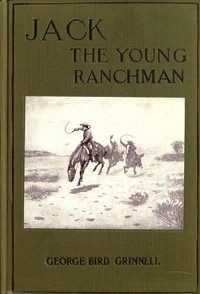
Jack, the Young Ranchman: A Boy's Adventures in the Rockies — A Reader’s Guide

(4 User reviews)   613
In Category - School Stories
Grinnell, George Bird, 1849-1938, Deming, Edwin Willard, 1860-1942 [Illustrator] Project Gutenberg 2014
Children's stories; Rocky Mountains -- Juvenile fiction; Ranch life -- Juvenile fiction; Ranchers -- Juvenile fiction Readers of public-domain and historical texts
Project Gutenberg digital edition en

Edition facts

Words: 85,259
Reading time: 371 min
Text sections: 9
George Bird Grinnell's 1899 children's adventure follows Jack Danvers from his city home to a Rocky Mountain ranch, where he learns roping, hunting, and wildlife observation through precise, episodic encounters with grizzlies, antelope, wolf pups, and a mountain lion.
Share
Editorial Edition Score 4.8/5

Calculated from edition completeness, EPUB availability, text structure and catalogue metadata. Not a user rating.

Edition quality

Read the Text

Jack was not a very strong boy. He was slim and pale and spent most of his time reading, instead of playing out of doors as all boys should. In the summer when he was in the country and in the open air he grew brown and hearty, but through the winter he became slender and white again.

Jack had no brothers and sisters, and his parents were often anxious about his health. They had thought several times of moving to the country to live, so that Jack might have an out-door life all the year round, but Mr. Danvers' business was so confining that he was obliged to be in town constantly, and Mrs. Danvers was not willing to leave him.

Dr. Robertson, whom Mr. Danvers had consulted, had given much thought to the boy's case, and at last had advised his mother to send him out to his uncle's ranch for a year, or at least for a summer, telling her that a few months of rough life in the open air would do him more good than all the medicines in the world. When Dr. Robertson told her this, Mrs. Danvers at first thought the advice dreadful. She said, "Oh, doctor, I couldn't think of doing that. Why the life out there is one of constant danger and hardship. There are cowboys and Indians and wild animals of all sorts. I should never have an easy moment while Jack was away."

"My dear madam," said the doctor, "medicine is often very unpleasant to take, unpleasant for the patient and sometimes for his friends as well. I can build your boy's system up from time to time with tonics, but I can do him no permanent good. My medicines are only palliatives; the real trouble is with his environment. If the conditions of his life are changed, he will be certain to throw off the lassitude and weakness which he now feels, and to become a stout and hearty boy about whose general health you need have no farther concern; but it is important that now, when eight or ten years of schooling and study are before him, he should have a well-nourished body. I know of nothing that promise so much in this direction as a course of open-air life and vigorous exercise. Now he stays too much in the house and cares for nothing but books. This is not natural for a boy of his age. He ought to be full of animal spirits and to be working them off by climbing trees, running races and fighting. Think this matter over carefully, Mrs. Danvers, and let me know what you and your husband decide."

After much thought and many long talks, the parents had at last made up their minds to let their boy go. All preparations had been made, and on the next day Jack and his uncle were to take the train for the Far West.

"Well, Uncle Will," said Jack, "first, I want to know how long it will take us to get out to the ranch?"

"Five days, unless something happens to delay us," said Mr. Sturgis.

"Next," said Jack, "I want to know what I can do on the ranch. I want to help in the work, you know, but I don't know how to ride, or how to do anything that you have to do out there among the cattle and horses. I'll have to learn a great deal before I can be of any use."

"Yes, of course, you will have to learn. You will pick up riding and roping readily enough, but to learn the ways of the prairie and the mountains is not so easy, and unless you are with some one that knows all that and tries to teach you, it will take you a long time to learn. You can easily learn the cowboy part of your education from almost any of us out at the ranch, but there is only one man there who can teach you how to become a good mountain man; that is old Hugh Johnson. He has lived on the plains and in the mountains for more than forty years, and has hunted, trapped and fought Indians from the Mississippi to the Pacific, and from the Saskatchewan to the Rio Grande. He knows the plains and the mountains better than any one I ever saw, and is like an Indian for reading sign."

"What do you mean by reading sign, Uncle Will?" said Jack.

"Sign is a word which may mean a great many things. Sign may be the tracks of animals, or of people, or the smoke of fires, or an old camp, or clothing dropped by some one who has passed along. Anything that shows that animals or people have been in a certain place is called sign. Sign may be old or fresh, and there is always something about it that should tell you more than the mere fact that whatever made it has been there. You ought to be able to tell when the sign was made, and sometimes how it came to be made. Sometimes the sign is merely the way the wild animals act. I remember years ago, when the Sioux and Cheyennes were troublesome, I was travelling alone with Hugh, and one night when we camped, he rode out to kill a buffalo heifer. Before long he came back and told me that he had seen Indian sign, and that as soon as it was dark we must start and travel on all night. When I asked him what he had seen, he said that the animals were uneasy and the buffalo were running, and that some one was chasing them not far off. We hid our horses in a ravine and crept on top of a near-by hill from which we could see a good stretch of country. Sure enough, before long we saw buffalo running as if frightened, and a little later we saw, far off, two Indians chasing a little bunch. We lighted no fire that evening, but soon after dark rode away, and did not rest till we had put forty miles behind us."

"Do you think they would have tried to kill you, if they had seen you?" asked Jack.

"I don't know," said his uncle, "we were not taking any chances.

"Now, when you get to the ranch," he went on, "you will learn a lot about the birds and animals, and if your tastes lie that way, and you keep your eyes open, you will find out much of the life of these wild things that few people know. Although I have been out there so many years and have always tried to observe things, I see every season something that I never saw before, and learn more and more how little I really know about the beasts and the birds of the west--even those that are most common about the ranch. Only last year I saw for the first time a little blind coyote puppy dug out from a hole in a ravine and was astonished to find that, instead of being yellow it was dark blue, almost black in fact. You could get a great collection of pets together at the ranch. Young elk, young antelope and deer and wolves, possibly a buffalo calf, some foxes, and birds of a dozen different kinds, grouse, ducks, magpies, young hawks. Why, you could have a regular menagerie."

"Oh, what fun that would be," said Jack. "I should like that. But how do you catch all these things? I supposed that young deer and antelope could run so fast that they could not be caught. I thought that they ran even faster than the old ones."

"They can run very fast and they are hard to catch as soon as they are a few weeks old," said his uncle; "but when they are quite young--for the first few days after they are born--they can scarcely run at all. During this time the mother hides them, telling them, I suppose, in her own language, to lie perfectly still until she returns. The young one lies flat on the ground, and the old mother goes off a little way--not far though--and feeds about. If she sees any one coming, or if danger of any kind threatens, she runs away and only returns after it is past. Meanwhile, the little one, lying there among the grass or weeds or undergrowth, and keeping perfectly still, is not noticed by the hunter or the wild animal that is passing along, and when the mother returns, she finds it just where she left it. It is said that at this time of their lives, these young animals give out no scent, and so they are not found by the wolves, unless these brutes happen to come right upon them."

"Well, but how do you catch them then?" said Jack.

"When we see an old doe antelope by herself on the prairie at about the season of the year when the young are born, we watch her and we can tell pretty well whether she has a young one or not. If we think she has a kid, we can get some idea of where it is hidden by the way the mother acts. Then the only way to find it is to go to the place and search the ground over foot by foot, until the young one is found or the task is given up. Usually both kids will be found side by side, but sometimes they are three or four feet apart. When they are taken up, they do not struggle or try to get away. They hang perfectly limp, and if you try to make them stand up, their legs give way under them and they sink down again. It is often twenty-four hours before they seem to take any interest in what is going on about them, but when they get hungry, and after they have once drunk some milk, they are tame, and as soon as they become strong, very playful. Young antelope are not always easily reared, but young deer and elk are more hardy. If a buffalo calf is caught it can be given to a cow to rear. Wolf or coyote puppies can be reared on a bottle. Those animals do not easily become tame and trustful. They are likely to be shy and to dodge and jump away if any sudden motion is made, but when they are pleased, when any one in whom they have confidence approaches them, they lay back their ears and wag their tails and wriggle their bodies just like an affectionate dog. Once we had a young bear at the ranch for a year and a half, and he was an amusing pet. If you gave him a bottle of milk he would stand on his hind legs, and holding the bottle in both hands he would tilt it up and let the milk trickle down his throat until the bottle was empty, when he would throw it away."

"Uncle Will, I think we're going to have a splendid time out west. I don't feel as if I could wait for to-morrow to come."

"It will be here before you know it, old fellow; and we'll be at the ranch before you know it too."

PRAIRIE WOLVES AND ANTELOPE

One morning, a few days later, a train was speeding westward among the foothills of the Rocky Mountains, bearing the travellers towards their summer home. The grey monotone of the prairie was unbroken by any bit of colour. The soil, the sage-brush, the dead grass that had grown the summer before, were all grey, unvaried except where a great rock or a bush taller than its fellows cast a long black shadow. Now and then the train passed close to some high butte, whose sides were gashed and gullied by deep ravines, and whose summit was crowned by a scattered fringe of black pines. Far off on either side, rose great mountains, covered with a mantle of snow, the most distant looking like far-off white clouds. From this snowy covering long fingers of white ran down the narrow valleys and ravines, seeming like white clasps holding the covering close in its place. The nearer foothills were white towards their tops, and against the shining snow the black pine trees stood out in strong contrast. Scattered over the grey plain were horses and cattle, most of them in little herds, but now and then a single cow was seen and near her a staggering calf, which had just been born, to face the scorching heats and bitter colds of the high plains.

Suddenly as the train rushed around a low knoll, a dozen animals were seen, running swiftly along, parallel with the track, and less than three hundred feet distant. In colour they were bright yellow, almost red, with white patches and white legs, and two or three of them had black and nearly straight horns. They were graceful, and ran very swiftly, easily keeping pace with the train.

"Oh, Uncle Will," said Jack, grasping his uncle's arm, "what are those? They're not deer, I am sure. They must be antelope. How pretty they are, and see how fast they run! Why, they are going faster than the train, I do believe. They just seem to skim over the ground."

"Yes, those are antelope, the swiftest animal on the plains. And yet the coyotes catch a good many of them, just by running them down. Now, how do you suppose they do that, Jack?" and his uncle smiled at the boy's puzzled expression.

"I don't know. You said they were the swiftest animals on the plains, and yet you say that the coyotes catch them. That seems to mean that the coyotes are swifter. Doesn't it?" asked Jack.

"Not exactly," replied his uncle; "it only means that they are smarter--more cunning. A single coyote who undertook to run down a single antelope, would get very tired and very hungry before he accomplished it, but when two or three coyotes are together, it is quite a different thing. The coyotes do not all run after the antelope together. They take turns, and while one runs, the others rest, so at last they tire the antelope out."

"But I should think that when the antelope ran, it would leave all the wolves behind, those that were resting even more than the one that was chasing it."

"It would do so if it ran straight away and out of the country, but this it does not do. Instead, it runs in large circles. When three or four prairie wolves decide that they want antelope meat for breakfast, one of them creeps as close as possible to the animal they have selected, and then makes a rush for it, running as fast as he possibly can, so as to push the antelope to its best speed and to tire it out. Meantime his companions spread out on either side of the runner, and get on little hills or knolls, so as to keep the chase in sight. They trot from point to point, and pretty soon when the antelope turns and begins to work back towards one of them, this one tries to get as nearly as possible in its path, and as it flies by, the wolf dashes out at it and runs after it at the top of its speed, while the one that had been chasing the antelope stops running, and trots off to some near-by hill, where, while the water drips off his lolling tongue, he watches the race and gets his breath again. After a little the antelope passes near another coyote, which takes up the pursuit in its turn. And so the chase is kept up until the poor antelope is exhausted, when it is overtaken and pulled down by one or more of the hungry brutes."

"Why, I should think the coyotes would kill all the antelope after awhile," said Jack.

"Of course the coyotes do not catch every antelope they start," said his uncle. "Sometimes the game runs such a course that it does not pass near any of the waiting wolves, and only the one that starts it has any running to do. Then the chase does not last long; the wolves give up. Sometimes the antelope is so stout and strong that it tires out all its pursuers. Yet they catch them more frequently than one would think, and it is not at all uncommon to see coyotes chasing antelope, although, of course one does not often see the whole race and its termination. Often if a wolf running an antelope comes near to a man, he gives up the chase and that particular antelope is saved. It is a common thing for a single coyote to chase an old doe with her kids, just after the little ones have begun to run about. At that time they are very swift for short distances, but have not the strength to stand a long chase. In such a case a mother will often stay behind her young, and will try to fight off the coyote, butting him with her head and striking him with her forefeet. He pays little attention to her, except to snap at her, and keeps on after the kids. Several times I have seen a mother antelope lead her young one into the midst of a bed of cactus, where the wolf could not go without getting his feet full of thorns. If the bed is small, the wolf will make fierce dashes up to its borders, trying to frighten the little ones, so that they will run out on the other side and he can start after them again, but usually the mother has no trouble in holding them. I have several times killed young antelope whose legs had been bitten up by coyotes, but which had got away. One hot day last summer a gang of section-men were working in a railroad cut west of here, when suddenly a big buck antelope ran down one side of the cut, across the track and up the other side. His sudden dash into the midst of them startled the men, and as they stood looking up where he had crossed, a coyote suddenly plunged down the side of the cut, just as the antelope had done. The readiest of the section men threw a hammer at him, and the wolf turned and scrambled up the bank and was not seen again.

"I wonder what the men thought?" said Jack.

The story begins not on the trail but at a city doorbell, with Jack Danvers in the library and Aunt Hannah refusing to let guns into the house. That domestic friction immediately signals the central tension: Jack is about to trade indoor safety for the unpredictable Rockies. Grinnell, a noted naturalist and ethnographer, grounds the fiction in real geography—a sage-brush basin 7,500 feet above sea level, walled by mountains. The preface insists the story is "about real things and about real people," and the excerpts bear this out. Jack's education is hands-on: he learns why a calf wasn't choked, how to aim at a grizzly, and why wolf pups rarely tame. The narrative voice is plain and patient, letting the landscape and its creatures dictate the pace.

From Parlor to Prairie

The opening chapter places Jack in a familiar domestic setting—a library, a bell, a disapproving aunt—before the story pivots westward. Grinnell uses this contrast to establish Jack's transformation. The city is a place of restrictions ("Guns! no indeedy, chile"); the ranch is a place of direct experience. The preface describes the ranch as "in a great basin, walled in by mountains on every hand," and the table of contents promises a sequence of practical lessons: roping, riding, hunting, and even digging out a wolf's den. Jack's first antelope kill, his encounter with a lion, and his ride on a wild horse are all framed as milestones in a boy's education. The excerpts show that Grinnell is less interested in plot than in process—how to track, how to shoot, how to build a cage. Readers should expect a series of discrete, instructive episodes rather than a single dramatic arc.

The Craft of the Wild

Grinnell's background as a naturalist and conservationist shapes every scene. When Jack and Hugh capture wolf pups, the description is meticulous: poles cut to length, wired down, loose poles left for access, heavy sticks laid across the roof. The dialogue is practical—"How are you going to feed and water them puppies?"—and the outcome uncertain: Hugh notes that if the pups don't tame, they'll have to be killed. This unsentimental realism extends to the sage grouse nest. Jack wants to take the thirteen eggs, but Hugh advises against it: "we've got a long way to go yet, and the chances are we'd smash the eggs." The lesson is about foresight and respect for the fragility of wild things. The writing avoids anthropomorphism; animals are observed as animals. The wolf pups "restlessly trot" and push their noses between poles; the grouse runs "with wings partly extended and body held low." Grinnell trusts the reader to find interest in accurate detail.

Voice and Vernacular

The dialogue carries much of the story's character. Aunt Hannah's dialect ("chile, ye can't leave 'em here") sets a regional tone, but the ranch hands speak a plain, competent English. Hugh, the experienced guide, uses phrases like "seems to me" and "I've seen a heap of wolf and coyote puppies caught." His speech is unhurried and authoritative, full of practical wisdom. Jack's voice is eager but respectful: "Oh, Hugh! ... can't we take them along?" The exchanges are brief and functional, rarely philosophical. Grinnell lets action and observation speak for themselves. The narrative voice in the preface is more formal—"It is a pleasure to review those days in memory"—but the body text stays close to the characters' perspectives. Readers will notice that the story is told in third person, but filtered through Jack's limited experience. He doesn't know why the calf wasn't choked; he has to ask. This keeps the learning process central.

Episodes, Not Chapters

The table of contents lists twenty-nine chapters, each with a concrete title: "A Grizzly Killed," "Roping and Riding," "Jack's First Elk," "Digging out a Wolf's Den." The excerpts confirm that each chapter is a self-contained vignette. There is no overarching villain or mystery; the adventure is in the daily work of ranch life. The chapter "Birds and their Nests" begins with Hugh and Jack returning to the ranch, checking on the wolf pups, and then discovering a sage grouse nest. The transition is casual, almost documentary. This episodic structure means readers can dip in and out, but it also builds a cumulative picture of a boy becoming competent. The illustrations—Jack aiming at a grizzly, the lion launching toward him—highlight key moments of action, but the text gives equal weight to quiet observation. The final chapter, "Swiftfoot in New York," hints at a return to civilization, but the excerpts don't reveal how that journey concludes.

Grinnell's book rewards readers who enjoy learning how things are done—how to rope a calf, track an elk, or build a wolf-proof cage. The story moves at the pace of a horse, not a train, and the pleasure is in the details: the feel of a sage grouse's nest, the look of a lion's leap, the sound of Hugh's steady advice. Approach it as a series of field notes from a vanished world, and let Jack's curiosity be your guide.

Reading about Jack learning to read tracks in the Rockies brought back a quiet summer afternoon when I first felt that subtle shift—how a landscape becomes a language. The Boy Spies of Philadelphia The Story of How the Young Spies Helped the Continental Army at Valley Forge — A Reader’s Guide gave me the same hushed thrill: a boy noticing what others miss, the world opening into secret signs, and me, just watching from the page.

Matthew Baker
1 week ago

Sebastian Anderson
1 month ago

Charlotte Smith
4 weeks ago

Sofia Ramirez
2 weeks ago

4.5
4.5 out of 5 (4 User reviews )

Add a Review

Your Rating *
There are no comments for this eBook.

Reader reflection

How will you remember this book?

Save your reaction, strongest insight, and memorable passage.

Your progress 0 / 10
1

Where are you in your reading?

2

Was reading this book enjoyable?

3

Is this a title you would suggest to others?

4

How easy was the book to follow?

Related eBooks