1

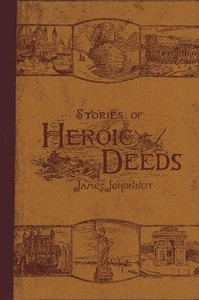
Stories of Heroic Deeds for Boys and Girls Historical Series - Book II — Text and Context
(0 User reviews)
832
Project Gutenberg
2014
Not confirmed
Biographical fiction; Conduct of life -- Juvenile fiction; Children's stories; Children -- Conduct of life -- Juvenile fiction; Indians of North America -- Juvenile fiction; Scotland -- Juvenile fiction; Courage -- Juvenile fiction
Readers of public-domain and historical texts
Project Gutenberg digital edition
en
Edition facts
Words
31,445
Reading time
137 min
Text sections
43
The catalog record for Stories of Heroic Deeds for Boys and Girls Historical Series - Book II — Text and Context provides practical reading context through 31,445 words, 2 hr 17 min estimated reading time, and 43 detected text sections.
The text analysis averages about 19.7 words per sentence, while the detected sections provide another way to judge how the source is divided.
Project Gutenberg metadata also associates the work with “Biographical fiction,” connecting these edition facts with the source record’s subject description.
Source:
Project Gutenberg record #47764
James Johonnot's 1887 collection presents historical and mythical tales for young readers, emphasizing moral lessons through direct language and dramatic scenes. Excerpts reveal a preference for vivid action, stark contrasts between courage and cowardice, and a pedagogical aim to distinguish fact from fiction.
Read the complete public-domain text at its original source.
Read on Project GutenbergJames Johonnot's Stories of Heroic Deeds for Boys and Girls (1887) opens with a preface that lays bare its pedagogical strategy: the author insists on using "the language of common life" and warns teachers against "dealing out moral pap." The stories themselves, drawn from myth, colonial history, and Scottish legend, are built around moments of high tension—a tomahawk whizzing past a baby's head, a general bluffing a band of raiders by shouting orders to an imaginary company. Johonnot's prose is lean and immediate, favoring short paragraphs and exclamatory dialogue that push the action forward without editorializing.
Diction and the Avoidance of Baby-Talk
In his preface, Johonnot explicitly rejects "baby-talk" and "words of one syllable," arguing that pupils should "stretch upward" in their reading. This principle shapes the excerpts: vocabulary includes terms like "pillaging," "booty," and "tomahawk," and sentences are often complex, with subordinate clauses that demand attention. For instance, the description of Mrs. Schuyler's baby being forgotten "in the hour of flight" uses a participial phrase that compresses time and emotion. Johonnot's commitment to adult-adjacent language is consistent; he does not simplify syntax for his young audience, trusting that "the interest in the story will be a sufficient stimulus."
Dialogue as a Tool for Characterization
Dialogue in the excerpts is sparse but pointed. When a Tory mistakes a daughter for a servant and asks, "Wench, wench, where is your master?" her reply—"Gone to alarm the town!"—is quick and deceptive, revealing both her wit and her loyalty. Similarly, General Schuyler's shouted command, "Come on, my brave fellows! Surround the house!" is a bluff that works because the raiders "knew that voice." Johonnot uses dialogue not for exposition but to crystallize a character's resourcefulness or authority in a single line. The effect is theatrical: each speech acts as a turning point in the scene.
Description and the Construction of Danger
Johonnot builds suspense through carefully chosen sensory details. In the Schuyler raid, the hall is "as black as night" except for "a small patch of light" from the dining room, where Indians are "pillaging the shelves, pulling down the china, and quarreling." The specificity of the china and the quarrelsome behavior grounds the threat in the domestic, making the intrusion feel immediate. Later, a tomahawk "whizzes" within inches of the baby's head and sticks "deep in the stair-rail." These details are not merely decorative; they anchor the reader in the physical space of the house and the trajectory of the weapon, heightening the sense of peril without melodrama.
Structure: The Set Piece and the Moral Frame
Each excerpt functions as a self-contained set piece with a clear arc: a problem, a tense confrontation, and a resolution that rewards cleverness or courage. The Schuyler story, for example, moves from the family's failed escape to the daughter's rescue of the baby, then to the general's bluff. Johonnot rarely pauses to moralize; the lesson is embedded in the action. The preface, however, frames these stories as tools for "high endeavor by noble example," and the inclusion of a poem by Collins at the end of a section suggests a deliberate alternation between prose narrative and lyric reflection. This structural variety keeps the reader engaged while reinforcing the book's didactic purpose.
Readers approaching this collection should attend to the way Johonnot balances action with restraint. He trusts his young audience to follow complex sentences and infer moral lessons without explicit preaching. The excerpts suggest a book that rewards close attention to language and structure, where even a single line of dialogue can shift the course of a story. Those interested in nineteenth-century children's literature or the craft of historical storytelling will find in these pages a deliberate, unsentimental model of how to make the past vivid.
There’s something about old storybooks that stays with you quietly, like a memory of sitting still while the world turns elsewhere. I felt that again with these heroic tales, their plain lessons and stark choices. It reminded me of The Jungle Fugitives: A Tale of Life and Adventure in India Including also Many Stories of American Adventure, Enterprise and Daring — Background and Themes, where courage isn’t shouted, just carried forward, step by step, in the heat.
There are no reviews for this eBook.
There are no comments for this eBook.
Reader reflection
How will you remember this book?
Save your reaction, strongest insight, and memorable passage.
Your progress
0
/
10
2
Was reading this book enjoyable?
3
Would you pass this book on to a friend?
4
Did the language feel accessible?
5
How would you describe its reading pace?
6
Would you start a conversation about this book?
7
Did the book offer a fresh perspective?
8
Could you follow the author’s main argument?
9
Which lesson or insight stayed with you?
10