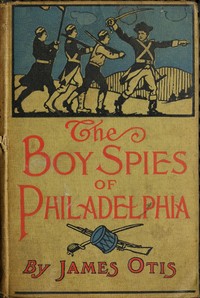
The Boy Spies of Philadelphia The Story of How the Young Spies Helped the Continental Army at Valley Forge — A Reader’s Guide

(0 User reviews)   41
In Category - School Stories
Otis, James, 1848-1912, Graves, George E. [Illustrator] Project Gutenberg 2014
Children's stories; Spy stories; United States -- History -- Revolution, 1775-1783 -- Juvenile fiction; Spies -- Juvenile fiction; Washington, George, 1732-1799 -- Juvenile fiction Readers of public-domain and historical texts
Project Gutenberg digital edition en

Edition facts

Words: 82,271
Reading time: 358 min
Text sections: 8
This editorial note examines how the opening, middle, and later excerpts of James Otis's 1897 novel guide a first reading, focusing on the shift from historical exposition to tense spy action and the use of setting and sensory detail.
Share
Editorial Edition Score 4.8/5

Calculated from edition completeness, EPUB availability, text structure and catalogue metadata. Not a user rating.

Edition quality

Read the Text

CHAPTER I. A "Market-Stopper." 1

CHAPTER II. Under Arrest 17

CHAPTER III. In Sore Distress 33

CHAPTER IV. A Bold Scheme 49

CHAPTER V. The Patrol 65

CHAPTER VI. Released 81

CHAPTER VII. On the Alert 98

CHAPTER VIII. Barren Hill 113

CHAPTER IX. Robert Greene 129

CHAPTER X. Conciliatory Bills 144

CHAPTER XI. A Recognition 160

CHAPTER XII. Important Information 176

CHAPTER XIII. The Evacuation 192

CHAPTER XIV. Lord Gordon 208

CHAPTER XV. On Special Duty 223

CHAPTER XVI. Tory Hospitality 240

CHAPTER XVII. In Self-Defense 256

CHAPTER XVIII. Preparing for Action 272

CHAPTER XIX. A Friendly Warning 287

CHAPTER XX. The Victors 305

The Boy Spies Of Philadelphia

On the morning of April 2, 1778, three boys, the eldest of whom was not more than sixteen years of age and the youngest hardly a year his junior, were standing on that side of the town-house nearest the pillory, in the city of Philadelphia.

They were not engaged in sportive conversation, nor occupied with schemes for pleasure, as is usually the case with boys of such age; but wore a graver look than seemed suitable to youth under ordinary circumstances.

These boys were witnessing and taking part in events decidedly startling--events well calculated to impress themselves upon the minds even of children.

It is hardly necessary, because such fact is familiar to all Americans, to say that on the 26th of September, 1777, General Howe took possession of the city of Philadelphia, and it was yet occupied by the British forces on this 2d day of April, 1778.

The past winter had been one of gayety for the wealthy Tory inhabitants of the city, since the English officers were pleased to spend their time in every form of revelry, and ever ready to accept the more than generous hospitality which was extended by such of the citizens as were desirous of remaining under British rule.

The officers of the army indulged to the utmost their love for luxury and ease while serving in the command of the indolent Howe, and the privates had so far followed the example set by their superiors that the king's troops had become more demoralized by this winter of idleness than could have been possible under almost any other circumstances.

So great was this demoralization that Benjamin Franklin was able to say with truth, when taunted with the fact that the enemy had captured the city:

"General Howe has not taken Philadelphia; Philadelphia has taken General Howe."

It was at about the time of which this story treats that the British government decided to give command of the forces under General Howe to Sir Henry Clinton, and those of the population loyal to the cause of freedom were considerably exercised in mind as to how this change of officers might effect them.

The three boys, who have as yet hardly been introduced, were by no means prominent in the cause of freedom; in fact they had but just arrived at an age when they began to realize their responsibilities, and as yet had been powerless to perform any great deed in behalf of the cause.

The eldest was Jacob Ludwick, son of that Christopher Ludwick, baker of Germantown, who, having amassed considerable property before the beginning of the struggle for freedom, gave one entire half of it for the cause, and swore at the same time never to shave until the United States were free and independent.

As is known, Washington made him baker-general of the army; but as yet young Jacob had never been able to gain his father's consent to his enlisting.

The second of the trio in point of age was Seth Graydon, son of that Widow Graydon who kept a boarding-house in Drinker's Alley, which had been largely patronized during the winter by officers of the Forty-second Highland and the Royal Irish regiments.

The third was Enoch Ball, also the son of a widow, and his mother it was who had for several years taught French and dancing in her home on Letitia Street.

These three boys had grown old beyond their years during the past winter.

They had witnessed, and more particularly in the case of Seth Graydon, the revelry of the officers who had come to whip into submission the struggling patriots, and well knew to what desperate straits, even for the common necessities of life, were driven the families of those men who had enlisted in the American army.

They saw the invading foe and their sympathizers enjoying every luxury of the table, while hundreds of the poorer classes were literally starving.

Those loyal to the American cause had suffered severely from lack of food and fuel, and were now questioning as to whether, under this newly appointed commander, they would not be called upon to bear yet greater troubles.

Neither of these three lads had ever been hungrier than boys of their age usually are at all times; yet they realized what suffering might come, if, as had been rumored, Sir Henry Clinton was an officer who believed harsh measures necessary when dealing with "rebels."

"There's no doubt about the order having been given," Seth said in reply to a question from one of his companions. "The officers were discussing it last evening, and seemed to think, as they always do, that I can work them no harm through learning their secrets. The time shall come, however, if they stay here much longer, when I will prove that even a boy can be of service to his country."

"But what is the order?" Enoch Ball asked impatiently.

"The entire army is to be in readiness, with three days' rations, to start at a moment's warning on some maneuver which will be executed between now and the fifth of this month."

"Do you suppose General Howe intends to march to Valley Forge?" Jacob asked, with no slight show of anxiety as he thought that his father might be in danger.

"That cannot be. Since the British took possession of Philadelphia there have been many better opportunities for them to fall upon General Washington and his command than now, and it is not likely the enemy would have remained idle all winter waiting to strike a blow after our friends were prepared for it."

"But _are_ they prepared for it?" Jacob asked.

"So I heard Lord Gordon say last night. He declared that, thanks to the instructions of the Baron de Steuben, the American troops were never in better condition, so far as discipline is concerned, than they are at present, and now that the sufferings caused by the severe winter have come to an end, they are in good spirits."

"But if the command is to be taken from General Howe, why is he getting ready for any movement?"

"If I could answer that question, Enoch, I might be able to give even General Washington information for which he would thank me."

"Do you know why General Howe is to be removed from his command?"

"I have heard the British officers say he was severely censured by Parliament for his blunder in causing the disaster to Burgoyne's army by going to the Chesapeake as he did. It seems that he has asked permission to go home, and that is why Sir Henry Clinton has been given the command."

"This maneuver to be executed before the fifth may be one which has been ordered in advance by Clinton," Jacob suggested.

"If such had been the case, the officers who were discussing the matter would have said so."

"Whether it be the one or the other, I do not understand how we can be benefited by having the information. Why did you say that at last we had work to do?"

"For this reason, Enoch Ball: We are now old enough to be of some service to the cause. Jacob's father refuses to allow him to enlist. Mother insists I must remain at home while the British are in possession of the city, and that is also the reason why you are not already a soldier. Now even though we are not in the army, it may be possible for us to aid our friends, and surely nothing at this time can be more important than making them acquainted with the fact that the Britishers are getting ready for some important movement."

"But how can we let them know?" Enoch asked with considerable show of trepidation, for it was not yet two weeks since he had seen a man flogged with an hundred lashes because of its being suspected that his intention was to enter the American lines.

"It is not impossible for one of us to find an officer within a few miles of the town who would forward the information. I believe I know where General Reed and General Cadwalader are, or, at least, how to reach them."

"Would you attempt to leave the city on such an errand?"

"And you expect us to go with you?" Enoch continued, showing yet greater signs of fear.

"Not unless you choose."

"Two can do the work as well as three," Jacob interrupted. "If you and I go, Seth, there is no reason why Enoch need be afraid, for we shan't need him."

"But do you think I would let you make an attempt to aid the cause, and not be with you?"

"You are frightened now at the very thought of it," Jacob replied scornfully.

"Yes; and if I am, what then? I may be afraid, for it was terrible to see that poor man's back cut with the lash; but yet I should go if you went."

"Now you are showing yourself to be brave, Enoch," Seth said approvingly, but before he could finish the sentence a shouting, yelling mob turned from High Street[A] into Second, and the boys darted forward to learn the cause of the commotion.

"They have captured another market-stopper," Jacob said a moment later as they neared the noisy throng.

The term he used was one given by the British to those Americans stationed near the city to prevent such farmers as had no scruples against selling provisions to the enemy from disposing of their wares save to those who favored the cause.

During the winter just passed General Howe had attempted to do little more than keep the roads open in order that the country people might come in with their marketing, and severe was the punishment he caused to be meted out to those who would thus attempt to shut off the supplies.

"It is the farmers themselves who should be whipped!" Jacob cried indignantly. "They care not how much aid is given to the enemy so that money comes into their pockets, and the freedom of their country is as nothing compared with the price at which eggs, butter or potatoes can be sold."

"It is better to keep a quiet tongue, Jacob Ludwick," Seth whispered. "There are too many redcoats for us in the crowd, and if one of them should hear your words, that soldier would not be the only one pilloried this day."

"I do not care to fall into their clutches, and therefore I remain silent while good patriots like this light-horseman are being abused; but if it ever happens that the odds are more nearly even I shall say for once to a redcoat what is in my mind."

"And get a flogging for your pains, without having done any one good?"

"As to whether I am whipped depends upon how well the Britisher can fight, while I'm certain great good will be done me by the opportunity to use my tongue as I please."

"Don't talk so loud," Enoch whispered impatiently. "We shall all find ourselves in the jail or on the pillory unless you are careful."

It was quite time Jacob put a bridle on his tongue; the throng of idlers and soldiers who were amusing themselves by pelting the light-horseman with stale eggs, decaying vegetables, or other filth, had now approached so near the boys that words even less loudly spoken could have been overheard.

The prisoner made no effort to protect himself from the unsavory shower; he probably realized that any attempt to do so would only result in his being used more roughly, and did his best to appear unconcerned.

"Do not stay here while he is being whipped," Seth whispered. "What we saw this day a week ago was more than enough for me, and I hope I'll never witness another flogging."

"Wait awhile," and Jacob went nearer the prisoner. "I do not think this one is to be served in that way. See! they are going to put him on the pillory, and by stopping here until the beasts are weary of abusing a helpless man we may be able to render him some assistance."

Seth no longer insisted on leaving the place; the thought had come into his mind that this soldier could tell him where the information he believed the Americans should have would be the most valuable, and it was not improbable they might have an opportunity to talk with him privately.

During half an hour after the prisoner had been placed in the pillory the mob jeered, hooted and pelted him with missiles of every description, and then, one by one, tiring of the inhuman sport, they left the yard for fresh amusement, until the three boys and the horseman were alone, save for the curious ones who, passing by on the street, stopped a moment to look at the soldier.

"It will not always be allowed that the men who are fighting for our liberties can be treated like this in Philadelphia," Seth said in a cautious tone as he stepped so near the pillory that those at the entrance of the yard could not overhear the words.

"Are you a friend?" the prisoner asked with some show of surprise. "I had begun to think there were none left in this town since Howe has made so brave a show, while we at Valley Forge have been starving."

"There are as many friends to the cause in the city as before the Britishers came; but it can do no good for that fact to be known while we are powerless to act."

"You are old enough to serve in the ranks, and should be there, if you would aid the cause."

"So we shall be in good time, friend; but it is not all who are the most willing that can do as they choose. This boy," and Seth pulled Jacob forward, "is the son of Ludwick the baker, of whom you must have heard."

"Heard, lad? Why I know Chris Ludwick as well as I know myself! Do you tell me that he won't allow his son to enlist?"

"He has promised to give his consent this spring, and when Jacob signs the rolls Enoch and I will go with him."

"Then you will have done only that which is your duty. If General Washington could have as many men as he needs, this war would soon be ended, with the United States free and independent."

"We shall do our share," Seth replied, speaking more hurriedly lest those who had captured the prisoner should put an end to the interview before he had accomplished his purpose. "If you believe us to be friends, tell me where we can find an officer of the American army?"

"I have heard you say you were friends; but even if I was able to answer your question I should hesitate about giving any information until I had better surety of your purpose than words which might be spoken by any one."

"Then you shall know why I asked, and after that say if we may be trusted. My mother keeps a boarding-house, and among her guests are several British officers; last night I heard them talking about an order which has just been issued, to the effect that a large portion of the army is to be ready to move at a moment's warning. From what they said, it seems certain some important move is to be made before the fifth of the month."

"Why are you so certain as to the date?" the man asked after a brief pause, during which he appeared to be settling some question in his own mind.

"It was so said by the officers."

"And you have no idea of what may be on foot?"

"I know nothing, except as I have told you. Those who were talking appeared to be ignorant of what it meant."

The prisoner remained silent several moments, and then said in a whisper:

"I shall trust you, lads, for it seems necessary the information should be known at headquarters. If you are deceiving me, you must always remember it as a scurvy trick, and one not worthy even a Tory."

"But we are not deceiving you, nor are we Tories. You know what would be the penalty if we were discovered trying to send information to the Continental army, and yet we are willing to take all the risks, if thereby we can aid our friends."

"That you can, lad, if it so be what you have heard is true. Will you be able to leave town at once?"

"Very well, you cannot go too soon. If you travel six miles on the Delaware Road I'll answer for it that you meet some of our friends who will conduct you to those whom you wish to see. Don't tell your story to any officer lower in rank than a colonel, and do not be surprised if those whom you meet give rough usage at first. Hold both your tongue and your temper until the purpose has been accomplished, and then I warrant you will be well thanked for the service."

"We will go at once," Jacob said decidedly. "Is there anything we can do for you, friend?"

"What I most want is to get my neck and wrists out of this contrivance, and that is exactly what you can't help me in the doing. I suppose I should be thankful for being let off so lightly."

"Indeed you should!" Enoch replied quickly. "The Britishers have been flogging the market-stoppers, and that punishment is truly terrible."

"I have seen those who had a taste of it," the prisoner said grimly, "and have no desire to take a dose. But do not stand here talking with me when you have valuable information to give our friends. When you meet with soldiers of our army, say that Ezra Grimshaw sent you to speak with Colonel Powers."

"Is your name Grimshaw?" Enoch asked.

"Yes, lad. If you can get speech with Colonel Powers you need have no fear of rough treatment. Now set out, for time may be precious. Which of you is to do the work?"

"All," Enoch replied quickly, as if fearing that, because of the timidity he had displayed, his friends might deprive him of the opportunity to do his share.

"There is no need of but one," Grimshaw said decidedly, "and many reasons why three should not make the venture, chiefest of which is, that so many might attract the attention of the enemy's patrol, while a single boy on the road would pass unchallenged."

"It is not right one should have all the honor, while the others are deprived of their share," Enoch replied decidedly.

"Lad, is it honor for yourself or the good of the country you have most at heart?" Grimshaw asked sternly.

"I want to be known as one who did not remain idle when he was needed."

"If you really desire to do good to the cause, decide among yourselves as to who shall go, and then let the other two aid him all they can. Do not spend the time in squabbling, but set about the business without delay."

There was no opportunity for him to say more; at that moment a party of British officers entered the yard, evidently bent on amusing themselves by making sport of the prisoner, and the boys were forced to step aside.

Seth beckoned for his comrades to follow him, and not until he was on High Street did he speak. Then it was to say:

"Grimshaw was right; we must not quarrel as to who shall go, but settle the matter at once. Of course each one wants----"

"I should have the chance," Jacob said decidedly. "Either of you may have some trouble to get away; but it is not so with me. My aunt will not worry if I am absent a week; she knows I----"

"Either Enoch or I would have permission to leave home if we explained the reason for going, and, therefore, are as much entitled to the position of messenger as you," Seth interrupted.

"Then how shall it be decided?"

"We will draw lots. Here is a straw; will you hold it, Jacob?"

"Not I, for I want the chance to make my choice."

The novel opens on April 2, 1778, with three boys near the Philadelphia town-house, described as having “a graver look than seemed suitable to youth.” The narrator immediately supplies historical context: the British occupation since September 1777, the winter of Tory revelry, and the demoralization of Howe’s troops. This expository start establishes the boys as witnesses to “events decidedly startling,” but the reader is not yet told which boy is the protagonist or how they will become spies. The tone is that of a historical overview, with the narrator addressing the reader directly (“It is hardly necessary… to say”).

From Historical Frame to Flight

The middle excerpt shifts sharply from exposition to a chase scene. The protagonist—unnamed in this passage but later identified as Enoch—is hiding in a log-pile, then darts toward the river. The prose becomes immediate: “Creeping out to the very end of the logs he looked ahead.” The narrator now stays close to the character’s thoughts, using free indirect discourse: “My only show is at the river.” The pace accelerates with short sentences and physical details—stooping low, hearing a shout, leaping forward. The historical context recedes; the focus is on survival. This transition shows how Otis moves from setting the stage to immersing the reader in a single character’s peril.

The River as a Trap

When Enoch reaches the water, the setting becomes a constraint. The only boat is “hauled high up on the shore” and too heavy for one person; a small sloop is heeled over for repairs. The river, which might offer escape, instead forces him to hide in the sloop’s hold. The description is precise: “the almost perpendicular deck” and “the open hatchway.” The narrator notes the distance of warships “at anchor in the river,” emphasizing his isolation. Enoch’s plan to swim is abandoned as “desperate and dangerous.” This sequence demonstrates how Otis uses the physical environment to heighten tension, turning a potential route to freedom into a dead end.

The Weight of Suspicion

In the later excerpt, Enoch reflects on why he is hunted: he is suspected of aiding Seth’s escape, of bringing news to Lafayette, and of eavesdropping. The narrator lists these accusations in Enoch’s own worried summary: “They’ve got proof enough that I’m a spy.” The word “spy” appears here for the first time in the excerpts, directly tied to the threat of execution (“the hanging would come mighty quick”). This moment crystallizes the stakes. The reader, who may have inferred the boys’ role from the title, now sees the character acknowledge it. The passage also hints at a network of resistance—Seth, Greene, Lafayette—without explaining it, leaving the reader to piece together the larger conspiracy.

Sound and Silence in the Hold

Once inside the sloop, the narrative narrows to sensory details: “Crouching in the darkness of the tiny hold, panting so loudly… that it seemed as if the pursuers must hear him.” The sound of his own breathing becomes a threat. Then footsteps on sand and voices “near at hand” break the silence. Otis uses auditory cues to mark danger, a technique repeated from the earlier chase (the shout that fades). The hold is described as “tiny,” emphasizing confinement. Enoch’s plan to wait until night and then “go down the river” is immediately interrupted by the approaching voices, ending the excerpt on a cliffhanger. This pattern of hope followed by interruption drives the suspense.

Readers should note how Otis balances historical explanation with immediate action. The opening’s direct address to the reader gives way to a more cinematic style as the chase unfolds. Pay attention to the way setting—the town-house, the log-pile, the riverbank, the sloop—functions as both obstacle and refuge. The excerpts do not reveal how Enoch’s mission connects to the larger war effort, but the repeated emphasis on being overheard and hunted suggests that secrecy and sound are central to the spy’s craft.

I remember how the boys in Otis's Philadelphia slipped through winter shadows, their sharp eyes serving a cause larger than themselves. That same quiet daring breathes through the Indian tales in The Jungle Fugitives: A Tale of Life and Adventure in India Including also Many Stories of American Adventure, Enterprise and Daring — Background and Themes. Both books hold that old ache—young courage against vast, indifferent wilderness. A kinship of nerve, nothing more, but it lingers long after the lamplight dims.

There are no reviews for this eBook.

0
0 out of 5 (0 User reviews )

Add a Review

Your Rating *
  • ...
    Randy Gomez - 1 month ago
    This book is a decent historical adventure for middle schoolers. The setting is vivid and the dangers the boy spies face feel real, which is a plus. However, the characters are somewhat one-dimensional, and the plot follows a predictable pattern. The dialogue is also a bit wooden compared to modern children’s books. Still, it’s an engaging way to learn about Valley Forge and the contributions of young patriots. If your child loves history, they’ll likely enjoy it.

  • ...
    Rachel Torres - 4 weeks ago
    I found this book quite dated. The prose is excessively patriotic, and the constant praise of the young heroes gets grating. The story does have some exciting moments, but they are overshadowed by long, dull passages of description and lectures on liberty. Furthermore, the characterization is extremely flat; the boys are all brave, noble, and interchangeable. While it might have been popular in its time, modern young readers will likely find it boring and heavy-handed. A better historical novel would contain more nuance and character development.

  • ...
    Leroy Martinez - 4 weeks ago
    An exciting and historically immersive adventure set during the dark winter at Valley Forge. The Boy Spies of Philadelphia is a thrilling tale of courage, patriotism, and quick thinking as young spies help Washington’s army. The author does a superb job of blending factual events with fictional characters and suspense. I was hooked from the first page, and so were my kids. It’s an excellent choice for young readers interested in the American Revolution, offering both entertainment and education.


Reader reflection

How will you remember this book?

Save your reaction, strongest insight, and memorable passage.

Your progress 0 / 10
1

How far have you progressed with this book?

2

Was reading this book enjoyable?

3

Would you pass this book on to a friend?

4

How demanding did the text feel?

Related eBooks