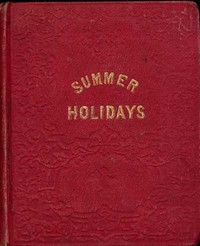
The summer holidays — Themes and Context

(6 User reviews)   950
Amerel Project Gutenberg 2005
Children -- Conduct of life -- Juvenile fiction; Children's stories, American; Family -- Juvenile fiction; Uncles -- Juvenile fiction; Domestic animals -- Juvenile fiction Readers of public-domain and historical texts
Project Gutenberg digital edition en

Edition facts

Words: 12,219
Reading time: 54 min
Text sections: 2
This editorial note examines how Amerel's 1851 children's story uses a series of structured walks and conversations to blend adventure with moral and natural history lessons, focusing on the movement between domestic and outdoor settings.
Share
Editorial Edition Score 4.5/5

Calculated from edition completeness, EPUB availability, text structure and catalogue metadata. Not a user rating.

Edition quality

Read the Text

CHAPTER I. Uncle Harvey's Parlor

CHAPTER II. The Evening Walk

CHAPTER III. A Visit to Daddy Hall

CHAPTER IV. The Walk through the Woods

CHAPTER V. What Uncle Harvey said about Rain

CHAPTER VI. How Thomas killed a Hawk

CHAPTER VII. About Bats

CHAPTER VIII. The Walk to the Creek

CHAPTER IX. The Hard Battle

CHAPTER X. About Corn and the uses of Animals

CHAPTER XI Alice Gray

CHAPTER XIII. The Return Home

UNCLE HARVEY'S PARLOR.

Mr. Harvey's two sons, Thomas and John, were very anxious for their cousin, Samuel Reed, to spend the August holidays with them. His father said that he might; and when school was closed for the season, Samuel bade his father good bye, and was soon in the carriage, driving toward Uncle Harvey's country seat.

The boys had not seen each other since New Year's day. It was a happy meeting when Samuel jumped out of the carriage, by the gate leading from the main road up to Mr. Harvey's house; for there his uncle, and two cousins, were waiting for him. Thomas and John, each grasped a hand, while their father led the way to the house. "We were afraid you were not coming," said John. "How tall you have grown since Christmas," exclaimed Thomas. "Were you not tired of being in the hot city such weather as this?" Samuel said that he was; and then they all entered the house, while the driver brought in Samuel's baggage.

It was about five o'clock in the afternoon when Samuel reached his uncle's house. He was taken into a small parlor, which opened upon a garden where many flowers were in bloom. It was a warm day, but this room was cool and fragrant; and on the table were several plates of fruit, and some cakes, which his uncle caused to be placed there, so that he might eat some as soon as he arrived, While Samuel was eating some of them John said:

"We are so glad you have come, Samuel. Last winter you could see nothing but snow."

"What became of the snow-man we made last winter?" asked Samuel.

"It froze very hard for more than a week after you left," replied Thomas; "but John and I broke its head a great deal, with snow balls, and afterwards a warm rain fell, and washed it away."

"Is it warm in the city now?" asked John.

"Yes," answered his cousin. "In the middle of the day the pavements seem to be about on fire, and people are afraid to walk far, lest they may be sunstruck. Yesterday two men died with the heat. There seems to be no air stirring from morning till night. Besides, there is much sickness in town, and many persons have left their houses, and gone into the country.

"Father," said Thomas, "how miserable we should be if we had no water to drink this weather, like those poor Arabs that you told us of the other day."

"Yes," answered Mr. Harvey, "the sun must be burning hot in Arabia now."

"How can they live in such a place?" asked John.

"They are not all so miserable as the party I told you of the other day," replied his father. "Besides, you know it is their country, and God has taught them to love it. If an Arab were brought here, he would, probably, think it a most dreary land, except in summer."

"But what do you do in town, Samuel," asked John, "when it is too warm to go out?"

"It is very hot only in the middle of the day," replied his cousin, "and then, you know, we are at school. In the afternoons, I sometimes rode out with father, or went on the steamboat. Last week a balloon went up, from the other side of the river. We had a fine view of it from the roof of our house. Two men were in it, and when they had risen so high that the balloon appeared quite small, they threw out a little machine, called a parachute. It looked something like an umbrella, and had a dog to it. The balloon sailed a great distance through the air, and came down safely."

It was now six o'clock, and Mr. Harvey told the boys that they might go to supper, which he had ordered to be ready earlier than usual.

After supper, Samuel and his cousins took a walk in the meadow, toward the mill pond. The air was now cool and pleasant, and as the boys moved through the narrow path, among the low grass, thousands of grasshoppers, and other insects, filled the air with their cheerful hum. Thomas, with his companions, passed round the mill, and then climbed a fence which led through a field of corn. The corn was not very high, so that they had to be careful not to tread upon it. When they reached the other side, Samuel saw that the fence was covered with raspberry vines, from one end to the other. He asked what they did with so many. "All that father wishes to use, or to eat," replied Thomas, "he gathers out of the garden; but these he leaves for two or three poor families, who live not far off, and who take them to town to sell. It helps them to pay their rent."

"And does he give away blackberries, too?" asked Samuel.

"Yes, and many other kinds of fruit," replied his cousin. "He has such large fields and orchards, that he can afford to give away great quantities of apples, peaches, currants, grain, and vegetables."

The boys roamed about the fields, talking in this manner, until after sunset, when Thomas said it was time to return. They crossed into a bye path, and walked toward the house through a field in which wheat had been growing. Among the short straw, left by the reapers, Samuel saw many birds' nests, and deep holes that had been dug by rabbits, field mice, and other small animals. In a short time they passed a very old house, whose sides appeared as if they would fall every moment. The roof was covered with moss and grass, and the boards had crumbled and separated from each other; a number of bats and swallows were flying about it, and Thomas said that dozens of these little animals, beside rats and mice, lived inside. Samuel asked him if any body lived there. "No," said his cousin; "but father remembers very well when an old soldier, that the farmers called Jack, did live in this house. His leg had been shot off in battles with the Indians. After it healed he moved to this place, and lived on the vegetables he could raise in a little garden, besides what people gave him. Every night he came out and sat on the log by the door, playing on an old fiddle. Then the school children would collect around him, and give him pennies, or fruit, and such things. Sometimes he told them stories; for he had travelled in many lands, and knew a great deal about them. In the summer nights, father says, he often heard poor old Jack singing the songs that he had learned when he was a boy; and sometimes he could be seen hobbling down this lane, on his crutches, or sitting by the water catching some fish for his supper. One day he was missed, and folks thought he was sick; but they waited till the next morning, and then a great crowd collected round the house, and called him. No one answered; so some one lifted the latch and went in. Old Jack was not there, and the people began to get frightened. They hunted for him all that day, and many days afterward; but he was never found. Some think that he was drowned; others that he went away with strangers, and a few are foolish enough to believe, that he is still living, and will one day come back. Since that time, no one has ever lived in his house, and in a few years it will tumble down with old age."

While Thomas had been giving this account of Poor Jack, the Soldier, John was very busy moving round the old house, and peeping through the cracks in the boards. At last he motioned Thomas and Samuel, to come to him, and then whispered:

"Stoop down--don't make a bit of noise--and peep through this crack. You'll see the biggest owl that ever you did see, in all your life." Both of them looked through. It was very dark, but Samuel saw two great eyes, like balls of fire, and in a little while he could perceive the body of an owl, which, as John had said, was the largest he had ever seen.

"Let us go in and catch him," said John. But Thomas answered, that as it was now dark the owl could easily fly away; and besides, as they did not wish to kill it, it could be of no use to them, if they should catch it. "It might do for cousin to look at," replied John; but he did not insist upon entering the house. As they were going away, Samuel asked his cousin if he did not think owls were ugly.

"No, indeed," answered John. "I would rather see an owl any time than these little birds that can do nothing but sing. See how soft his feathers are--all barred and spotted with black and brown, which is more handsome than to be all over red or yellow. I know he can't sing; but he's got nice, long ears, and that no other bird has. And how nice and round his head is. Then he sits on a tree, and looks wise, as father says. The Canary, and the mocking bird, are good enough to keep in cages, but of all birds, give me an owl."

Thomas and Samuel laughed at this notion, but John continued:

"Thomas, did not some people, who lived a long while ago, call the owl the 'bird of wisdom?'"

"Yes," replied Thomas. "I have heard father say that it was the Athenians."

"That shows how wise they were," said John. "I seems to me as though that owl, which we saw, was keeping house for poor old soldier Jack."

"Do hush about owls," said his brother, laughing; and they ran together through the gate, and into the yard.

A VISIT TO DADDY HALL.

Next morning, Mr. Harvey told his sons that they might go to see an old man, who lived in a small house, about two miles off, and who was so sickly that he could not work. This old man's name was Hall, and the boys of the school called him Daddy Hall. He had once been rich; but sickness and misfortune had reduced him to poverty, so that he now lived with his little son, in a small hut, near a hill. Every week he sent fruit and vegetables to market, in a cart, drawn by a donkey, which some of the neighbors had given to him. Every week Mr. Harvey sent either a servant, or one of the boys, to see how he was getting along, and to carry him something nice.

The two boys, with their cousin, were soon off, carrying with them a basket full of things for the old man. They went by the road across the meadows, and through a small gate in the hedge. Samuel observed, that the hawthorn of the hedge grew very thick and close, so that a bird could scarcely get through it. The roots and branches were twisted into each other, appearing like strong, thick chains woven together; and on the vines grew sharp thorns, longer than a needle. Mr. Harvey's boys told their cousin, that neither man nor beast could get through such a hedge; and that if a man were placed on the top, he could walk on the vines without sinking down, they were so strong and close. "It would be uneasy travelling, though," added John; "for his feet would be torn to pieces by these spiky thorns."

They now left the hedge, and went on through two wide fields, until they reached some hills that stood by themselves, and were steep and bare. Three of them had deep pits dug in them, while piles of rock, stones, and sand, were lying around. Samuel asked his cousins what place it was.

"It is an iron mine," said Thomas; but it is not worked any more, because there is not enough of iron found to pay for the trouble. All these stones lying about here are pieces of ore; but the quantity of iron in them is so small that it will not pay for the expense of taking it out from the ore."

"How is iron taken from the ore?" asked Samuel. Thomas replied:

"The ore is first crushed into coarse dust, and then washed. Afterwards this dust is melted in a hot furnace, and the iron is separated from the melted stone, or dross, in a manner which is very troublesome, and which father can explain to you better than I can. Sometimes the ore is almost all iron; John and I have some pieces in our cabinets, in which you cannot see any stone."

"But did men go down this deep well?" asked Samuel.

"Yes; they were lowered down in buckets. And the water was pumped out by a machine. The water was so cold, even in the middle of summer, that one could scarcely hold his hand in it."

The boys began to throw stones down one of the wells, so that they might guess by hearing them strike the bottom, how deep it was. The first stones were too small to be heard; then they threw larger ones, and listened, but could hear no sound. At last, John took up a piece of rock as big as his head, and rolled it into the well. It fell with a hollow, rumbling noise, and all was then still. The boys thought it had reached the bottom; but all at once they heard it splash into water. Then the boys knew that the well was very deep, for the stone had been falling several seconds. They then hunted among the piles of ore for some handsome pieces to give to Samuel; after which, they picked up their basket, and hurried on toward Daddy Hall's.

On reaching his house, they found the old man sitting at the door, while his son, a good boy, was preparing to take the donkey to market, with a cart load of turnips, radishes, peas, beans, and cabbage. Daddy Hall was pale and thin; but he arose to meet the boys, and seemed very glad to see Samuel. Although he was sick almost every day, and sometimes suffered great pain, yet no one ever heard him complain. He loved children, and was very fond of talking to them; and before he grew so weak and feeble, many of the farmers sent their little ones to him, to learn to read. After they had been seated a little while, John asked him if he did not get tired of staying in the house.

"Sometimes," said the old man, "I wish I could go out, as I once could, and work for myself; but I do not feel tired. Besides, this is the best condition I can be placed in; and if you ask me why, I will tell you. God, my children, has placed me in it; and he knows what is best for each of us. He has given me many comforts, kind friends, plenty to eat and drink, and a son, who is one of the best of boys. There is nothing, John, more cheering to the heart of an old man than the kindness of a dutiful son; and let me ask each of you, to listen to the advice of one who owns such a blessing, and always to show honor and respect to your parents."

THE WALK THROUGH THE WOODS.

The boys left their basket with Daddy Hall, and set out on their return to the house. "Let us go through the woods," said Thomas, and they all walked toward a thick wood which stood not far from the hill, near which Daddy Hall's house was built. They were glad to reach its cool shade; for the sun was now getting warm. Samuel saw a number of birds among the branches, that he did not know the names of; and many bright little flowers were growing in the shade, among the roots of oak and beech trees. A little distance in the wood, they reach a small rock, near which some large stones were lying, as if they had been thrown together. Thomas stopped, and said, "Samuel, this is the place where we killed a big snake last spring. You can see his hole under this rock. John and I tried hard to move these loose stones, but we could not. I dare say there are snake nests underneath."

"Perhaps we three can move one of them," replied his cousin. They all caught hold, and at last pulled the stone from its place. There was nothing underneath, but some old nut shells; but John said he was sure they would find snakes if they could but move the other stones. After much pulling, they raised another one; and under it was a large land tortoise, with several little ones, no larger than a walnut. After examining these, they observed a hole running under another stone, into the ground. Samuel also found two or three snake skins, which his cousins told him the snakes threw off every spring, after which, a new and larger skin grew on them. They pulled hard at this third stone, but could not move it; but while they were going away, Thomas said that they could bring an iron bar some day, and easily root it up.

In the middle of the wood was a fine spring of water, which gushed from a rock, and then spread out into a little pool, so clear and quiet, that the smallest stones could be seen at the bottom. Samuel tasted the water, and found it cold and refreshing. He asked his cousin how so much water could come out of the rock.

"It does not come from the rock," replied Thomas; "but only runs through it. Father says, that spring water often comes from the hills and mountains, running under the ground through cracks and holes in the rocks, until it finds some outlet. I suppose this water runs down from the tops of the hills near the iron mine."

"But this is not rain water," said his cousin. "It neither tastes nor looks like it."

"It has become changed while passing under the ground," replied Thomas. "After a heavy shower the water soaks into the earth until it reaches the sand, or rock underneath, then it runs through every little crack down the hill, and under the ground to some place like this where it can escape. The sand and gravel, which it meets with, make it pure and the lime and other substances of the rocks, alter its taste."

WHAT UNCLE HARVEY SAID ABOUT RAIN.

When the boys reached the house, Mr. Harvey was in his study. Samuel was anxious to ask him some questions about springs, but he would not go up stairs to disturb him. But after dinner his uncle came into the parlor where the boys were, and then Samuel asked him where all the water comes from that flows in the rivers and other streams.

"From the ocean," answered Mr. Harvey. "I suppose you have seen water boiling, Samuel."

"And have you seen the steam rise up from the water into the air?" Samuel said that he had. His uncle continued:

"Whenever water is heated, it is turned into steam, or vapor, as it is sometimes called. If there is enough of heat to make water boil, the vapor passes off very fast, until the water is gone. Now the sun is continually changing the water of rivers, ponds, lakes, and of the ocean, into vapor. This vapor rises. The air about a mile above the earth, is much colder than it is on the earth; so when the hot vapor from the ocean meets the cold air, it again becomes water, and forms clouds. I see you are ready with a question, John."

"Yes, sir," said John. "I cannot see, father, how the clouds can float in the air if they are nothing but water. Why do they not pour down?" His father answered:

From the moment Samuel Reed steps out of the carriage at his uncle's country seat, The Summer Holidays establishes a pattern of movement that structures the entire narrative. The story unfolds through a sequence of walks—to Daddy Hall's, through the woods, to the creek—each serving as a frame for both physical adventure and instructive conversation. This alternating rhythm between active exploration and reflective discussion in Uncle Harvey's parlor or library gives the book its distinctive pedagogical shape.

Walks as Structural Units

The chapter titles themselves announce the book's organizing principle: "The Evening Walk," "A Visit to Daddy Hall," "The Walk through the Woods," "The Walk to the Creek." Each walk propels the boys into a new setting where they encounter something worthy of note—a donkey, a hawk, a dog attack, a field of corn. The narrator rarely lingers in one place; even the opening chapter, "Uncle Harvey's Parlor," quickly gives way to outdoor activity. This constant motion keeps young readers engaged while allowing the author to introduce a wide range of subjects without didactic stagnation.

Recurring Images of Heat and Danger

Summer's intensity is a persistent undercurrent. Samuel arrives complaining of city pavements "about on fire" and men dying of sunstroke. Later, the boys' battle with a fierce dog leaves them "very warm, and could scarcely get their breath." Mr. Harvey warns that in summer a dog bite "often caused madness, followed by certain death." These references to heat and peril create a subtle tension beneath the holiday idyll, reminding readers that the season is not merely carefree but carries real risks—a point the story uses to underscore the value of caution and adult guidance.

The Library as a Counterpoint to the Field

After the corn-gathering episode, Mr. Harvey calls the boys into his library—a room described earlier as "very large" where he spends much time reading or writing. There he shows them "beautiful pictures of animals and countries" and explains the purposefulness of creation, using the sloth as an example. This scene typifies the book's method: direct experience (pulling corn) is followed by structured explanation (the library lesson). The domestic interior becomes a space for synthesizing outdoor discoveries, reinforcing the idea that knowledge is built through both action and reflection.

Voice and Dialogue as Instructional Tools

The boys' conversations are marked by natural curiosity and a slightly formal politeness. Samuel asks "why corn was sometimes called Indian corn," and Thomas replies with a mini-lecture on maize and its history. John interjects with personal preference: "I like Indian meal with sugar, eggs, and milk in it." The dialogue never strays into childish slang; instead, it models a respectful, information-seeking exchange. This controlled voice, consistent across all three boys, suggests that the author prioritizes clarity and moral instruction over individual characterization.

Movement Between Scenes

The narrative moves briskly from one episode to the next, often with a simple transitional phrase: "When Samuel had been at his uncle's about two weeks" or "After resting themselves, they walked home." These shifts keep the story progressing without elaborate scene-setting. The effect is a series of vignettes, each self-contained yet linked by the boys' ongoing summer stay. This episodic structure makes the book suitable for reading aloud in installments, with each chapter offering a complete incident and a discrete lesson.

Readers will find that The Summer Holidays rewards attention to its deliberate structure. The alternation between outdoor adventure and indoor instruction, the recurring motifs of heat and danger, and the consistent, polite dialogue all work together to create a coherent world where learning is woven into the fabric of play. Pay particular attention to how each walk introduces a new subject—natural history, morality, or practical wisdom—and how Uncle Harvey's library serves as the place where these threads are gathered and explained.

There’s something about the unhurried strolls in The Summer Holidays — how each turn of the path quietly opens a small lesson or a gentle wonder — that reminds me of another rambling companion. That same sense of a friendly guide, forever optimistic, lingers in Uncle Wiggily's Fortune — Inside the Classic. Two worlds, different walks, yet the same warm light spilled across the page.

Sebastian Mitchell
2 weeks ago

Joseph Thompson
2 weeks ago

Lucas Robinson
1 month ago

Victoria Jackson
3 weeks ago

Joseph Perez
1 week ago

4.5
4.5 out of 5 (6 User reviews )

Add a Review

Your Rating *
  • ...
    Antonio Wu - 3 weeks ago
    The Summer Holidays is a joyous celebration of childhood freedom. The author captures the essence of summer perfectly—lazy days, outdoor adventures, and budding friendships. The characters are vibrant and relatable, and the story is filled with gentle humor and warmth. It's a nostalgic trip down memory lane that will make you smile. Perfect for a family read-aloud.

  • ...
    Joshua Micheal Hill - 2 weeks ago
    A charming tale of summer fun with a nostalgic feel. The writing is simple and evocative, and the adventures are endearing. However, the plot lacks a strong central conflict, and the ending feels abrupt. Nonetheless, it's a delightful page-turner for young readers who enjoy stories about friendship and exploration.

  • ...
    Ashley Jackson - 1 week ago
    Unfortunately, The Summer Holidays falls flat. The story is episodic and lacks a cohesive narrative arc, making it feel like a series of random events. The characters are interchangeable and underdeveloped. The prose is serviceable but uninspired. A forgettable read that never seems to go anywhere. I'd recommend skipping this one.


Reader reflection

How did this book work for you?

Your answers remain private and are stored only in this browser.
Your progress 0 / 10
1

Which reading stage best describes you?

2

Did this book hold your interest?

3

Would you recommend this book to another reader?

4

How demanding did the text feel?

Related eBooks