About 77 minutes
The Tale of the The Muley Cow Slumber-Town Tales — Text and Context
Childrens Adventures
17,568 recorded words. 1 minutes difference from this book's estimate.
View Gutenberg source #24545
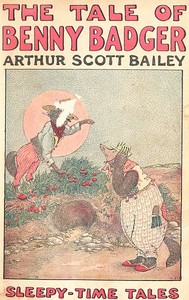
This digital edition of The Tale of Benny Badger — Themes and Context is described by source-level measurements including 17,809 words, 1 hr 18 min estimated reading time, and 3 detected text sections.
The text analysis averages about 13.0 words per sentence, while the detected sections provide another way to judge how the source is divided.
Project Gutenberg metadata also associates the work with “Animals -- Juvenile fiction,” connecting these edition facts with the source record’s subject description.
Explore this collection
These alternatives are selected using recorded categories and estimated reading time.
About 77 minutes
Childrens Adventures
17,568 recorded words. 1 minutes difference from this book's estimate.
View Gutenberg source #24545About 79 minutes
Childrens Adventures
18,111 recorded words. 1 minutes difference from this book's estimate.
View Gutenberg source #24592About 77 minutes
Childrens Adventures
17,611 recorded words. 1 minutes difference from this book's estimate.
View Gutenberg source #24608Search stored excerpts and compare books → Choose by your preferences →
Choices use stored catalog measurements. Estimates vary with reading speed. A shared category is a catalog label, not a claim that two books have the same argument or literary quality.
Search reads excerpt text stored with this catalog and links to its associated Gutenberg record. The connection is stored in the site database; this tool does not recheck that every excerpt is word-for-word identical to that external record. Excerpt search does not cover every chapter and does not verify historical publication dates.
Catalog snapshot checked: 2026-09-25. Coverage: 96 public books, 96 available source excerpts.
Read the complete public-domain text at its original source.
Read on Project GutenbergThe story opens with Benny Badger living on the high, dry plains, where his neighbors—ground squirrels and prairie dogs—wish he would go elsewhere. Benny, however, is oblivious to their hints and eagerly digs into their burrows. The narrator notes that digging is “the easiest thing he did,” and Benny even digs holes “just for the fun it gave him.” This early emphasis on digging as both a skill and a compulsion sets the tone for a tale driven by physical action and humorous misunderstandings.
Benny’s single-mindedness is clear: when he sees a prairie dog vanish into its hole, he is “more than ready to go right in after him.” The excerpts show a character who acts first and reflects later, often missing social cues—a trait that leads to both trouble and comedy.
Benny Badger’s digging is not merely a habit but a defining trait. The opening chapter describes his powerful body, short stout legs, and “big feet, which bore long, strong claws.” When he digs into another animal’s home, “he certainly did make the dirt fly.” This physical description grounds his behavior in anatomy, making his actions feel inevitable rather than arbitrary.
Yet digging also creates obstacles. Benny’s tunnels are too small for larger predators, but foxes and coyotes have been known to move into holes he abandoned. This detail hints at a world where Benny’s labor benefits others, though he seems unaware. The narrator’s dry tone—“if he had only left other folk’s holes alone”—underscores the gap between Benny’s intentions and their consequences.
Later, when an owl suggests Benny “dig a hole somewhere, crawl inside it, and pull it in after me,” Benny takes the idea literally, exclaiming, “What fun that would be!” This moment crystallizes his literal-mindedness: he misses the insult but embraces the absurd logic of the suggestion.
The excerpts are rich with dialogue that reveals character through misunderstanding. When the owl accuses Benny of insulting him, Benny replies, “Don’t mention it! I’m sure you’re quite welcome,” having “not the least idea what the owl meant.” The humor lies in Benny’s obliviousness, not malice.
Similarly, when Mrs. Coyote scolds Benny for “spoiling our hunting,” Benny asks, “Whose hunting?” as if the concept of cooperative predation is foreign to him. His responses are polite but clueless, defusing conflict through sheer incomprehension. The narrator’s phrasing—“To tell the truth, he had not the least idea”—invites readers to share the joke.
This pattern recurs: Benny smiles “all over his face” when he sees prairie dogs peeping at him, interpreting their fear as welcome. The comedy depends on the reader understanding what Benny does not.
Benny’s interactions with other animals reveal a society governed by appetite and self-interest. The prairie dogs and ground squirrels view Benny as a threat, not a neighbor. The coyote couple treats the prairie dog village as a hunting ground, and Benny’s presence disrupts their plans. Mrs. Coyote’s angry outburst—“Go away from this village! You’re spoiling our hunting!”—shows that even predators have territorial expectations.
The owl, too, is “a peppery fellow” who threatens Benny with his “cruel beak.” When Benny calls his house “second-hand,” the owl takes offense, and the exchange escalates into absurdity. The narrator notes that the owl “looked daggers at him,” a phrase that blends human emotion with animal behavior.
These encounters suggest a world where every creature is both predator and potential prey, and where politeness is a thin veneer over competition. Benny’s failure to grasp these dynamics makes him an outsider, even among his own kind.
The three excerpts span the beginning, middle, and later portions of the book, offering a clear arc: Benny’s introduction as a digger, his confrontation with the owl, and his encounter with the coyotes at the prairie dog village. The excerpts show a consistent voice—dry, understated, and fond of ironic juxtaposition—but they do not reveal the plot’s resolution.
From the table of contents, we know that later chapters include “The Rancher Is Angry” and “The New Home,” suggesting human intervention and a change of setting. However, the excerpts contain no humans, so readers must wait to see how Benny’s world expands.
The excerpts also omit any moralizing. Despite the catalog subject “Conduct of life,” the text itself avoids explicit lessons. Benny’s behavior is neither praised nor condemned; it is simply observed. This restraint leaves room for readers to draw their own conclusions.
The excerpts present Benny Badger as a creature of appetite and instinct, whose digging both defines and isolates him. Readers should pay attention to the gaps between what Benny says and what he understands—these are the engine of the story’s humor. The book’s episodic structure, hinted at by the chapter titles, suggests that each encounter will test Benny’s literal-mindedness in a new way. Approach the tale as a series of comic set-pieces rather than a linear narrative, and enjoy the narrator’s wry observations.
Benny Badger’s scrappy, underground world made me laugh, but it was the quiet patience in his digging that stuck with me. That same unhurried endurance lives in the little mongoose’s tale, where wit wins over size. It feels like remembering a shared afternoon, not a lesson. The Story of Little Black Mingo — Story, Setting & Ideas lingered the same way for me.
Create a short personal record of your experience with this book.