About 77 minutes
The Tale of the The Muley Cow Slumber-Town Tales — Text and Context
Childrens Adventures
17,568 recorded words. 0 minutes difference from this book's estimate.
View Gutenberg source #24545
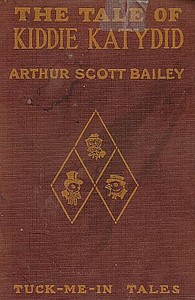
The source record for The Tale of Kiddie Katydid — Reading Notes measures this digital text at 17,611 words, 1 hr 17 min estimated reading time, and 3 detected text sections.
The text analysis averages about 12.8 words per sentence, while the detected sections provide another way to judge how the source is divided.
Project Gutenberg metadata also associates the work with “Animals -- Juvenile fiction,” connecting these edition facts with the source record’s subject description.
Explore this collection
These alternatives are selected using recorded categories and estimated reading time.
About 77 minutes
Childrens Adventures
17,568 recorded words. 0 minutes difference from this book's estimate.
View Gutenberg source #24545About 78 minutes
Childrens Adventures
17,809 recorded words. 1 minutes difference from this book's estimate.
View Gutenberg source #24589About 75 minutes
Childrens Adventures
17,199 recorded words. 2 minutes difference from this book's estimate.
View Gutenberg source #24590Search stored excerpts and compare books → Choose by your preferences →
Choices use stored catalog measurements. Estimates vary with reading speed. A shared category is a catalog label, not a claim that two books have the same argument or literary quality.
Search reads excerpt text stored with this catalog and links to its associated Gutenberg record. The connection is stored in the site database; this tool does not recheck that every excerpt is word-for-word identical to that external record. Excerpt search does not cover every chapter and does not verify historical publication dates.
Catalog snapshot checked: 2026-09-25. Coverage: 96 public books, 96 available source excerpts.
Read the complete public-domain text at its original source.
Read on Project GutenbergThe opening chapter of The Tale of Kiddie Katydid immediately establishes a central mystery: the identity of Katy and what she did. The Katydids' chant—"Katy did, Katy did; she did, she did!"—is presented as a collective assertion, with only a few dissenters insisting "she didn't." This ambiguity is never resolved in the excerpts, leaving readers to wonder whether the story will ever reveal the truth. Instead, the narrative quickly shifts to Kiddie's personal adventures, focusing on his relationships with other nocturnal creatures like Benjamin Bat and Mr. Frog. The catalog subjects list "Conduct of life -- Juvenile fiction," but the excerpts show little direct moral instruction; the characters are more concerned with social standing, competition, and avoiding being eaten.
The excerpts depict a lively nighttime community in Pleasant Valley, where creatures like Benjamin Bat, Mr. Frog, and Freddie Firefly interact with Kiddie Katydid. Benjamin Bat is portrayed as a potential predator—Kiddie lies low until the bat has eaten his fill—yet they become companions who chat and plan sports. This tension between danger and camaraderie is a recurring thread. Mr. Frog, the tailor, is boastful and eager to manage events, while Kiddie prefers to remain hidden among leaves, listening and speaking without showing himself. The social dynamics are driven by self-interest and caution rather than explicit lessons about right and wrong.
Chapter XVI describes a planned night of races and sports that draws a noisy crowd, disturbing Farmer Green. Mr. Frog objects to the arrangements, claiming he doesn't want to embarrass Kiddie in a jumping contest, but his concern seems more about his own reputation. Kiddie, hidden in the leaves, refuses to show himself. The event highlights the characters' preoccupations with winning, managing, and avoiding harm. The excerpts do not reveal the outcome of the sports, but the buildup emphasizes competition and social maneuvering over any moral resolution.
Bailey's prose relies on repetition and a conversational tone. The Katydids' chant is echoed throughout, and characters often repeat phrases for emphasis. The narrative voice is omniscient but playful, occasionally addressing the reader directly. The structure of the excerpts—with chapters like "A Great Secret" and "A Noisy Crowd"—suggests a series of episodic adventures rather than a tightly plotted arc. The catalog subject "Animals -- Juvenile fiction" fits, but the excerpts show little of the moralizing common in early 20th-century children's literature; instead, the story focuses on the creatures' daily concerns and interactions.
Readers approaching The Tale of Kiddie Katydid should expect a series of loosely connected episodes centered on Kiddie's nocturnal life. The excerpts offer no resolution to the opening mystery about Katy, and the sports event remains unfinished. The story's charm lies in its detailed depiction of insect and animal behavior, filtered through a human-like social lens, rather than in any clear moral or plot conclusion.
Flipping through The Tale of Kiddie Katydid, I noticed how the Pleasant Valley gossip feels less like a lesson and more like a shared sigh. It reminded me of another quiet world I once loved—The Orphan's Home Mittens, and George's Account of the Battle of Roanoke Island Being the Sixth and Last Book of the Series — Text and Context—where the little details of daily life soften even the harshest edges. Both felt like holding a warm hand in the dark.
Use these questions to collect your thoughts before moving on.