About 77 minutes
The Tale of Kiddie Katydid — Reading Notes
Childrens Adventures
17,611 recorded words. 0 minutes difference from this book's estimate.
View Gutenberg source #24608
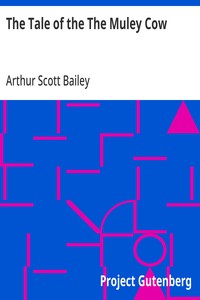
The Tale of the The Muley Cow Slumber-Town Tales — Text and Context can be approached with a clearer sense of reading commitment from its source measurements: 17,568 words, 1 hr 17 min estimated reading time, and 5 detected text sections.
The text analysis averages about 13.6 words per sentence, while the detected sections provide another way to judge how the source is divided.
Project Gutenberg metadata also associates the work with “Animals -- Juvenile fiction,” connecting these edition facts with the source record’s subject description.
Explore this collection
These alternatives are selected using recorded categories and estimated reading time.
About 77 minutes
Childrens Adventures
17,611 recorded words. 0 minutes difference from this book's estimate.
View Gutenberg source #24608About 78 minutes
Childrens Adventures
17,809 recorded words. 1 minutes difference from this book's estimate.
View Gutenberg source #24589About 75 minutes
Childrens Adventures
17,199 recorded words. 2 minutes difference from this book's estimate.
View Gutenberg source #24590Search stored excerpts and compare books → Choose by your preferences →
Choices use stored catalog measurements. Estimates vary with reading speed. A shared category is a catalog label, not a claim that two books have the same argument or literary quality.
Search reads excerpt text stored with this catalog and links to its associated Gutenberg record. The connection is stored in the site database; this tool does not recheck that every excerpt is word-for-word identical to that external record. Excerpt search does not cover every chapter and does not verify historical publication dates.
Catalog snapshot checked: 2026-09-25. Coverage: 96 public books, 96 available source excerpts.
Read the complete public-domain text at its original source.
Read on Project GutenbergThe opening chapter introduces the Muley Cow as Johnnie Green's favorite, a position that stirs jealousy among the farmyard folk. The little red cow complains that Johnnie wastes goodies on her, and the neighbors call her 'old Muley' behind her back. This sets up a central tension: the Muley Cow is both privileged and isolated, a pattern that shapes her interactions throughout the story.
Bailey's narrative voice is direct and gently humorous, with short sentences and repeated phrases that build a rhythm suitable for young listeners. The early chapters establish the cow's trusting nature, which will be tested by characters like Tommy Fox and Billy Woodchuck.
In the excerpt from Chapter V, Tommy Fox manipulates the Muley Cow into delivering a dangerous message to Turkey Proudfoot. Tommy's politeness and flattery—'I hope you don't mind carrying a message for me'—exploit her desire to be helpful. The cow agrees without suspicion, even when Tommy asks her not to mention his name, claiming it's a surprise.
Turkey Proudfoot's reaction is immediate and telling: his tail droops, he forgets to strut, and he gobbles at the Muley Cow, accusing her of trying to get him into trouble with Tommy Fox. The cow's astonishment reveals her naivety; she cannot understand why the gobbler is angry, as she found Tommy 'such an agreeable person.' This episode illustrates a recurring pattern: the Muley Cow's good intentions lead to unintended consequences because she fails to read the motives of others.
Bailey uses this scene to teach a lesson about discernment without moralizing. The humor comes from the cow's obliviousness, while young readers are invited to see what she misses.
Chapter XVI shifts focus to a different kind of trouble: Billy Woodchuck's theft of clover from the pasture. The Muley Cow notices his repeated trips and warns him, but he ignores her. She then appeals to the herd, declaring that something must be done to stop him, or there will be no clover hay for winter.
The little red cow jokingly suggests putting a poke on Billy, and everyone laughs—except the Muley Cow, who finds the idea silly. Her response—'Who ever heard of a Woodchuck wearing a poke about his neck?'—shows her literal-mindedness and her tendency to dismiss solutions that don't fit her experience. The poke, a device previously used on the Muley Cow herself (as seen in the illustration list), becomes a symbol of correction and restraint. This moment ties back to her own history, hinting that she may need to learn from her own past.
The excerpt also highlights the social dynamics of the farm: the herd's collective concern versus the Muley Cow's individual, somewhat stubborn perspective.
Bailey's prose is marked by deliberate repetition and a conversational tone that guides young readers through the narrative. Phrases like 'I hope you won't mind' and 'It doesn't matter' recur, signaling moments of persuasion or dismissal. The author often repeats key information within a short span, as when the Muley Cow delivers Tommy's message twice—once to the reader and once to Turkey Proudfoot—reinforcing the plot point for early listeners.
The use of animal names as titles (e.g., Turkey Proudfoot, Billy Woodchuck) and the consistent reference to characters by their full names create a stable, memorable cast. The narrator occasionally addresses the reader directly, as in 'You know everybody likes surprises,' which invites the child to share in the cow's perspective while also creating dramatic irony.
These stylistic choices make the text accessible for read-aloud sessions, with clear cues for pacing and emphasis.
The provided excerpts cover only the first sixteen chapters of a twenty-four-chapter book, leaving much of the story unknown. We see the Muley Cow's gullibility and her conflict with Billy Woodchuck, but we do not learn how she resolves these situations or whether she grows wiser. The later chapter titles—'Truth Will Out,' 'A Brave Deed,' 'The Vow of a Cow'—suggest further development, but the excerpts do not reveal the outcomes.
Readers should note that the Muley Cow's character may evolve beyond the naive figure presented here. The recurring motif of the poke, mentioned in the illustrations and the clover episode, may return as a lesson. Additionally, the relationship with Johnnie Green, established in the opening, is not explored in the middle excerpts; its role in the later story remains unclear.
These gaps invite speculation but caution against assuming a simple moral arc. Bailey's series, part of the Slumber-Town Tales, often balances humor with gentle instruction, but the specific trajectory of this cow is best discovered by reading the full text.
As you read the complete tale, pay attention to how the Muley Cow's encounters with tricksters like Tommy Fox and persistent pests like Billy Woodchuck shape her understanding of the farmyard world. Notice whether she learns to question appearances and whether her status as Johnnie Green's favorite protects her or isolates her. The excerpts offer a starting point, but the full story may reveal a more complex character than the gullible messenger of the early chapters.
The Muley Cow’s trusting nature brought back our old Guernsey, who believed every bucket meant grain. That gentle gullibility, needing a poke to learn, felt oddly familiar. Reading about her made me think of sitting in the barn with The Tale of Ferdinand Frog — Text and Context, where another creature’s easy confidence met the world’s quiet corrections. Both left me with a fond, slow smile about being fooled. The same warm patience lingers here.
A brief reflection can help important ideas stay with you longer.