About 75 minutes
The Tale of Ferdinand Frog — Text and Context
Childrens Adventures
17,199 recorded words. 3 minutes difference from this book's estimate.
View Gutenberg source #24590
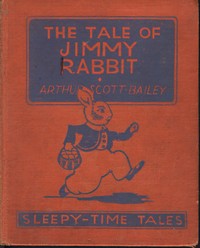
For The Tale of Jimmy Rabbit Sleepy-TimeTales — Reading Notes, the stored edition analysis reports 16,449 words, 1 hr 12 min estimated reading time, and 3 detected text sections.
The text analysis averages about 10.7 words per sentence, while the detected sections provide another way to judge how the source is divided.
Project Gutenberg metadata also associates the work with “Animals -- Juvenile fiction,” connecting these edition facts with the source record’s subject description.
Explore this collection
These alternatives are selected using recorded categories and estimated reading time.
About 75 minutes
Childrens Adventures
17,199 recorded words. 3 minutes difference from this book's estimate.
View Gutenberg source #24590About 69 minutes
Childrens Adventures
15,775 recorded words. 3 minutes difference from this book's estimate.
View Gutenberg source #43763About 77 minutes
Childrens Adventures
17,568 recorded words. 5 minutes difference from this book's estimate.
View Gutenberg source #24545Search stored excerpts and compare books → Choose by your preferences →
Choices use stored catalog measurements. Estimates vary with reading speed. A shared category is a catalog label, not a claim that two books have the same argument or literary quality.
Search reads excerpt text stored with this catalog and links to its associated Gutenberg record. The connection is stored in the site database; this tool does not recheck that every excerpt is word-for-word identical to that external record. Excerpt search does not cover every chapter and does not verify historical publication dates.
Catalog snapshot checked: 2026-09-25. Coverage: 96 public books, 96 available source excerpts.
Read the complete public-domain text at its original source.
Read on Project GutenbergFrom its opening sentence—'Jimmy Rabbit wanted a new tail'—Arthur Scott Bailey establishes a narrative voice that treats a rabbit's dissatisfaction with his own anatomy as a perfectly serious problem. The story proceeds through a series of concrete, physically detailed episodes: Jimmy lurks behind trees hoping to find a forgotten tail, ties a red-and-black tail to his stub with string he has carried for weeks, and later mistakes an artist's easel for a captured river. Bailey's prose is brisk and unadorned, relying on action and dialogue rather than internal reflection. The forest-people speak in colloquial, direct phrases—'handsome is as handsome does,' mutters old Mr. Crow—and their interactions are governed by a clear, practical logic. This is a world where problems are solved by doing, not by pondering, and where every new idea leads immediately to the next comic complication.
The opening chapters establish a pattern of desire and near-success that drives the entire narrative. Jimmy Rabbit wants a long tail, and Bailey makes this want concrete through a series of failed attempts: he almost cuts off Frisky Squirrel's tail, tries to buy one, then searches for a forgotten tail left lying in the woods. The author's choice to have Jimmy carry a piece of string 'for weeks' for the purpose of tying on a found tail is a small but telling detail—it shows a character who prepares for opportunity even when none seems likely. When Jimmy finally finds a red tail with a black tip, the narrator notes that 'that was the only drawback about it,' a dry understatement that typifies Bailey's humor. The forest-people's reactions are similarly understated: most compliment Jimmy, but old Mr. Crow mutters a proverb. Bailey does not moralize; he simply reports the action and lets the reader observe the consequences.
Bailey advances the plot almost entirely through spoken exchange. When Jimmy encounters the strange man painting by the river, his confusion is resolved not by narration but by Mr. Crow's explanation: 'That wasn't really Swift River that you saw in front of him. It was just something that looked like it.' The dialogue is brisk and functional, each line pushing the story forward. Characters reveal themselves through what they say and how they say it. Mr. Crow is knowledgeable but slightly pompous; Mr. Fox is surly and self-interested; Jimmy is impulsive and easily impressed. When Jimmy decides to become an artist, he announces it as a fact, and the woods-people respond by putting on their best clothes and hurrying to his house. Bailey's dialogue never explains emotions—it simply shows characters acting on their stated intentions, leaving the reader to infer the comedy of their self-importance.
The sequence in which Jimmy Rabbit discovers painting is the most structurally elaborate in the excerpts. It begins with a literal misunderstanding—Jimmy thinks the painter has captured Swift River itself—and ends with Jimmy's determination to make a picture of Mr. Crow. Bailey uses this episode to introduce a new kind of problem: the social complications of artistic ambition. Jimmy tells his callers they must wait their turn, and Mr. Fox refuses to leave. The negotiation over Mr. Crow's hat—'gentlemen never wear hats when they're having their portraits painted'—is a small comic set piece built entirely on conflicting desires. Bailey does not comment on the absurdity of a rabbit painting portraits; he simply reports the logistics. The episode shows how the story's world expands from simple physical wants (a tail) to social wants (recognition, precedence), while maintaining the same matter-of-fact narrative tone.
Bailey's prose in The Tale of Jimmy Rabbit is characterized by short declarative sentences, a preference for action verbs, and a narrator who reports events without interpreting them. Phrases like 'Jimmy Rabbit thought very hard. And pretty soon he smiled all over his face' convey problem-solving through physical description rather than internal monologue. The author avoids sentimentality: when Jimmy is polite to Mr. Crow, the narrator notes that 'It was not often that Jimmy was so polite,' a wry observation that does not slow the pace. The illustrations by Eleanore Fagan, though not reproduced in the text excerpts, are referenced in the chapter list—'He trundled the wheelbarrow home again' appears as the frontispiece caption, suggesting that the visual comedy of Jimmy's physical actions was central to the book's design. Bailey's voice is consistent: brisk, concrete, and lightly amused, never stopping to explain a joke.
Readers approaching The Tale of Jimmy Rabbit will find a narrative that moves quickly from one concrete problem to the next, with little time for reflection. The story rewards attention to small details—the piece of string Jimmy carries, the way Mr. Crow holds his hat, the exact wording of a complaint. Bailey's choices in diction and structure create a world where every character speaks plainly and acts on their desires, and where the narrator reports the results without judgment. This is a book best read for its precise, economical storytelling and its quiet comedy of earnest ambition.
Reading Jimmy Rabbit’s earnest scheming, I felt that quiet ache for things we think will fix us—a longer tail, a better view. It reminded me of sitting with Elsie on the Hudson years ago, where the river itself seemed to hold that same patient answer Jimmy never quite finds. Elsie on the Hudson — Reading Companion still feels like that shore, waiting.
Capture what you thought, learned, and would like to remember.